By WAJAHAT | Notes from comparing stair builds, code summaries and household use cases
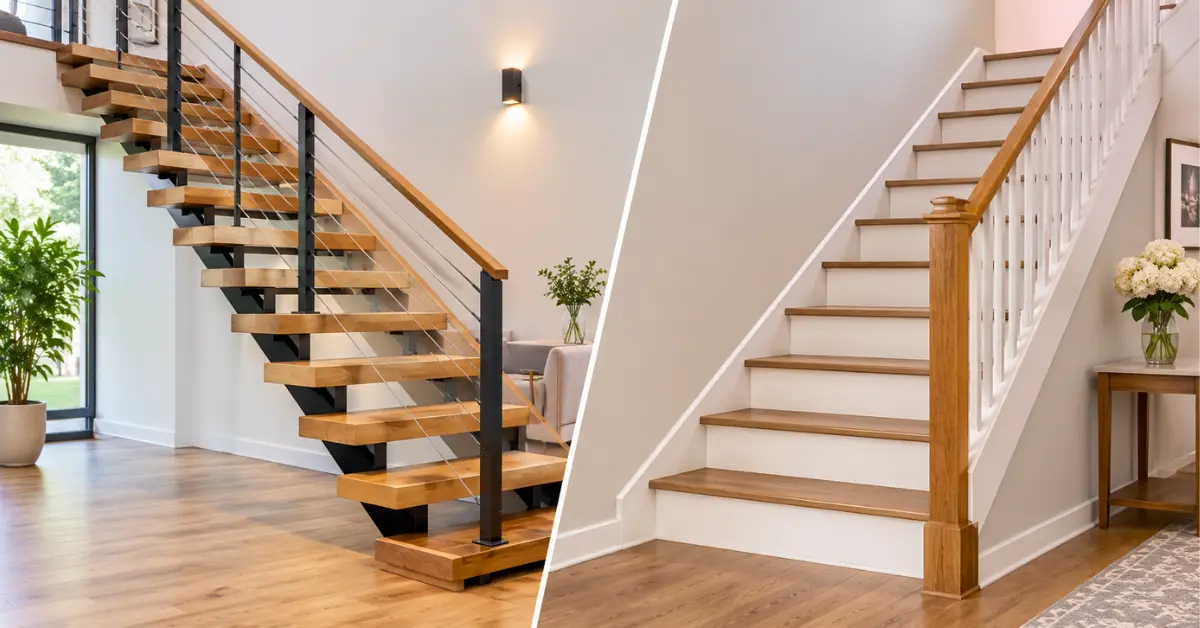
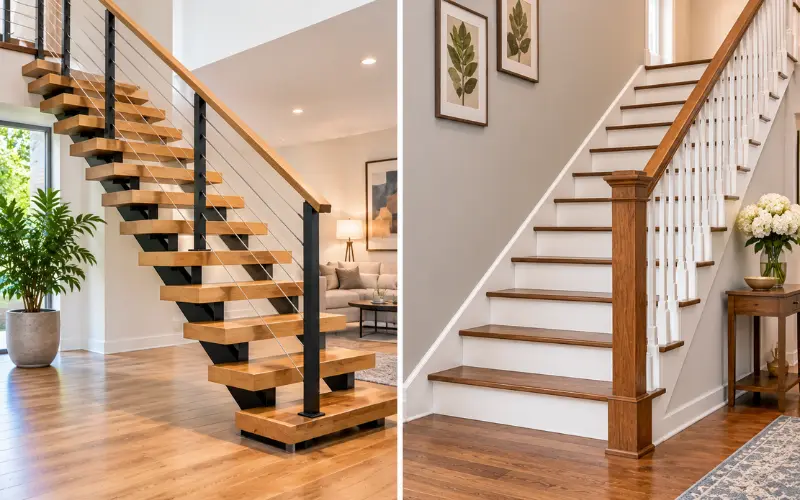
Open Tread vs Closed Tread Stairs: Open tread stairs have gaps between the steps, while closed tread stairs have a solid riser board under each step. Choose open for light and a modern look, and choose closed for lower cost, quieter use, easier code compliance and under-stair storage. Most homeowners also need to pick between open and closed stringers, which is a separate choice.
Two Choices, Not One: Risers and Stringers
People mix these up, so here is the clear version. “Open tread” usually means open risers. Stringers are the side supports, and they can be open or closed too.
| Term | Meaning | Look |
|---|---|---|
| Open riser (open tread) | No vertical board between treads | See-through gaps |
| Closed riser | Solid board under each tread | Solid, traditional |
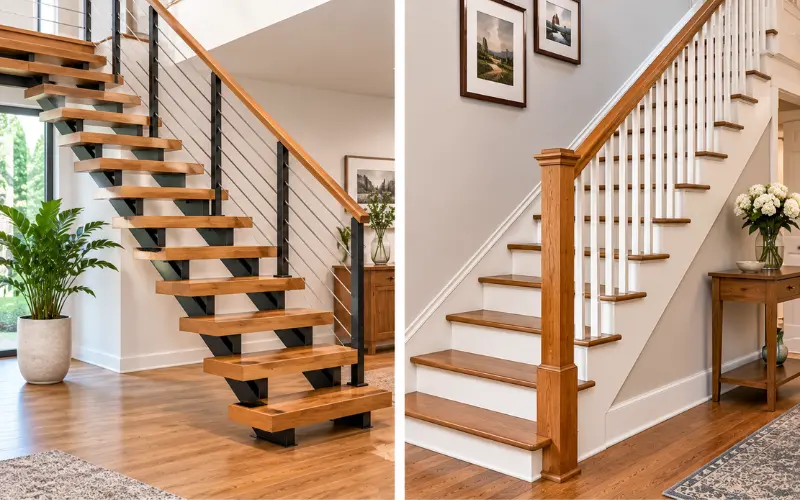
| Open stringer (exposed) | Treads sit on top of cut side supports, tread ends visible | Sawtooth profile |
| Closed stringer (housed) | Treads and risers sit inside a solid side board | Clean, boxed profile |
You can combine them. A closed-stringer stair with open risers is a common remodel look. A floating stair uses open risers with a slim central beam instead of side stringers.
Open Tread vs Closed Tread Stairs: Side-by-Side
| Factor | Open tread (open riser) | Closed tread (closed riser) |
|---|---|---|
| Light and sightlines | High | Low |
| Code complexity | Higher (4 inch sphere rule) | Lower |
| Typical installed cost | $6,000 to $20,000 (wood, side stringers) | $4,000 to $12,000 (estimate) |
| Under-stair storage | None | Possible |
| Footfall sound | Often sharper | Often softer |
| Toe catch risk | Higher | Lower |
| Cleaning | Dust falls through, underside visible | Simpler |
| Pets and toddlers | Needs extra thought | Easier |
These are planning ranges, not quotes. Floating versions cost more. See our floating stairs cost guide for that tier.
Code Differences That Change Your Decision
Verify everything with your local building department. These points are commonly based on the IRC.
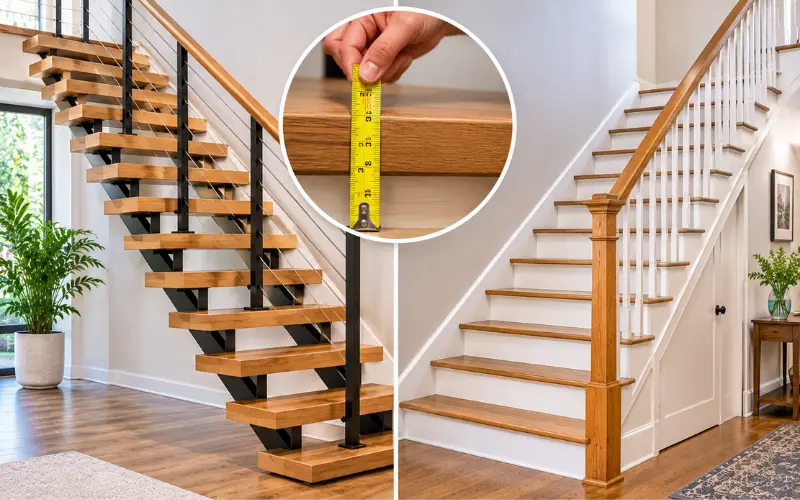
- Open riser gaps: Must stop a 4 inch sphere in most cases. Closed risers skip this test. Our open riser staircase guide has the gap math.
- Riser height and tread depth: About 7 3/4 inches maximum and 10 inches minimum apply to both.
- Handrail: Required on flights with four or more risers for both types.
- Under-stair space: Enclosed accessible space under stairs commonly needs fire-rated drywall protection, often 1/2 inch gypsum board. Open stairs avoid this because nothing is enclosed.
Expert note: If an open riser design fails the 4 inch test, adding riser boards is one of the cheapest fixes. It turns the stair into a closed riser stair without redoing the structure.
Open Stringer vs Closed Stringer Stairs
| Factor | Open stringer | Closed stringer |
|---|---|---|
| Side profile | Sawtooth, tread ends visible | Solid board hides tread ends |
| Look | Casual or rustic | Formal or clean |
| Build difficulty | Simple cutting | More precise housing cuts |
| Finish work | Visible cut edges to finish | Fewer exposed edges |
| Squeaks | Can appear at tread-stringer joints | Often fewer with housed joints |
Closed stringers also hide fasteners and framing, which gives more forgiveness for site errors. Our traditional staircase guide shows classic closed-stringer styles.
Safety in Real Households
Open risers are not unsafe by default, but they change how people use the stair.
- Toddlers: The 4 inch rule exists for small bodies. Add gates at the top and bottom anyway.
- Small dogs and older pets: Many hesitate on open stairs. Closed risers feel more solid.
- Older adults: Depth perception can suffer with see-through gaps. Use contrast on the tread edge and good lighting.
- Socks and bare feet: Choose matte or textured tread finishes on either type.
Under-Stair Storage: The Hidden Tie-Breaker
Closed riser stairs give you a usable volume under the flight. That can be a closet, a pantry or built-in drawers. Open stairs give you view and light but no storage. If your home is short on storage, our under stair storage ideas may settle the decision for you.
Which One Fits Your Situation?
| If you want | Better choice |
|---|---|
| Brighter room and open sightlines | Open tread |
| Lowest cost | Closed tread |
| Quieter stairs | Closed tread |
| Under-stair storage | Closed tread |
| Easier code approval | Closed tread |
| A modern, architectural feature | Open tread, often floating |
| Safer feel for toddlers and pets | Closed tread, or open with tight railing |
Switching Between Types in a Remodel
- Closed to open: Often possible, but check the stringers and the wall beside the stair first. See our open staircase ideas for remodel options.
- Open to closed: Usually simpler. Add riser boards to each step and finish them.
- Closed to floating: A full rebuild. Read our what is a floating staircase guide before committing.
Quick Decision Steps
- List your priorities: light, budget, storage or noise.
- Check your household: kids, pets and older relatives.
- Check code gaps: Use the 4 inch sphere rule for open risers.
- Pick the stringer: Open for casual, closed for clean.
- Get one quote for each option. Compare cost and lead time side by side.