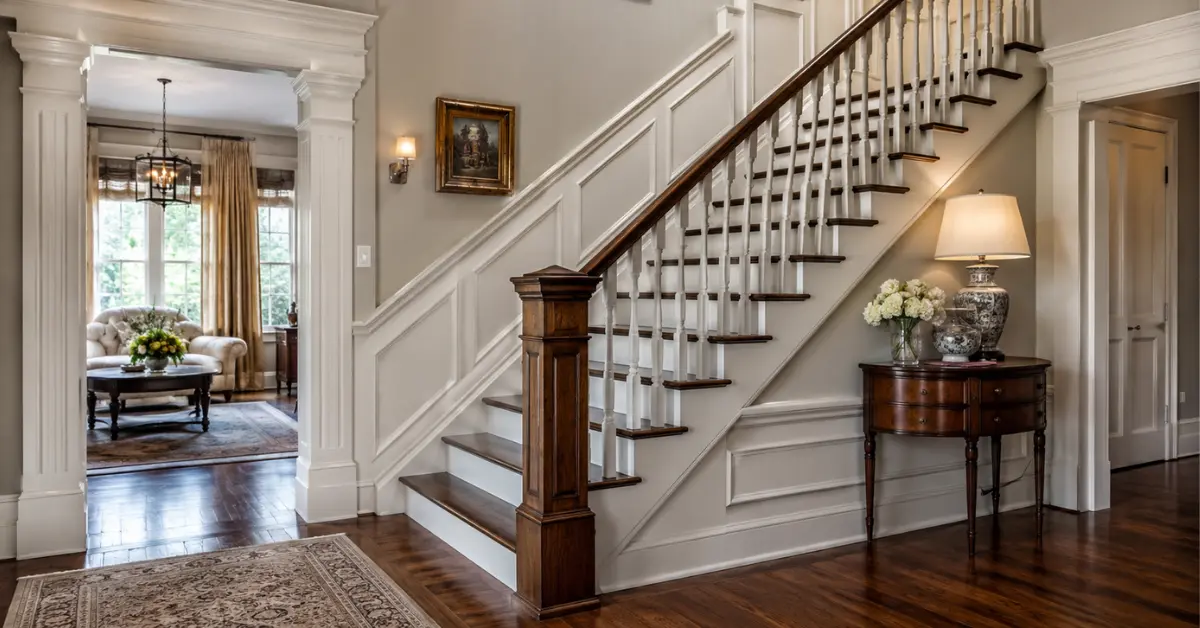
A traditional staircase is one of the most powerful design elements you can bring into a home. It does more than connect two floors — it sets a mood, communicates craftsmanship, and gives a home a sense of permanence that newer design styles rarely match. Whether you are building from scratch, renovating an older home, or simply researching ideas, understanding what makes a traditional staircase work will help you make smarter decisions.
This guide covers everything: the defining features of a traditional staircase, the best materials to use, how different styles compare, cost expectations, and practical planning tips most competitors leave out entirely.
What Is a Traditional Staircase?
A traditional staircase is defined by its emphasis on natural materials, ornamental detailing, and a warm, welcoming visual weight. Where modern staircase designs lean into minimalism — open risers, cable railings, floating treads — a traditional staircase leans the other way. It is solid, detailed, and built to feel substantial.
The traditional staircase has roots in Georgian, Victorian, Colonial, and Craftsman architectural styles. Each brought its own spin, but they all share the same core values: quality hardwood, decorative balusters, turned newel posts, and a handrail that feels good in your hand.
If your home has crown molding, wainscoting, panel doors, or brick fireplaces, a traditional’s staircase will feel right at home.
Key Design Elements of a Traditional Staircase
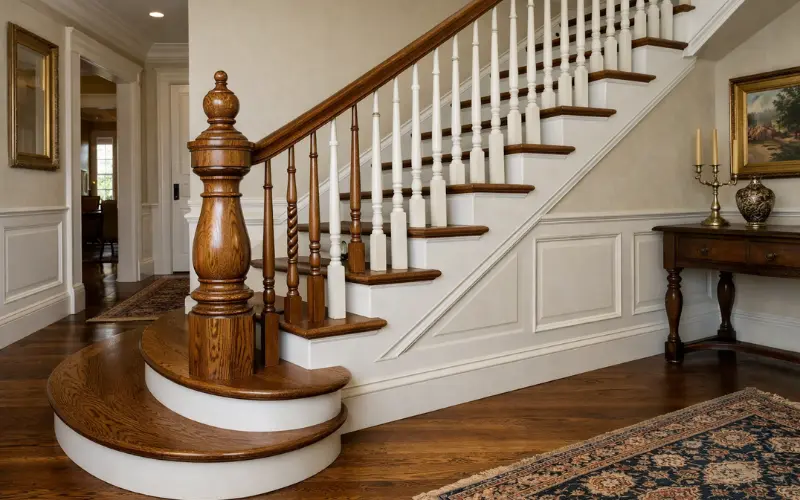
Getting a traditional’s staircase right is about the details. Here are the components that define the look.
Newel Posts
The newel post is the anchor of a traditional’s staircase. It sits at the base of the stairs and at any landings. Turned newel posts — shaped on a lathe with curves, rings, and tapers — are the most common choice. Box newels, which are square and panelled, suit Colonial and Craftsman-influenced interiors. Grand D-End starting steps that wrap around the newel post are a hallmark of high-end traditional staircase design.
Balusters and Spindles
Balusters (also called spindles) fill the gap between the handrail and the treads. On a traditional staircase, they are almost always wood. Turned balusters in classic profiles — pin top, colonial twist, Grecian — are the standard. Alternating two different baluster profiles on the same flight adds visual rhythm without straying from the traditional look. Spacing is typically one baluster per tread or two per tread for a denser, more formal appearance.
Handrails
A traditional staircase uses a continuous wood handrail. Oak is the most popular species because of its durability and grain character. The handrail profile matters — a full round or oval profile gives a warmer, more classic feel than the flat-topped profiles common in modern designs. Volutes (spiral handrail endings) and turnouts at the base are finishing details that separate a truly traditional’s staircase from a basic builder-grade version.
Treads and Risers
Solid treads and closed risers are the norm on a traditional staircase. Open-riser designs belong to contemporary styles. For treads, oak and walnut are the gold standard, though pine is a budget-friendly option for painted traditional’s staircases. Stained treads paired with painted white risers is a classic combination that never looks dated.
Stringers
A cut stringer — where the profile of the steps is visible on the side of the staircase — is an elegant choice for a traditional’s staircase. It shows off the craftsmanship and adds to the decorative weight of the design. Closed stringers, where the side panel is flat, are cleaner and suit more formal interiors.
Traditional Staircase Styles and Configurations
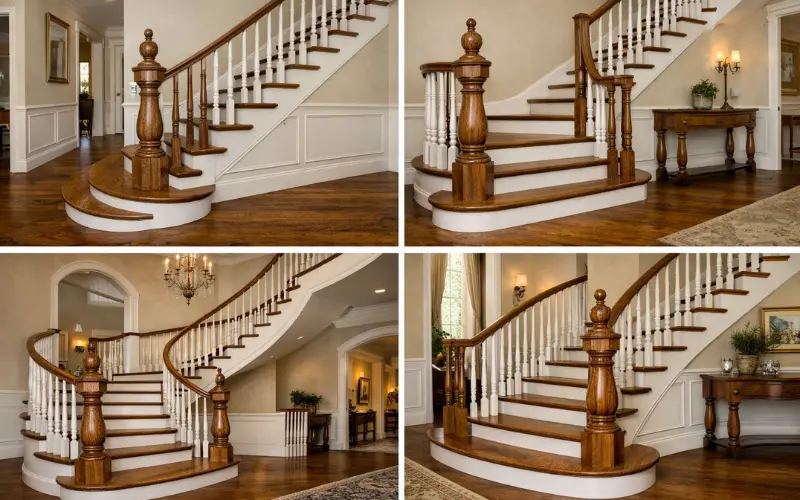
Not all traditional’s staircases look the same. The style you choose depends on your home’s layout and architecture.
Straight Traditional Staircase
The simplest configuration. A straight flight of stairs with a turned newel at each end, a wood handrail, and decorative balusters reads as traditional immediately. It suits Colonial and Federal-style homes especially well.
L-Shaped and U-Shaped Staircases
These introduce a landing, which gives you more design real estate. The landing post becomes another opportunity for a grand turned newel. Wider, deeper landings make the traditional staircase feel more stately.
Curved or Swept Traditional Staircase
A curved traditional staircase is the pinnacle of the style. A sweeping staircase with a curved handrail, wreath fittings, and closely spaced turned balusters is immediately impressive. This configuration requires custom fabrication and significantly higher craftsmanship, which is reflected in cost — but nothing makes an entry hall like a well-executed curved traditional staircase.
Half-Turn Staircases with Feature Steps
A bullnose or D-End starting step at the base of a traditional’s staircase adds a detail that makes even a simple straight flight look custom and considered. Bullnose steps have a rounded front edge that extends slightly beyond the newel post. D-End steps wrap fully around the post for a grander effect.
Best Wood Species for a Traditional Staircase
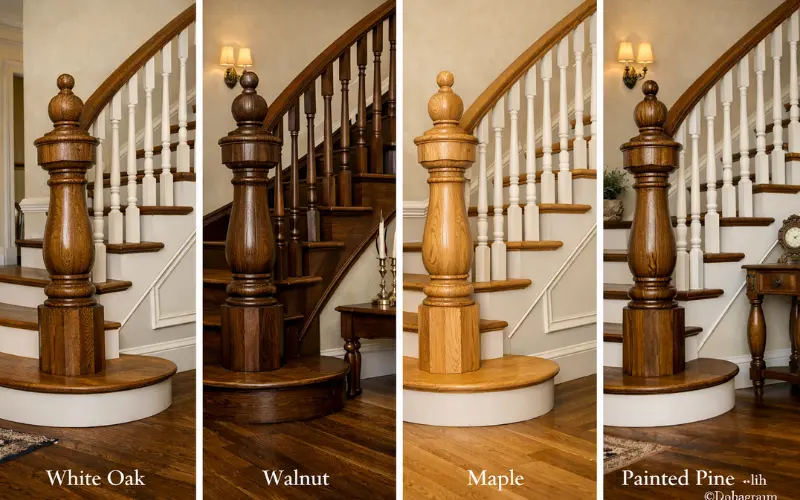
Wood choice is one of the most important decisions you will make. Here is how the main options compare.
Oak is the default for good reason. It is hard, stable, takes stain evenly, and ages beautifully. Red oak has a more open grain and warmer tone; white oak is denser with a slightly cooler, more refined appearance. A traditional’s staircase in white oak with a medium walnut stain is a combination that works in virtually any home.
Walnut is darker and richer. It suits formal, high-end interiors. It is softer than oak, so it shows wear faster on treads, but the visual effect is unmatched.
Maple is very hard and has a fine, even grain. It is a good choice for a painted traditional staircase because it takes paint cleanly. It can be difficult to stain evenly due to its tight grain, so consider painting rather than staining if you go with maple.
Pine is the budget option. Softwood staircases have been used in traditional homes for centuries — the key is painting them so the softness is less of a visual problem. A painted pine traditional staircase with stained oak handrails and newels is a cost-conscious approach that still looks right.
Traditional vs. Modern Staircase: The Key Differences
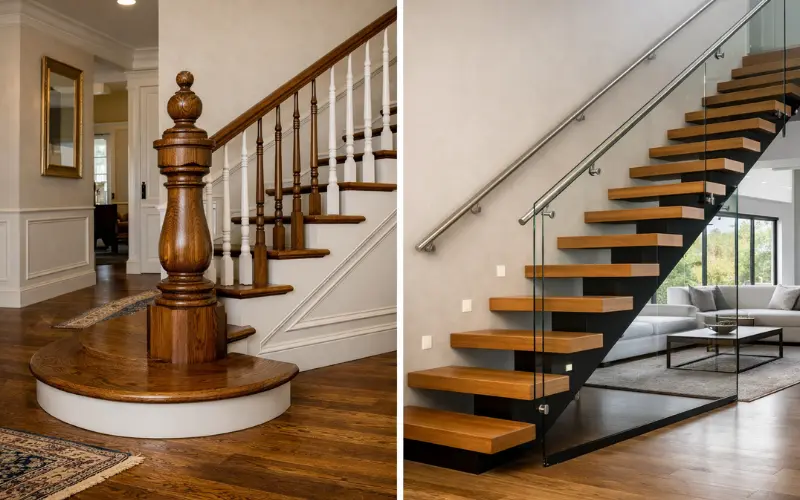
You may be weighing both options. Here is a clear-eyed comparison:
A traditional staircase uses closed risers, solid wood handrails, turned balusters, and decorative newel posts. It feels warm and grounded. A modern staircase tends to use open risers, glass or cable railings, metal stringers, and floating treads. It feels light and minimal.
Traditional staircases suit homes with classical architectural detailing. Modern staircases suit homes with open floor plans, large glazing, and clean-line finishes. If your home has both — which is increasingly common in renovations — a transitional approach blends the warmth of a traditional’s staircase with slightly simplified details, keeping the wood and closed risers but simplifying the baluster profile.
Cost is roughly comparable. High-end versions of both styles are expensive. The craftsmanship on a detailed traditional staircase (carved newels, curved handrails, alternating spindles) can drive costs higher than a standard modern design, but a custom floating glass staircase can easily exceed it.
How Much Does a Traditional Staircase Cost?
This is something most competitor articles skip entirely.
A basic builder-grade traditional staircase — straight flight, pine treads, simple turned balusters, box newel — runs roughly $3,000 to $6,000 installed in the US, depending on region.
A mid-range traditional staircase in oak with quality turned newels, decent baluster profiles, and a proper wood handrail typically runs $8,000 to $18,000 installed.
A custom high-end traditional staircase with curved flights, carved newels, wreath fittings, and premium hardwood can easily reach $25,000 to $60,000 or beyond.
What drives cost up: curved elements (handrails and stringers must be custom bent or built up), exotic wood species, double-height flights, elaborate baluster patterns, and site-specific fitting challenges.
Planning Your Traditional Staircase: Practical Advice
Before you hire anyone or buy anything, a few things to get right first.
Check your building codes. Minimum tread depth (typically 10 inches), maximum riser height (typically 7.75 inches), handrail height (34–38 inches), and baluster spacing (no gap wider than 4 inches, so a 4-inch sphere cannot pass through) are regulated in most jurisdictions. A good stair company will handle this, but knowing the rules protects you.
Decide on a finish strategy early. Staining requires consistent wood species throughout — mixing stained oak treads with pine balusters will look inconsistent. If budget requires mixing materials, plan a paint and stain combination where painted components (risers, balusters, stringers) hide species variation and stained components (treads, handrail, newel posts) are consistently one species.
Think about maintenance. Wood staircases need refinishing every 10–15 years depending on traffic. Treads wear faster than risers. Prefinished treads from a quality manufacturer will last longer before refinishing is needed than site-applied finishes.
Consider under-stair storage. A traditional staircase with a closed stringer offers a natural opportunity for a built-in under-stair cupboard or bookcase. This is a detail many homeowners overlook and regret when the staircase is already installed.
FAQs About Traditional Staircases
What makes a staircase look traditional?
Closed risers, solid wood handrails, turned or decorated balusters, ornamental newel posts, and warm wood tones are the hallmarks. Decorative details like carved newel caps, D-End starting steps, and alternating baluster profiles amplify the effect.
What wood is best for a traditional staircase?
Oak is the most practical all-around choice for a traditional staircase. White oak takes stain well, is hard and durable, and suits a wide range of interior colour palettes. Walnut is a premium choice for richer, darker interiors.
How long does a traditional staircase last?
Properly built and maintained, a solid hardwood traditional staircase will outlast the house. The finish will need refreshing every 10–15 years on high-traffic treads. Structural components rarely require replacement if the original build quality is sound.
Can I renovate an existing staircase to look traditional?
Yes. The most cost-effective approach is replacing the balusters and newel posts while keeping the existing structure. Adding stained oak treads over existing sub-treads and painting risers can transform a plain staircase into a convincing traditional one without a full rebuild.
Are traditional staircases more expensive than modern ones?
Not necessarily as a category. A simple traditional staircase can be cheaper to build than a custom floating glass modern staircase. Cost is driven more by complexity, customisation, and materials than by style. Highly detailed traditional staircases with curved elements and carved components are expensive, but so are high-spec modern designs.
What baluster spacing is required for a traditional staircase?
Building codes in the US typically require that no opening in the balustrade be wide enough to pass a 4-inch sphere. In practice, this means balusters are spaced roughly 3.5 to 4 inches apart. Your stair contractor should confirm the specific requirement in your jurisdiction.
Is oak or pine better for a traditional’s staircase?
Oak for stained finishes; pine for painted finishes. Oak is harder and more durable, making it the better choice when treads will be stained and visible. Pine is softer and less expensive, but works well when the staircase is entirely painted or when treads are a higher-grade wood and the rest (balusters, risers) is pine.
What is a newel post on a traditional staircase?
The newel post is the large vertical post at the base of the stairs and at any landings. On a traditional’s staircase, it is typically a turned or boxed post significantly larger than the balusters. It anchors the handrail and is one of the most visually prominent elements of the design.
Can a traditional staircase work in a modern home?
Yes, particularly in transitional interiors that blend classical and contemporary elements. Simplifying the details — using cleaner-profiled balusters and less ornate newels — lets you keep the warmth and wood character of a traditional’s staircase without it feeling out of place in a more contemporary setting.
Do traditional staircases add home value?
A well-designed and properly built traditional staircase adds meaningful value in homes where the architectural style supports it. In a traditional or transitional home, the staircase is a focal point that buyers notice immediately. It signals quality of construction throughout the property.
Final Thoughts
A traditional staircase is not a trend — it is a design choice rooted in craft, material quality, and architectural honesty. Done well, it becomes one of the most admired features in a home and one that holds its appeal for decades without needing reinvention. Whether you are planning a full custom build with curved flights and carved newels or a more modest renovation with new balusters and an oak handrail, the principles are the same: use solid materials, attend to the details, and build it to last. A traditional staircase is an investment that pays back in beauty, durability, and the kind of quiet confidence that only good craftsmanship produces.