
Greek home decor blends whitewashed Cycladic minimalism, sun-bleached natural materials, and classical architectural details like columns and the Greek key motif. The real style isn’t just blue and white walls: it’s about texture, proportion, and the way light moves through a space. Get those three right, and the color palette almost takes care of itself.
Most guides stop at “add blue accents and an olive tree.” That’s the aesthetic without the substance. Below is what actually separates a convincing Greek-inspired room from a stereotype, plus the practical details competitors skip entirely: which Greece you’re decorating for, what materials hold up in a US climate, and where people waste money.
Greek Home Decor Isn’t One Style, It’s Three
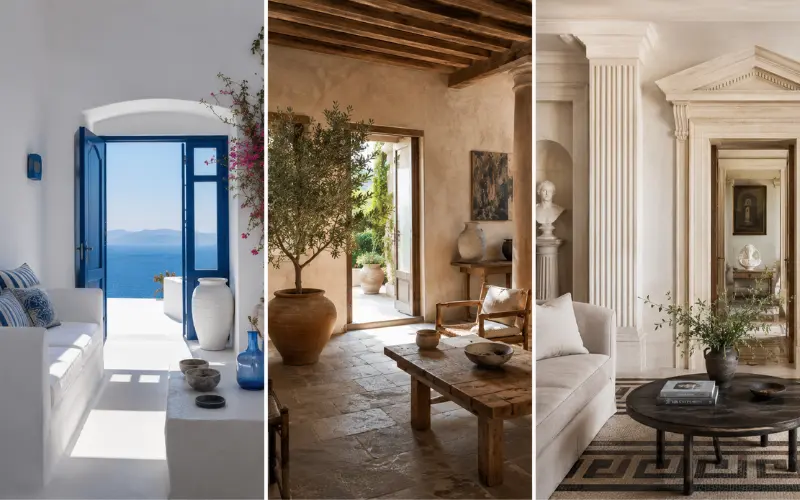
Here’s the gap in almost every article on this topic: “Greek decor” gets treated as a single look, when it’s really three distinct regional traditions.
- Cycladic (Santorini, Mykonos): Whitewashed walls, cube-shaped architecture, cobalt blue doors and shutters, minimal ornamentation. This is the Instagram version most people picture.
- Mainland/Athenian: Warmer, earthier palette: terracotta, ochre, sage, weathered wood. Think courtyard homes with stone floors, not island villas.
- Ancient/Neoclassical revival: Columns, pediments, marble busts, Greek key borders, symmetry. This is the “Greek Revival” tradition that already shaped a lot of American colonial and federal-style architecture, so US homeowners often have a head start without realizing it.
Mixing all three in one room is the most common mistake I see in decor mood boards. A Cycladic all-white living room with a heavy neoclassical column and a rustic terracotta floor reads as three different houses stitched together. Pick a lane, then borrow sparingly from the others.
The Color Palette, With Actual Undertones
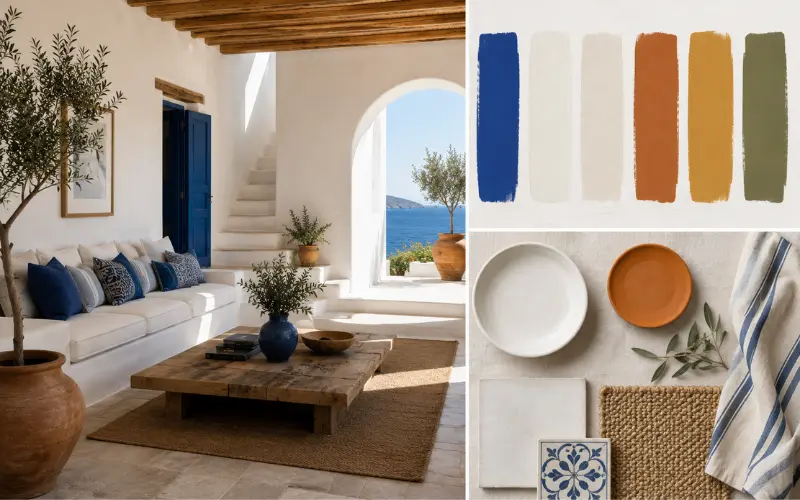
Every competitor article says “blue and white.” Almost none tells you which blue or which white, and that’s where DIY attempts fall apart.
- Aegean blue leans toward a saturated cobalt with a slight purple undertone, not sky blue or navy. Paint-wise, look for something close to Benjamin Moore’s “Van Deusen Blue” or Sherwin-Williams “Riverway” as a starting reference point at the store.
- Cycladic white is rarely stark white. It’s a warm off-white with a faint gray or cream base, so the walls don’t glare under direct sun. Pure bright white can look clinical rather than coastal.
- Terracotta and ochre work as accent tones, not wall colors, in mainland-inspired rooms: think plant pots, throw pillows, or a single accent wall.
- Olive and sage green round out the palette and keep an all-blue-and-white room from feeling flat.
A north-facing US room needs a warmer white to avoid looking cold and gray. A south-facing room can handle the crisper, cooler Cycladic white without it feeling harsh.
Materials That Actually Hold Up (Not Just Look the Part)
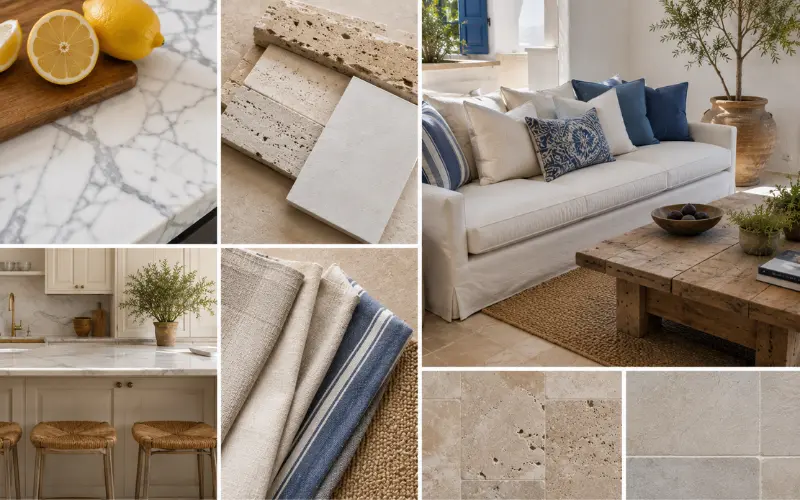
This is the section every competitor skips, and it’s the one that saves people money.
Marble looks stunning in photos but etches easily from acidic spills like lemon juice or wine, which matters a lot if you’re doing a marble-look kitchen counter rather than a display piece. For high-traffic surfaces, a marble-look porcelain or quartz gets you 90% of the visual with none of the maintenance headache.
Real limestone and travertine are gorgeous for flooring but porous, so they need sealing every year or two in humid US climates, especially in the Southeast. If you’re not up for that upkeep, a limestone-look large-format tile is the more realistic choice for most homeowners.
For textiles, natural linen and jute are period-correct and breathable, but they wrinkle and stain more than blends. If you have kids or pets, a linen-look performance fabric on upholstery gives you the texture without the fragility.
Room-by-Room Application, Beyond the Obvious
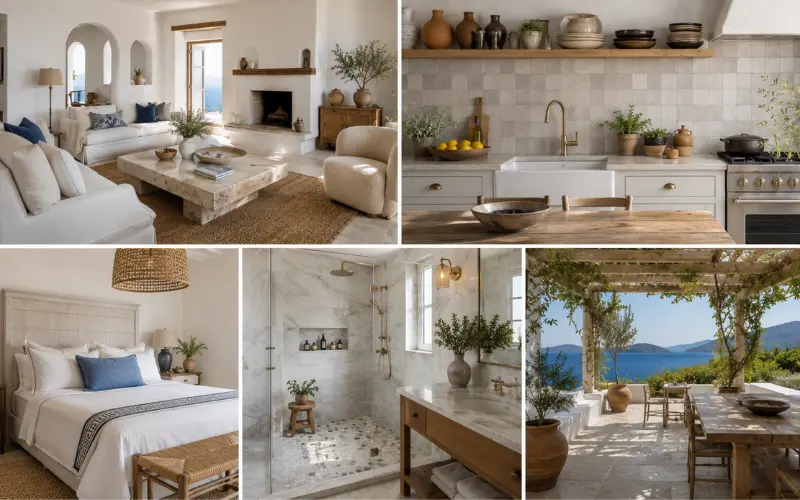
Living room: Skip the matched furniture set. Greek interiors layer mismatched, well-worn pieces: a stone or plaster coffee table, a linen sofa, one curved chair. Curved silhouettes matter more than most people realize, since Greek design has favored arches and rounded forms long before the “curvy furniture” trend hit US retailers a few years back.
Kitchen: A textured stone or zellige-style backsplash does more visual work than a full marble slab. Open shelving with ceramic vessels for olive oil and herbs adds authenticity without a renovation budget.
Bedroom: Whitewashed wood headboards, woven rattan lighting, and a single Greek key border on bedding or a rug reads as intentional. Covering every surface in the pattern reads as costume.
Bathroom: This is where Greek-inspired design translates most naturally, since marble and stone already suit wet spaces. A pebble or mosaic tile floor in the shower is a detail almost no other style guide mentions, and it’s genuinely one of the easiest high-impact additions.
Outdoor space: A pergola, potted olive tree (or a quality faux one in colder zones below USDA hardiness zone 8), and simple stone pavers do more than any indoor styling to sell the look, because Greek design was always built around indoor-outdoor flow.
Common Mistakes That Undercut the Look
- Overusing the Greek key pattern. One rug, one border, or one piece of trim is a nod. Five items with the pattern is a theme park.
- Going too glossy. Greek interiors favor matte, honed, and lime-washed finishes. High-gloss marble or lacquered furniture breaks the illusion immediately.
- Ignoring scale. A single oversized column or urn in a small room looks like a prop, not architecture. Classical elements need breathing room to read as intentional rather than decorative clutter.
- Forgetting texture. An all-blue-and-white room with smooth, flat surfaces looks like a nautical theme, not a Greek one. Plaster walls, rattan, and rough-hewn wood are what separate the two.
Budget Tiers, Since Not Everyone Is Renovating
| Budget | What to prioritize |
|---|---|
| Under $200 | Ceramic vases, linen throw pillows, one Greek key accent rug, a faux olive tree |
| $200–$1,000 | Lime-wash or plaster-effect paint, rattan light fixtures, a marble-look side table |
| $1,000+ | Stone or zellige backsplash, real marble accent piece, custom arched doorway or niche |
FAQ
What is the Greek Home Decor style of interior design called?
It’s most often called Cycladic style when referring to the whitewashed island look, or Greek Revival when referring to the neoclassical, column-based architectural tradition.
What does a typical house in Greece actually look like inside?
It varies heavily by region. Island homes tend toward small, whitewashed rooms with stone floors and minimal furniture. Mainland homes often have warmer tones, wood ceilings, and courtyard-facing layouts.
What color were Greek houses historically?
Ancient Greek buildings weren’t originally white marble, they were painted in bright reds, blues, and yellows, which faded over centuries. The all-white look associated with “Greek style” today actually comes from Cycladic island tradition, not ancient temples.
Can I do Greek home decor on a rental budget?
Yes. Focus on removable elements: peel-and-stick lime-wash wallpaper, ceramic accessories, linen textiles, and a single statement rug. None of it requires structural changes.
Is Greek decor the same as Mediterranean decor?
No, though they overlap. Mediterranean style pulls from Greece, Italy, Spain, and southern France, so it’s generally warmer and more eclectic. Greek decor specifically leans cooler, more minimal, and more architecturally symmetrical.
How do I add Greek Home Decor without it looking like a themed restaurant?
Limit yourself to two or three signature elements (a color palette, one architectural detail, one textile pattern) and execute them well, rather than layering in columns, urns, key patterns, and statues all at once.
Does Greek home decor work in a modern house?
Yes, especially the Cycladic version, which already shares DNA with modern minimalism: clean lines, neutral palettes, and uncluttered space. Adding curved furniture and one architectural detail is usually enough to bridge the two styles.
What plants are used in Greek home decor?
Olive trees are the signature choice, along with potted herbs like rosemary, oregano, and basil, and bougainvillea for outdoor color. In colder US zones, rosemary and herbs can be grown indoors year-round in ceramic pots.

