
Yes, Egyptian home decor still works in modern interiors, but only if you treat it as an accent language rather than a full room script. The style holds up best when you borrow its color logic, materials, and a handful of symbolic pieces, then let contemporary furniture carry the rest of the room. Go all in on every motif at once and you end up with something closer to a movie set than a home.
What Actually Reads as “Egyptian” in a Room
Most people picture gold sarcophagi and hieroglyphic wallpaper the moment someone mentions Egyptian home decor. That’s the costume version. The real style is built on four layers working together: color, material, form, and a small dose of symbolism.
Strip any of those layers out and the room drifts toward generic “desert glam.” Keep all four, even in a restrained way, and a single console table can carry the whole aesthetic without a single hieroglyph in sight.
The Color Palette, and Why It’s Not Just “Gold and Blue”
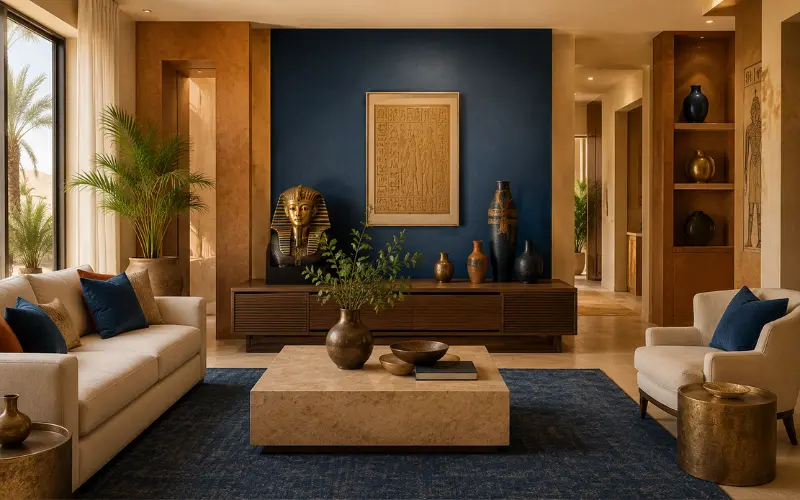
Here’s a detail most style guides skip: the ancient Egyptians weren’t picking colors for looks. Gold represented the flesh of the gods and eternity, since it never tarnishes. Blue stood for the heavens and the Nile’s floodwaters, and it was so prized that Egyptians invented the world’s first synthetic pigment, Egyptian Blue, because natural lapis lazuli had to be imported from what’s now Afghanistan. Red carried a double meaning, tied to both the chaos of the desert and the vitality of blood, so it was used carefully.
Knowing that changes how you use the palette in a modern room. Instead of splashing blue and gold everywhere, use blue as a grounding tone (walls, a large rug) and let gold show up only in accents (frames, hardware, a single sculptural piece). That restraint is closer to how the color was actually deployed in antiquity, and it reads far more sophisticated than a wall covered in gold leaf.
Modern egyptian home decor tends to lean on:
- Terracotta, ochre, and warm sand as a neutral base
- Deep lapis blue or teal as an accent wall or textile color
- Muted gold or brass, not shiny costume-gold
- A touch of deep red or rust, used sparingly
Materials That Do the Heavy Lifting
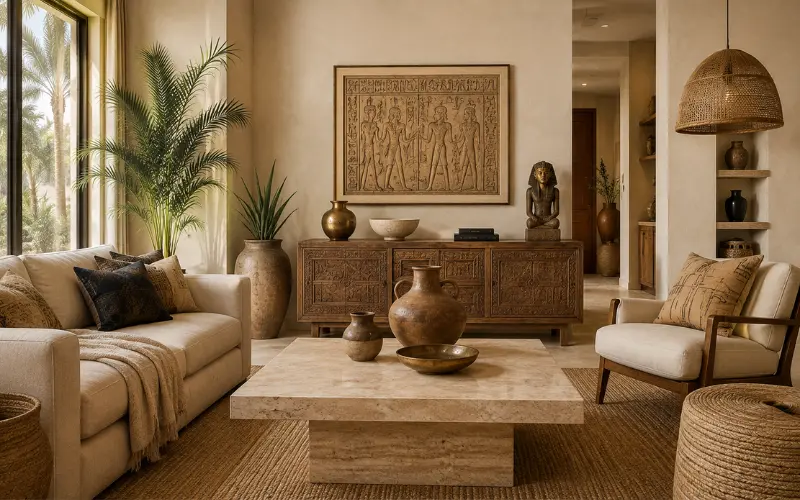
Traditional egyptian home decor relied on what the region had: limestone, sandstone, reeds, papyrus, and later, imported cedar for furniture. That material logic still matters today because these textures naturally suit warm climates and pair with almost any modern base.
- Stone and travertine for tabletops or flooring accents
- Rattan and reed weaving, which shows up in modern basket planters and light fixtures
- Linen and Egyptian cotton for bedding and drapery
- Brass or aged bronze hardware instead of polished chrome
If you’re working with handcrafted pieces, artisan pottery and carved wood pull double duty: they nod to the region’s craft tradition and hold up better long-term than mass-produced resin statues. My general rule with clients: one handcrafted piece per room does more visual work than five cheap ones.
Furniture: Where Most Modern Rooms Go Wrong
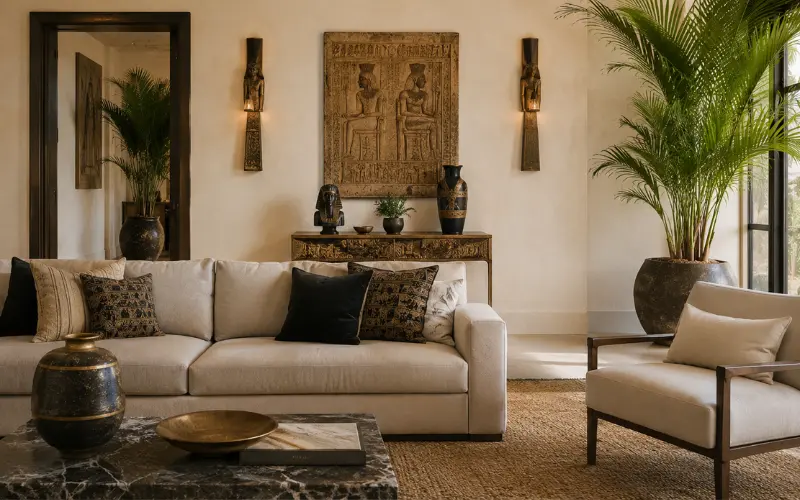
The biggest mistake I see is people trying to build an entire living room around Egyptian furniture shapes. Genuine Egyptian-style furniture is geometric, low-slung, and heavily ornamented on the edges. That’s a strong look, but it competes with almost everything else in a modern space.
A better approach for egyptian home decor ideas that actually get used:
- Keep the furniture silhouette modern (clean lines, neutral upholstery)
- Add one statement piece with Egyptian detailing, like a carved wood console or a sculptural side table
- Skip oversized, dark leather sofas unless the whole room is designed around them
- Use black, white, and gold as your accent trio in a bedroom if you want the look without overwhelming the space
This is where egyptian home decor for living room spaces tends to succeed or fail. One console table with brass inlay and geometric relief work, set against a plain sofa, looks intentional. A room full of ornamented furniture looks like a themed restaurant.
Wall Art, Symbols, and How to Use Them Without Overdoing It
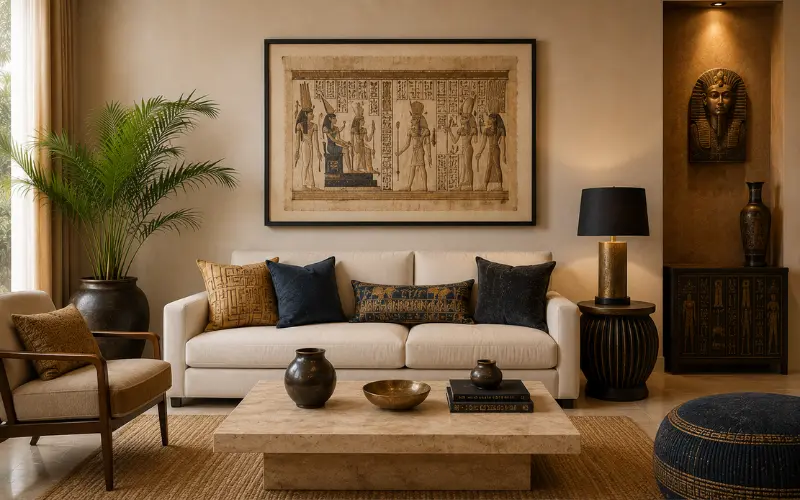
Hieroglyphic panels, papyrus art, and Eye of Horus pieces are the fastest way to signal the style, and also the fastest way to tip it into kitsch. The fix is scale and placement, not avoidance.
- One framed papyrus print or hand-carved relief as a focal point, not a full wall
- Mirror frames with geometric detailing instead of literal figures, if you want something subtler
- Fabric wall hangings with woven motifs for texture without a strong graphic statement
If you already lean toward organic, sculptural wall pieces in other rooms, that same instinct works well here. It keeps the symbolism present without turning the wall into a museum placard.
Bringing In Greenery the Egyptian Way
This is a gap most competitor guides skip entirely: ancient Egyptian homes and temple courtyards used papyrus reeds, palms, and lotus plants deliberately, not as an afterthought. Modern biophilic design trends in Egypt right now are essentially rediscovering that instinct.
- Papyrus or reed-style plants near a window
- Palms in woven or stone planters
- Hanging plant holders for smaller spaces, which also nod to the reed-weaving tradition
How It Compares to Other Global Decor Styles
People often lump Egyptian style in with other Middle Eastern and North African aesthetics, but the details diverge quickly. Moroccan interiors lean on tiled patterns, jewel-toned textiles layered densely, and lantern-style lighting. Egyptian style is more restrained and symmetrical, built around solid color blocks and a handful of symbolic objects rather than pattern-on-pattern layering.
If you’re deciding between the two for a full room, Egyptian decor generally suits a calmer, more monochromatic base, while a heavier pattern mix points you toward Moroccan-style choices instead.
Where Ancient Aesthetics Meet Modern Function
Egyptian homes across the region right now aren’t choosing between heritage and modern convenience, they’re combining them. Smart lighting and voice-controlled temperature systems are showing up in the same rooms as handcrafted brass lanterns and mashrabiya-inspired wood screens. Open floor plans have also replaced the walled-off room layouts you’d associate with more traditional versions of the style, which actually makes the aesthetic easier to work into a contemporary home instead of harder.
That’s a genuinely useful signal for anyone applying this look outside Egypt: you don’t need to sacrifice modern layout logic or tech integration to get the aesthetic right.
Budget Tiers: From One Accent Piece to a Full Room
You don’t need a full room commitment to get the look right.
| Budget Level | What to Buy | Where It Shows Up |
|---|---|---|
| Entry ($20-$75) | Papyrus print, small ceramic vessel, throw pillow | Any room, low commitment |
| Mid ($75-$300) | Carved wood side table, brass lantern, woven wall hanging | Living room or bedroom accent |
| Full Room ($300+) | Statement furniture piece, custom drapery, handcrafted pottery set | Living room or primary bedroom |
Common Mistakes That Make It Look Costume-y
- Overloading gold. Shiny, uniform gold across multiple surfaces reads as party decor, not design.
- Mixing too many eras of the aesthetic. Pharaonic motifs, 1920s Egyptian Revival jewelry style, and modern minimalist Egyptian trends don’t automatically sit well together in one room.
- Skipping the neutral base. Every successful example I’ve seen starts with a calm, sand-toned or warm neutral backdrop before any accent goes in.
- Buying resin instead of real material. Cheap resin statues fade and yellow within a year or two; stone or ceramic pieces hold their finish.
FAQ
How did ancient Egyptians decorate their homes?
Ancient Egyptian homes used painted plaster walls in bold colors, woven reed mats, wooden furniture with carved legs, and small household shrines or statues. Wealthier homes added imported materials like ebony and ivory inlays.
Is Egyptian home decor still popular in 2026?
Yes, though it’s shifted toward a more restrained, modern-Egyptian blend rather than the maximalist versions popular a decade ago. Warm earthy tones and handcrafted pieces are driving current interest.
What colors define Egyptian home decor?
Gold, deep blue (historically from lapis lazuli), sand and terracotta neutrals, and touches of red or black. Each color originally carried symbolic meaning tied to gods, the sky, and the desert.
Can I mix Egyptian decor with a minimalist style?
Yes, and it often looks better that way. A minimalist base with one or two statement Egyptian pieces avoids the overloaded look that dates the style quickly.
What’s a good starter piece for Egyptian home decor nearby a small apartment?
A single papyrus print, a small carved wood tray, or a ceramic vessel gives you the aesthetic without committing a whole room to it.
Does Egyptian home decor work in small spaces?
Yes. Because the style relies on a handful of intentional pieces rather than dense layering, it actually suits small spaces well when you keep the furniture profile low and simple.
What materials should I avoid for an authentic look?
Skip shiny plastic gold finishes and printed faux-hieroglyph wallpaper if you want the style to read as intentional rather than novelty décor.
How is Egyptian style different from Moroccan style?
Egyptian decor favors solid color blocks, symmetry, and symbolic objects. Moroccan decor leans on dense pattern layering, tiled surfaces, and warm lantern lighting.

