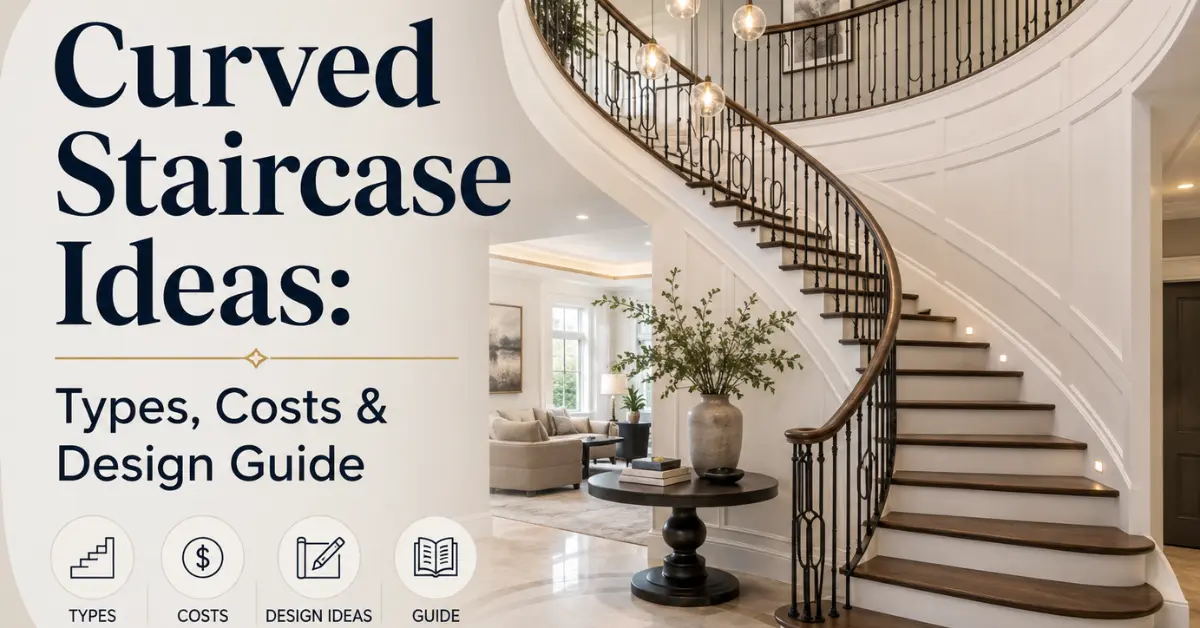
A curved staircase is one of those design choices that completely transforms a home. The moment you walk into a foyer with a graceful sweeping staircase, you feel it — the space looks bigger, more intentional, more luxurious. But beyond the wow factor, curved staircases are a serious investment, and getting one right requires understanding your options before you talk to a contractor.
This guide covers everything: types, materials, real costs, space requirements, and the mistakes most homeowners make. Whether you’re building new or renovating, this is your starting point.
Curved Staircase vs. Spiral Staircase: What’s the Difference?
These two get confused constantly, even by people in the industry.
A curved staircase travels along a large arc — think of the letter C. It does not complete a full circle. The radius is generous, the treads are wide, and it’s comfortable for everyday use. You’ll find them in grand foyers and open-plan living areas.
A spiral staircase wraps around a central pole and makes a full 360-degree rotation. The treads are narrower at the center, the footprint is small, and it works best as a secondary stair or in tight spaces.
A helical staircase is a variation of the curved staircase — it rises in a continuous helix without a central column, giving it a floating, sculptural quality. These are the most engineering-intensive of the three.
If your priority is elegance and daily comfort, curved is the right choice. If you need to connect a mezzanine or loft in a small footprint, spiral makes more sense.
Types of Curved Staircases
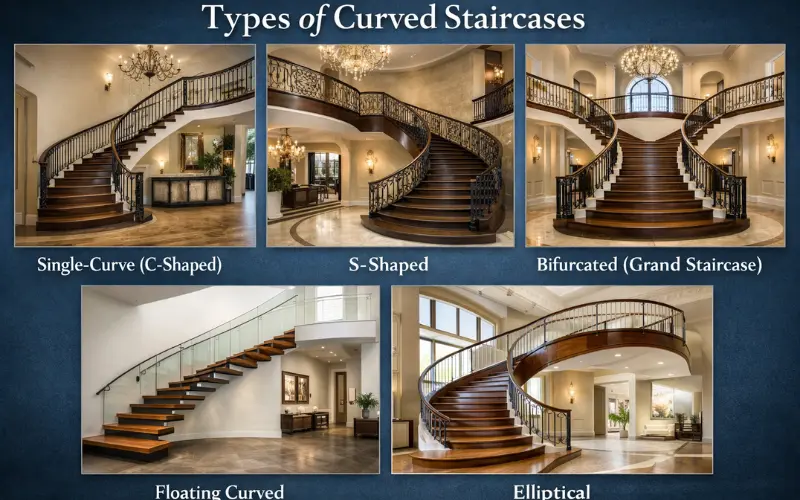
- Single-curve (C-shaped): The most common form. The staircase sweeps from one side to the other in a single graceful arc. Works in both traditional and modern homes.
- S-shaped: Two opposing curves connected into one continuous staircase. Dramatic and rare — typically seen in high-end custom homes. Requires significant floor space and structural engineering.
- Bifurcated (grand staircase): A central stair splits into two curved arms at a landing, descending in opposite directions. Classic in estate homes and formal dining rooms.
- Floating curved: The treads appear to cantilever from the wall with no visible support beneath. Pairs with glass or cable railings for a contemporary look. Structurally complex but visually stunning.
- Elliptical: Similar to a standard curved stair but following an elliptical rather than circular path. Gives a more elongated, elegant shape.
Materials: How to Choose What’s Right for You
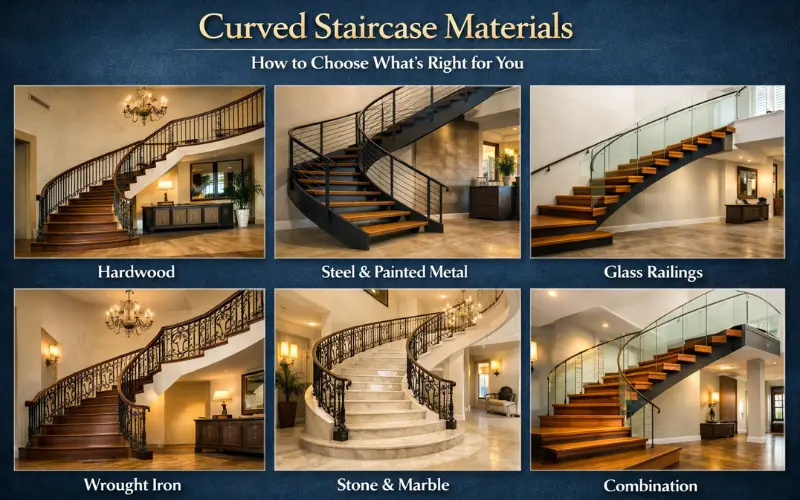
The material you choose affects cost, maintenance, longevity, and how the staircase fits your home’s style. Here’s a practical breakdown:
Hardwood (Oak, Walnut, Maple) The most popular choice for curved staircases in traditional and transitional homes. White oak ages beautifully, walnut offers a rich dark tone, and maple is a budget-friendlier option with good durability. Wood requires periodic refinishing — typically every 7–10 years depending on traffic — and is sensitive to humidity changes, which can cause slight movement over time.
Steel and Painted Metal The most cost-effective option for the structural components (stringers, risers). Powder-coated steel holds up well indoors and can be paired with wood treads for a modern-industrial look. For outdoor curved stairs, hot-dip galvanized or AISI 316 stainless steel is essential to resist corrosion.
Glass Used for railings and balustrades rather than treads in most residential applications. Frameless glass panels give a contemporary floating appearance and make narrow spaces feel more open. Tempered safety glass is the standard — it’s strong, but it shows fingerprints and requires regular cleaning. Glass staircases are at the premium end of the price range.
Iron and Forged Metal Hand-forged iron balusters and railings are a hallmark of Mediterranean, Victorian, and classical curved staircases. They add intricate detail and can be customized to almost any pattern. Iron needs periodic sealing or powder coating to prevent rust, especially in humid climates.
Stone and Marble Used primarily for treads in high-end installations. Marble curved staircases are among the most expensive builds — they require specialized structural support and expert installation. Cold underfoot and can be slippery without proper finishing, so anti-slip treatments are important.
Combination materials — wood treads with glass railings, steel stringers with stone steps — are common in modern curved staircase design and often deliver the best balance of cost, aesthetics, and durability.
How Much Does a Curved Staircase Cost?
This is the question most websites skip over. Here are realistic figures based on material and complexity:
| Type | Estimated Cost (Installed) |
|---|---|
| Basic metal curved stair (deck/mezzanine) | $8,000 – $18,000 |
| Wood curved staircase (standard) | $15,000 – $40,000 |
| Wood with iron balustrade | $25,000 – $55,000 |
| Floating curved staircase with glass | $35,000 – $80,000 |
| Marble or stone treads (custom) | $50,000 – $120,000+ |
| Helical/elliptical freestanding | $60,000 – $150,000+ |
These ranges include design, fabrication, and installation. They do not include permits, structural modifications, or finishing work like painting and floor repair around the base.
What drives cost up: custom radius, unusual floor-to-floor height, complex railing designs, premium materials, multi-story runs, and tight installation access.
What keeps cost down: standard arc radius, wood or steel construction, simple baluster design, and a straightforward floor-to-floor height between 2.8m and 3.2m.
Always get at least three quotes. Staircase pricing varies significantly between fabricators, and a significantly lower quote usually means modular components rather than custom engineering — which affects fit, finish, and longevity.
Space Requirements: What You Need Before Buying
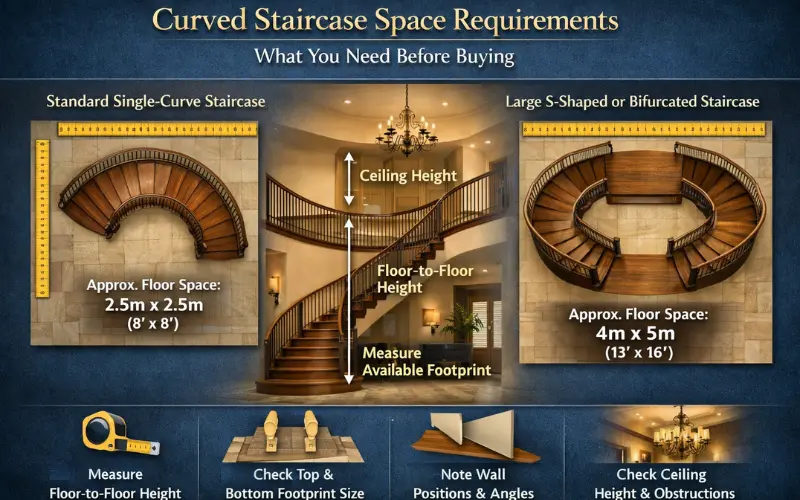
This is where many homeowners get caught out. A curved staircase needs considerably more floor space than a straight stair.
As a rough guide, a standard single-curve staircase with a 1,000mm tread width needs a floor opening or footprint of approximately 2.5m x 2.5m at minimum. Wider, more gradual curves require more. An S-shaped or grand bifurcated staircase can demand 4m x 5m or more.
Before contacting a designer, measure:
- Floor-to-floor height (finished floor to finished floor)
- Available footprint at both the top and bottom landing
- Ceiling height and any overhead obstructions
- Wall positions that could affect the arc direction
Bring these numbers to your first consultation. It will save significant time and prevent falling in love with a design that physically won’t fit your space.
Matching Style to Your Home
- Traditional and Colonial homes: Curved oak or mahogany staircases with turned wood balusters, carpet runners, and ornate newel posts. Classic proportions work here.
- Mediterranean and Tuscan homes: Wrought iron railings with scrollwork, stone or tile risers, warm wood treads. Oversized newel posts.
- Modern and contemporary homes: Floating curved stairs with glass panels, clean steel stringers, open risers. No carpet. Integrated LED lighting beneath treads.
- Transitional homes: White-painted risers with dark stained treads, simple iron balusters. Works across a wide range of interior styles.
- Industrial: Exposed steel stringers with raw wood or concrete treads. Metal cable railings instead of balusters.
Building Codes: What Homeowners Need to Know
Every curved staircase must meet local building codes. The specifics vary by country and municipality, but the core requirements in most residential codes (including IRC in the US and Part K in the UK) include:
- Riser height: Maximum 190–200mm (roughly 7.5 inches). Consistency between all risers is required — variation of more than 3/8″ between the tallest and shortest riser is a code violation.
- Tread depth: Minimum 230–280mm at the walking line (typically measured 300mm from the narrow end of a wedge tread).
- Railing height: Minimum 900mm (36 inches) for residential stairs; 1,070mm (42 inches) commercial.
- Baluster spacing: No gap wider than 100mm (4 inches) — to prevent a child’s head from passing through.
- Headroom: Minimum 2,000mm (6’8″) clearance above any tread.
Always pull permits for a new curved staircase. A staircase installed without permits creates problems at resale and may be flagged during a home inspection.
Common Mistakes to Avoid
- Not accounting for furniture movement. Curved stairs make moving sofas, mattresses, and large appliances significantly harder than a straight stair. If this is your only staircase in a multi-story home, think carefully.
- Choosing riser height for looks over comfort. Taller risers look elegant but are tiring on a daily basis, especially for elderly family members or young children. Stay between 160–175mm for the most comfortable climb.
- Skipping the engineer. A freestanding curved staircase needs structural engineering — this is not optional. The stringer design, load paths, and connection to floor structure all require professional sign-off.
- Underestimating the timeline. Custom curved staircases are fabricated to order. From deposit to installation, expect 8–16 weeks for a standard build, and up to 6 months for complex helical or stone designs.
- Ignoring lighting. A curved staircase with poor lighting is both dangerous and a missed design opportunity. Plan integrated step lighting, wall sconces, or a statement chandelier overhead during the design phase — retrofitting is expensive.
Maintenance Guide
- Wood: Sweep or vacuum regularly to prevent grit from scratching the finish. Re-coat with oil or polyurethane every 7–10 years. Address moisture issues immediately — swelling and gaps are early signs.
- Iron balusters and railings: Check annually for rust, especially in coastal or humid climates. Touch up with rust-inhibiting paint or clear lacquer.
- Glass panels: Clean weekly with a streak-free glass cleaner. Inspect fixings every year — loosening hardware is a safety issue.
- Stone and marble treads: Seal annually to prevent staining. Use non-slip treatments on polished surfaces. Avoid acidic cleaners which etch the surface.
FAQ’s
Q: What is the difference between a curved staircase and a spiral staircase?
A: A curved staircase travels along a large arc (C-shape) and does not complete a full circle. It has wide, comfortable treads and suits everyday use. A spiral staircase wraps around a central pole in a full 360-degree rotation with narrower treads — better suited for secondary or loft access in tight spaces.
Q: How much does a curved staircase cost?
A: Costs vary widely depending on materials and complexity. A basic metal curved staircase starts around $8,000–$18,000 installed. A standard wood curved staircase runs $15,000–$40,000, while a floating curved staircase with glass railings typically costs $35,000–$80,000. High-end marble or helical designs can exceed $150,000.
Q: How much space do I need for a curved staircase?
A: At minimum, a standard single-curve staircase with a 1,000mm tread width needs a floor footprint of approximately 2.5m x 2.5m. Wider curves, S-shaped designs, or grand bifurcated staircases require considerably more — sometimes 4m x 5m or larger. Always measure your floor-to-floor height and available footprint before consulting a designer.
Q: What materials are best for a curved staircase?
A: The best material depends on your style and budget. Hardwood (oak, walnut, maple) suits traditional and transitional homes and is the most popular choice. Steel or painted metal is the most cost-effective structural option. Glass railings work well in modern interiors. Marble and stone treads deliver a luxury look but come at a premium cost and need anti-slip treatment.
Q: Do curved staircases add value to a home?
A: Yes. A well-designed curved staircase is one of the few architectural features that consistently improves resale appeal and perceived property value. It becomes a focal point that buyers remember, particularly in the entry foyer. The return depends on quality of construction and how well it suits the home’s overall style.
Q: Do I need a building permit for a curved staircase?
A: In most countries, yes. Any new staircase installation requires a building permit and must meet local residential building codes covering riser height, tread depth, railing height, baluster spacing, and headroom clearance. Installing without a permit can cause problems at resale and during home inspections. Always confirm requirements with your local authority before work begins.
Q: How long does it take to install a curved staircase?
A: Custom curved staircases are fabricated to order, so timelines vary. From deposit to installation, expect 8–16 weeks for a standard wood or steel build. Complex helical, elliptical, or stone designs can take up to 6 months. The actual on-site installation typically takes 2–5 days depending on complexity.
Q: Are curved staircases difficult to maintain?
A: Not if you choose the right materials for your lifestyle. Hardwood needs sweeping regularly and refinishing every 7–10 years. Glass railings require weekly cleaning to stay streak-free. Iron balusters should be checked annually for rust and touched up as needed. Stone and marble treads need annual sealing. Regular upkeep keeps a curved staircase looking sharp for decades.
Final Thoughts
A curved staircase is one of the few home investments that delivers both daily pleasure and long-term property value. Done well, it becomes the defining element of your home — the thing guests mention first, the feature that photographs beautifully, and the detail that holds its appeal for decades.
The key is doing the groundwork: understanding your space, setting a realistic budget, choosing materials that suit your lifestyle, and working with a fabricator who provides proper engineering documentation. Rush any of those steps and you’ll pay for it — either in a poor fit, a costly revision, or a building inspector’s rejection.
Take your time with the design phase. A curved staircase is not a purchase you make twice.