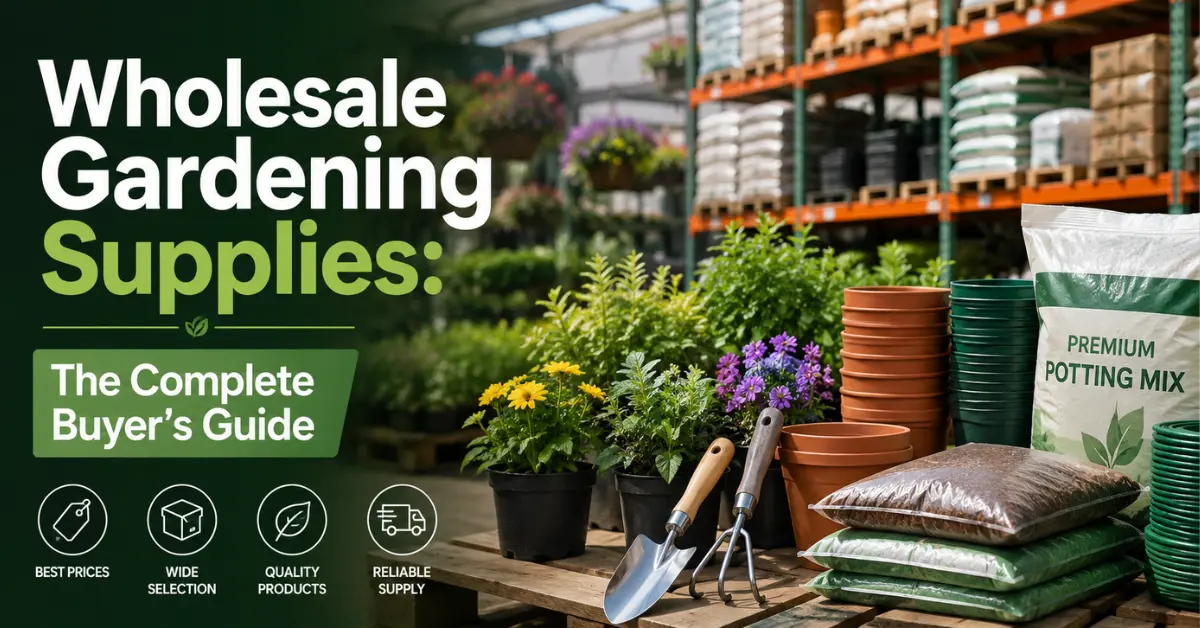
If you’re buying soil, containers, fertilizer, or plant material for a business rather than a backyard, retail pricing will eat your margins alive. Wholesale gardening supplies — sourced directly from growers, manufacturers, or distributors at volume pricing — are how garden centers, landscaping companies, greenhouses, and property managers keep their cost of goods sold under control. The catch is that “wholesale” isn’t a single, simple thing. It’s a web of minimum order quantities, freight terms, net payment schedules, and supplier relationships that most articles on this topic skip right past.
This guide covers what wholesale gardening supplies actually include, how the pricing structure works, how to evaluate a supplier before you commit, and the costs that don’t show up on the price sheet but absolutely show up on your bottom line.
What Falls Under “Wholesale Gardening Supplies”
The phrase gets used loosely, so it helps to break it into the categories buyers are usually shopping for:
- Growing media — bagged and bulk potting soil, compost, peat-based mixes, perlite, vermiculite, and soilless propagation media
- Containers and pots — nursery trade-gallon containers (#1, #2, #3, #5, #7), plug trays, 1020 flats, decorative pottery, and hanging baskets
- Fertilizers and amendments — granular, water-soluble, and slow-release fertilizers, mycorrhizal inoculants, and soil conditioners
- Plant material — bare-root stock, liners, plugs, finished annuals/perennials, trees and shrubs (sold by growers or brokers, separate from hardgoods suppliers)
- Pest and disease control — insecticides, fungicides, herbicides, traps, and netting
- Tools and hardgoods — pruners, loppers, hoses, sprayers, stakes, twine, and plant labels
- Structures and coverings — greenhouse poly film, shade cloth, landscape fabric, frost blankets, and hoop house components
- Irrigation — drip tubing, emitters, timers, and sprinkler components
A single distributor rarely covers all eight categories equally well. Greenhouse and growing-structure suppliers often skimp on decorative pottery; gift-and-decor wholesalers skimp on chemicals and growing media. Knowing which category you’re actually shopping for narrows the supplier list fast and saves you from comparing apples to oranges on price.
How Wholesale Pricing Actually Works
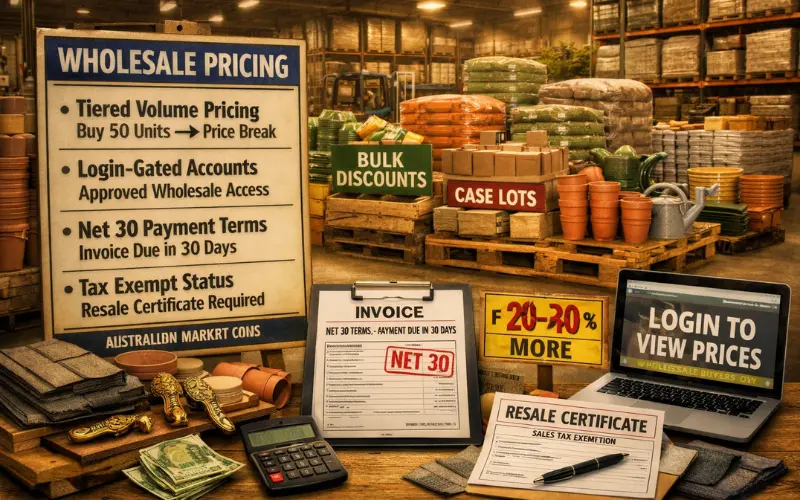
Most first-time business buyers assume “Wholesale Gardening Supplies” just means a flat discount off retail. In practice, pricing usually layers several mechanisms on top of each other:
Tiered volume pricing. The more you buy in a single order, the lower the per-unit cost — often structured around case packs, pallet quantities, or truckload minimums rather than a smooth sliding scale. Buying 47 units instead of 50 can mean missing a price break entirely.
Login-gated or quote-based pricing. Many distributors (Down to Earth, Hicks Commercial Sales, and BFG Supply all work this way) won’t show prices until you’ve applied for and been approved as a wholesale account. This isn’t a sales gimmick — it’s how they keep retail competitors and end consumers from seeing trade pricing, and it usually requires a resale certificate or business license to set up.
Net payment terms. Once approved, most distributors bill on Net 30 (occasionally Net 15 or Net 60 for larger accounts) rather than charging at checkout. This matters more than people think — it’s effectively interest-free short-term financing, and it’s worth asking about explicitly during account setup rather than assuming it’s standard.
Tax exemption. If you’re reselling product, a valid resale certificate exempts you from paying sales tax on the wholesale purchase. Wholesale Gardening Supplies will ask for this during account setup; have it ready, because incomplete paperwork is the single most common reason wholesale account applications stall.
How to Vet a Wholesale Gardening Supplies Before You Commit
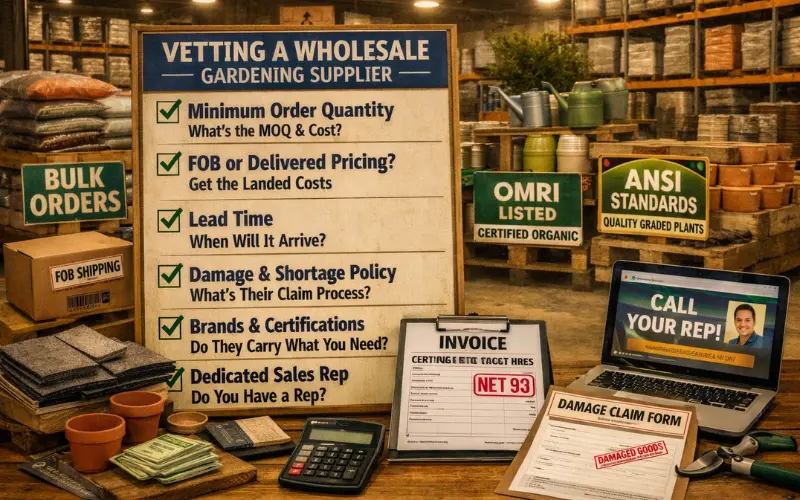
This is the part most buying guides skip, and it’s where buyers actually lose money. Price per unit is the easiest thing to compare and the least useful number on its own. Before signing up with a new supplier, run through these questions:
1. What’s the minimum order quantity (MOQ), and what does it tie up in capital? A pallet of bagged soil at a great per-bag price isn’t a deal if it sits in your yard for four months before you sell through it. Match MOQs to your actual sell-through rate, not just your storage space.
2. Is pricing FOB or delivered? FOB (free on board) pricing means you’re responsible for freight from the supplier’s dock — the listed price is misleadingly low until you add shipping. Delivered pricing bakes freight in. Always ask which one you’re looking at, and get a landed cost (product + freight) before comparing two suppliers’ price sheets side by side.
3. What’s the lead time, and does it match your planting calendar? A supplier with a great catalog and an eight-week lead time is useless if you need product for a spring rush. Ask for actual lead times on the SKUs you order most, not just the general “in stock” claim on the website.
4. What’s the damage and shortage policy? Plant material and pottery break. Bagged goods get water-damaged in transit. Find out — before you order, not after the first damaged pallet shows up — whether the supplier credits, replaces, or makes you eat the loss, and within what claim window.
5. Do they carry the brands and certifications you need? If your customers ask for OMRI-listed organic fertilizer or want nursery stock graded to the ANSI Z60.1 American Standard for Nursery Stock, confirm the supplier actually carries certified product rather than assuming “organic-sounding” branding means certified.
6. Is there a real account rep, or just a portal? Larger orders, special requests, and problem resolution move faster with a named sales rep who knows your account. Distributors like BWI and BFG Supply assign regional reps for exactly this reason — it’s worth asking who yours would be before you commit volume to a new vendor.
The Hidden Costs Nobody Puts on the Price Sheet
A lower unit price doesn’t always mean a lower total cost. The line items that quietly erase a “good deal”:
- Freight. On heavy bagged goods (soil, mulch, fertilizer), freight can run 15–30% of the product cost on smaller orders. Consolidating orders to hit freight breaks is often worth more than chasing the lowest per-bag price.
- Breakage and shrinkage. Glazed pottery, ceramic décor, and bare-root plant material all carry loss rates. A supplier with sturdier packaging and a fair claims policy can beat a cheaper competitor once you account for what doesn’t survive the trip.
- Capital tied up in inventory. Buying a full truckload to hit a price break only pays off if you can move it before the next season’s product replaces it on the shelf. Calculate carrying cost, not just unit cost.
- Account minimums and reorder fees. Some distributors charge a small-order fee or require a minimum dollar amount per order to maintain free or included freight — easy to miss until your second invoice.
A Seasonal Buying Calendar for Wholesale Gardening Supplies
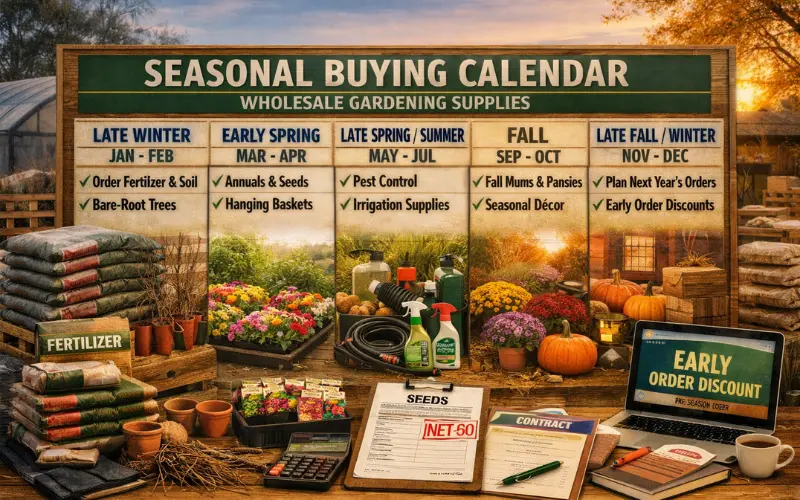
Timing your orders around the growing calendar — rather than reacting to what’s already running low — is one of the simplest ways to improve margins and avoid stockouts. A rough framework that works across most U.S. regions:
- Late winter (Jan–Feb): Lock in spring fertilizer, growing media, and container orders before suppliers’ peak-season lead times stretch out. This is also bare-root tree and shrub season for many growers.
- Early spring (Mar–Apr): Annuals, hanging basket components, and seed-starting supplies move fast. Reorder cycles should be short and frequent here rather than one big spring buy.
- Late spring/summer (May–Jul): Pest and disease control products peak; irrigation supplies (drip tubing, timers) see steady demand as outdoor planting season is in full swing.
- Fall (Sep–Oct): Mums, pansies, and fall décor have a narrow sell window — order early enough to land before the first frost in your region, not after.
- Late fall/winter (Nov–Dec): Good window to negotiate next year’s pricing and place pre-season orders for spring container and soil needs, since suppliers often offer early-order discounts to smooth their own production schedules.
Certifications and Quality Signals Worth Checking
Two credentials separate professional-grade Wholesale Gardening Supplies from generic ones, and most buying guides never mention either:
OMRI Listing. The Organic Materials Review Institute certifies that a fertilizer, soil amendment, or pest control product meets USDA National Organic Program standards. If you sell to organic growers or market your own operation as organic-friendly, confirm the OMRI seal is actually on the product label — not just implied by marketing language like “natural” or “eco.”
ANSI Z60.1. The American Standard for Nursery Stock sets grading criteria for caliper, height, and root ball size on trees and shrubs. Reputable wholesale growers grade to this standard; it’s a useful question to ask a new plant-material supplier because it tells you whether their “5-gallon shrub” actually matches industry sizing expectations.
Common Mistakes Buyers Make
- Chasing the lowest unit price without checking landed cost. As covered above, freight and damage rates can flip the math entirely.
- Single-sourcing a critical SKU. If one supplier has a shortage or a shipping delay, you need a backup vendor already vetted — not one you’re scrambling to find mid-season.
- Skipping the account application until the order is urgent. Wholesale account approval (resale certificate, credit check, sometimes a trade reference) can take days to weeks. Set up accounts with backup suppliers before you need them, not during a crunch.
- Ignoring MOQs relative to actual sell-through. A great price on a pallet you’ll take eight months to sell isn’t a win — it’s frozen capital and, for perishable goods, eventual write-offs.
- Not asking about substitutions. If a SKU is backordered, ask in advance whether the supplier will substitute automatically or call first. Unapproved substitutions on plant material or specific product lines can be a bigger headache than a short delay.
Quick Reference: What to Ask Before You Sign Up With a New Supplier
- Is pricing FOB or delivered, and what’s the landed cost?
- What are the MOQs by category, and do they match my sell-through rate?
- What are the actual lead times for my most-ordered SKUs?
- What’s the damage/shortage claims policy and window?
- Are net terms available, and what’s required to qualify?
- Do they carry OMRI-listed or ANSI Z60.1-graded product where I need it?
- Will I have a dedicated rep, or is it self-service only?
Frequently Asked Questions
Do I need a business license to buy wholesale gardening supplies?
Most distributors require a resale certificate or business license to open a wholesale account, since this is what lets them exempt the sale from sales tax. Requirements vary by state and supplier, so check with the specific distributor during account setup.
What’s the difference between a wholesale nursery and a wholesale distributor?
A wholesale nursery grows and sells plant material directly. A wholesale distributor (like a hardgoods or chemical supplier) typically doesn’t grow anything — it buys from manufacturers and growers and resells in bulk to garden centers, landscapers, and other nurseries. Many buyers need both, since most nurseries don’t also manufacture fertilizer or pottery.
Is buying directly from a manufacturer cheaper than going through a distributor?
Sometimes, but manufacturers often have much higher MOQs (full truckloads, not pallets) and may not offer the smaller, mixed-product orders a distributor can. For most small-to-midsize buyers, a distributor’s ability to consolidate multiple brands into one order and one freight charge outweighs the manufacturer’s lower unit price.
How early should I place spring orders?
Late winter (January–February) is the standard window for locking in spring fertilizer, soil, and container orders, since supplier lead times stretch significantly once the spring rush starts in March and April.
Final Thoughts
Buying wholesale gardening supplies is less about finding the lowest advertised price and more about understanding the full supply chain behind every order. Freight costs, MOQs, payment terms, lead times, certifications, and damage policies all have a direct impact on your real margins. A supplier with slightly higher unit pricing can easily become the better long-term partner if they offer reliable inventory, fair freight terms, faster fulfillment, and responsive account support.
The most successful garden centers, landscapers, greenhouses, and growers treat wholesale purchasing as a strategic operation rather than a simple transaction. They diversify suppliers, plan purchases around seasonal demand, monitor landed costs instead of sticker prices, and build relationships with distributors before peak season arrives. Taking the time to evaluate suppliers properly upfront can prevent inventory shortages, cash-flow problems, and costly mid-season surprises later on.