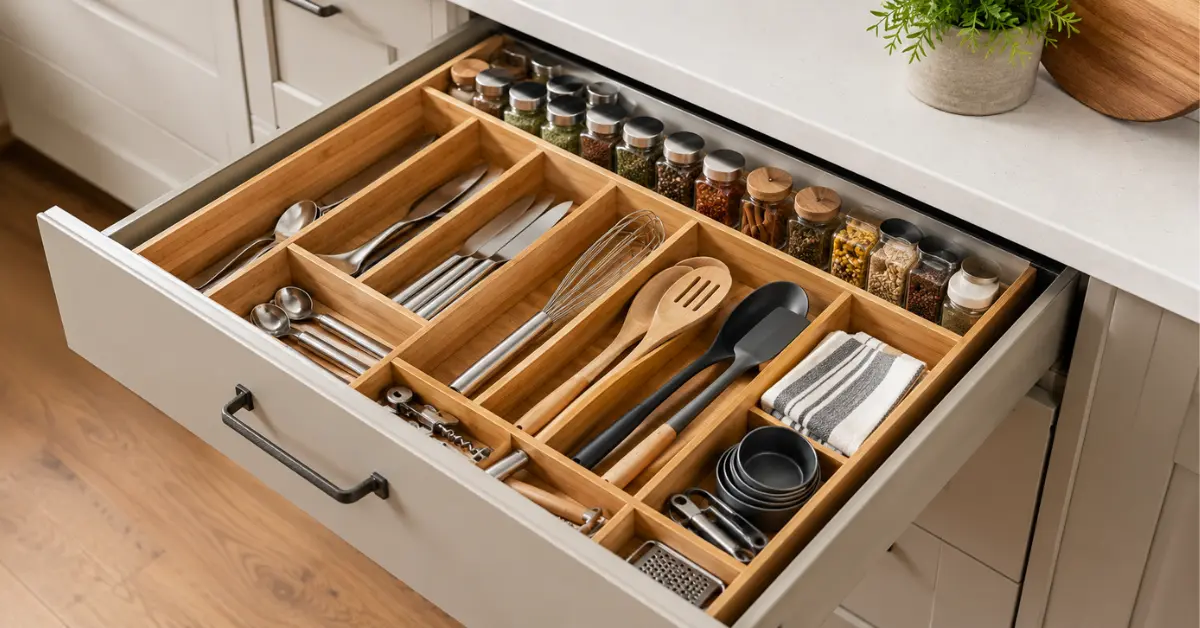
A cluttered kitchen drawer wastes time every single day. You dig past three whisks to find the one you need, or you shove the drawer shut because a spatula is jammed sideways. The right kitchen drawer organizer fixes this problem for good, and it does not require a full kitchen renovation to make it happen.
This guide walks you through exactly how to pick, measure, and set up a kitchen drawer organizer for every drawer in your kitchen, from silverware to pots and pans. You will also learn what most guides leave out: how to match organizer material to drawer function, how to avoid the sizing mistakes that lead to shifting trays, and how to keep the system working long after the initial setup.
Why a Kitchen Drawer Organizer Matters More Than You Think
A drawer without dividers is not really storage. It is a pile with a front panel. Items slide, stack, and hide, so you end up buying duplicates of tools you already own because you cannot find the original.
A well-chosen kitchen drawer organizer solves three problems at once:
- It gives every item a defined spot, so putting things away is as fast as taking them out.
- It protects sharp or delicate tools from knocking against each other.
- It makes your kitchen feel calmer, because open drawers show order instead of chaos.
Professional organizers agree that drawer systems succeed or fail based on one thing: whether the organizer fits the drawer and the items inside it, not just whether it looks nice in a photo.
Measure Before You Buy
This is the step almost everyone skips, and it is the single biggest reason a kitchen drawer organizer ends up shifting around or getting returned.
- Measure the interior width and depth of the drawer, not the outer cabinet front.
- Measure the depth from front to back.
- Check the drawer’s maximum height with nothing inside, since some organizers are too tall for shallow drawers.
Standard kitchen drawers fall into a few common width categories, typically around 12, 15, 18, 24, and 30 inches of usable interior space. If your drawer falls between sizes, look for adjustable or expandable trays rather than a fixed tray, since a rigid organizer that is even half an inch too wide will not sit flat.
Choosing the Right Material for Each Drawer
Not every kitchen drawer organizer should be made of the same material. Matching material to function extends the life of the organizer and improves how it performs.
- Bamboo and wood organizers work best for flatware and utensil drawers that see daily use. They are heavy enough to stay put without sliding, and they hold up well against the weight of everyday cutlery.
- Plastic and acrylic organizers are a smart choice for junk drawers, office supply drawers, or anything that needs frequent rearranging. They are lightweight, inexpensive, and easy to wipe clean.
- Expandable spring-loaded dividers are the most flexible option on the market. Instead of buying a differently sized kitchen drawer organizer for every odd-shaped drawer, a set of adjustable dividers lets you build custom compartments around whatever you are storing, from rolling pins to hot pads.
- Silicone-lined trays are worth considering for knife storage, since the soft lining protects blade edges and reduces noise when the drawer opens and closes.
A Room-by-Room Breakdown: Organizing Every Kitchen Drawer
Most articles cover the flatware drawer and stop there. A full kitchen has several drawer types, and each one benefits from a different kitchen drawer organizer strategy.
Flatware and Cutlery Drawer
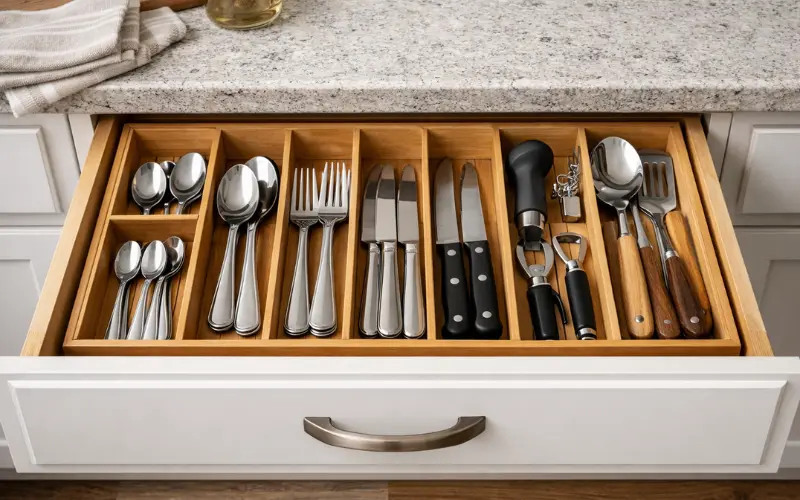
Choose a tray with individually sized compartments rather than one large open bin. Heavier flatware sets need a wood or bamboo kitchen drawer organizer, since lightweight plastic trays tend to shift once the drawer is full.
Knife Drawer
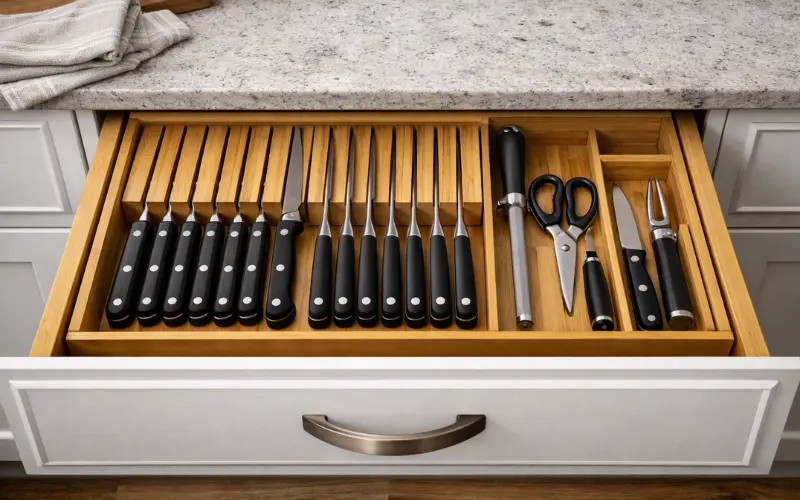
An in-drawer knife block keeps blades hidden, sharp, and off the counter. Look for a slotted design that separates each knife so blades never touch, and pair it with an adjustable divider if you also store kitchen shears or a sharpening steel in the same space.
Utensil Drawer
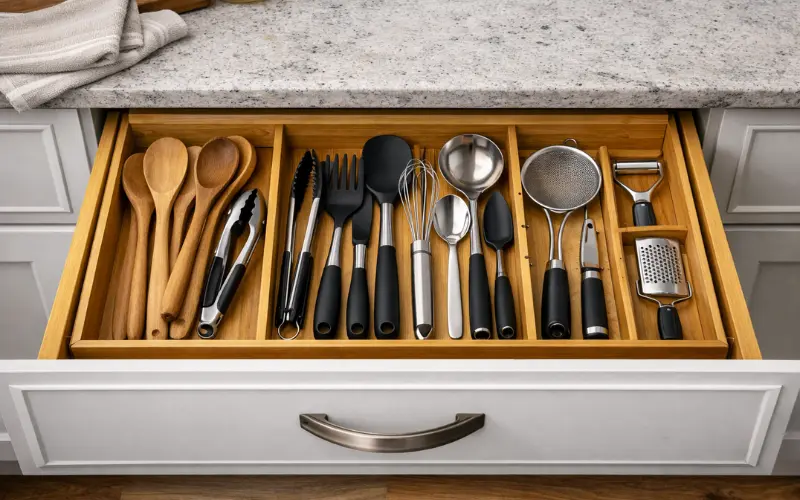
Wooden spoons, spatulas, and tongs need wider compartments than flatware. An expandable utensil tray with two or three large sections works better here than a small-slot organizer designed for silverware.
Baking and Measuring Tools Drawer
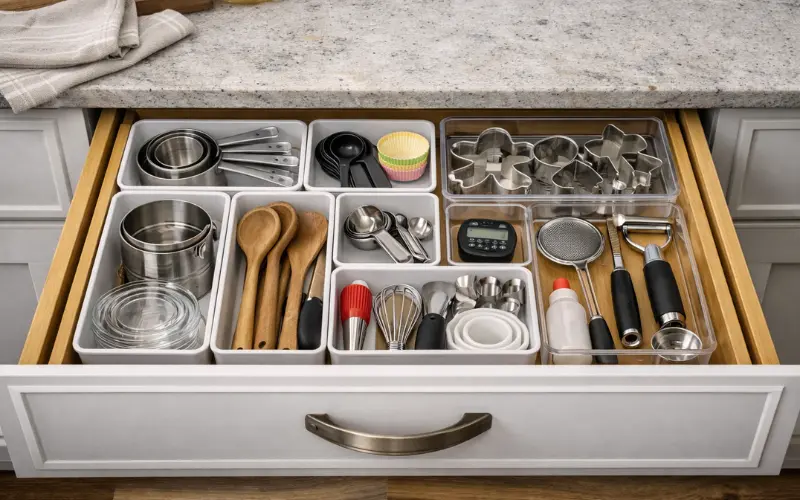
Small, modular bins are ideal for measuring cups, spoons, and cookie cutters. A stackable or nesting kitchen drawer organizer prevents these small tools from sliding to the back of the drawer where they are easy to forget.
Food Storage and Wrap Drawer
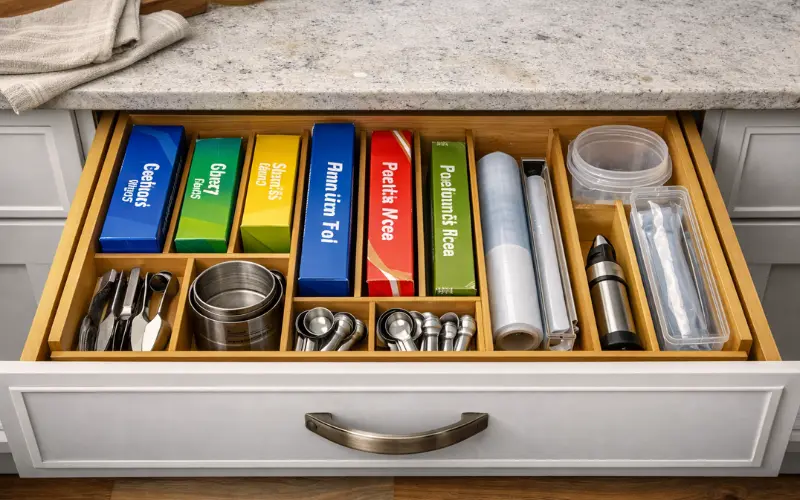
Vertical dividers work better than flat trays here, since they let you stand up boxes of foil, wrap, and bags instead of stacking them, which makes each one visible and easy to grab.
Pots, Pans, and Lids Drawer
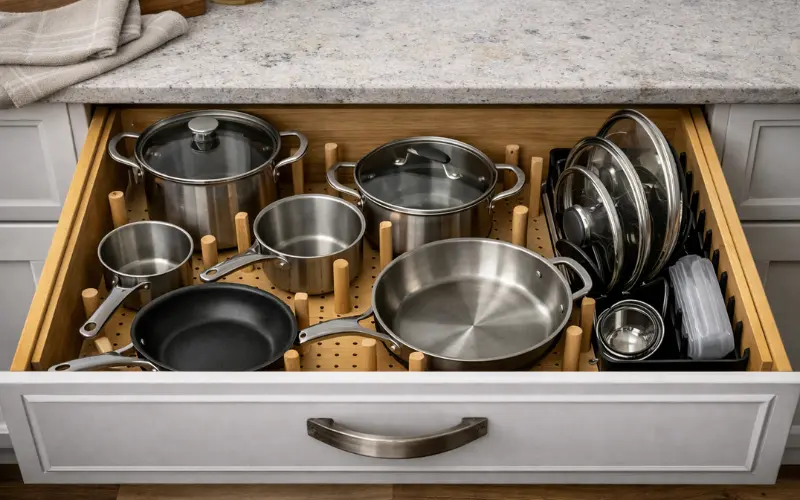
Deep drawers benefit from peg board style organizers, which let you customize a layout around your specific cookware instead of forcing pots into a fixed grid. If lids do not stack easily, a vertical lid rack solves the problem better than a tray.
Common Mistakes to Avoid
- Buying before measuring. This is the top reason people end up with a kitchen drawer organizer that does not fit.
- Overfilling the drawer first. Declutter before you organize. Adding dividers to a drawer full of unused tools just organizes the clutter instead of removing it.
- Ignoring drawer depth. A tray that is too tall will prevent the drawer from closing fully.
- Using one organizer style for every drawer. Flatware, utensils, and cookware all have different shapes and weights, so a one-size-fits-all approach rarely works well.
- Skipping non-slip feet or liners. Without grip on the bottom, even a well-fitted kitchen drawer organizer can slide every time the drawer opens.
How to Maintain Your Kitchen Drawer Organizer Long Term
Setting up the system is only half the job. Keeping it working requires a simple habit: reassess every few months. Pull the drawer, take out anything unused, and confirm the organizer still fits what you actually own. Kitchens change as cooking habits change, so a drawer that worked perfectly last year might need a slightly different layout today.
Wipe trays down monthly with warm soapy water, especially in drawers near the sink or stove where grease and crumbs collect. Wooden organizers benefit from an occasional light coat of food-safe mineral oil to prevent cracking.
Budget-Friendly Alternatives
You do not need to buy a full matched set to get organized. A few low-cost options work just as well:
- Repurpose small boxes or jars as makeshift dividers for a junk drawer.
- Use adjustable expandable dividers, which typically cost less than a full custom tray set and work across multiple drawer sizes.
- Shop secondhand for wood trays, which often just need a quick clean and a light sand to look new again.
Frequently Asked Questions]
What is the best material for a kitchen drawer organizer?
Bamboo and wood work best for daily-use drawers like flatware and utensils because they resist shifting. Plastic suits junk drawers or spaces you rearrange often.
How do I know what size kitchen drawer organizer to buy?
Measure the interior width, depth, and maximum height of the empty drawer before shopping. If your measurement falls between standard sizes, choose an adjustable or expandable option instead of a fixed tray.
Can I use the same organizer in every drawer?
No. Flatware, utensils, and cookware each have different shapes and weights, so matching the organizer type to the drawer’s contents gives better results than a single universal system.
How often should I clean my kitchen drawer organizer?
Wipe it down monthly with warm soapy water, and more often for drawers near the sink or stove. Wooden trays benefit from an occasional coat of food-safe mineral oil.
What is the biggest mistake people make when organizing kitchen drawers?
Buying an organizer before measuring the drawer, and organizing clutter instead of removing it first. Decluttering should always come before adding dividers.
Are expandable drawer dividers worth it?
Yes. They adjust to fit odd-shaped or nonstandard drawers, and one set can often replace several fixed-size trays across the kitchen.
Do deep drawers need a different type of organizer?
Yes. Deep drawers, especially for pots and pans, work better with peg board style systems that let you build a custom layout rather than a flat tray designed for shallow storage.
Final Thoughts
A kitchen drawer organizer is one of the simplest upgrades you can make to your kitchen, but only if you choose the right one for each drawer. Measure first, match the material to how the drawer is used, and resist the urge to buy a single organizer style for the whole kitchen. Declutter before you organize, reassess every few months, and your drawers will stay functional well beyond the first few weeks. Small, consistent changes like these make daily cooking faster and far less frustrating.