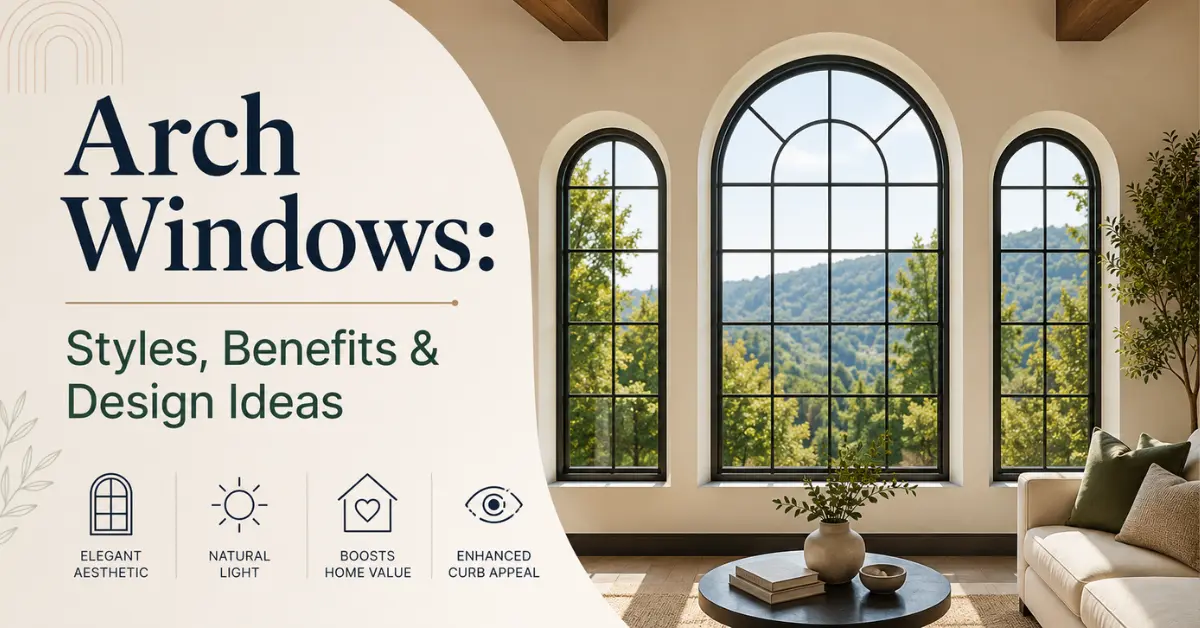
There’s something about an arch window that stops people in their tracks. Whether you’re scrolling through home design photos or walking past a beautifully built house, arched windows carry a visual weight that flat-topped rectangles simply can’t match. They’re bold, timeless, and surprisingly versatile.
But arch windows are more than just a pretty face. They bring in more natural light, add architectural character, and can dramatically boost curb appeal and resale value. If you’re considering installing them, already have them, or just want to understand them better — this is the guide for you.
What Are Arch Windows?
An arch window (also called a radius window, arched window, or curved window) is any window that features a curved, rounded, or semi-circular top instead of a standard 90-degree corner. The curve can be a full half-circle, a gentle eyebrow arc, or a pointed Gothic shape depending on the architectural style of the home.
Arch windows have roots going back thousands of years — from Roman aqueducts and medieval cathedrals to Victorian brownstones and modern luxury homes. Today, they fit beautifully into traditional, transitional, and contemporary architecture alike.
Types of Arch Windows
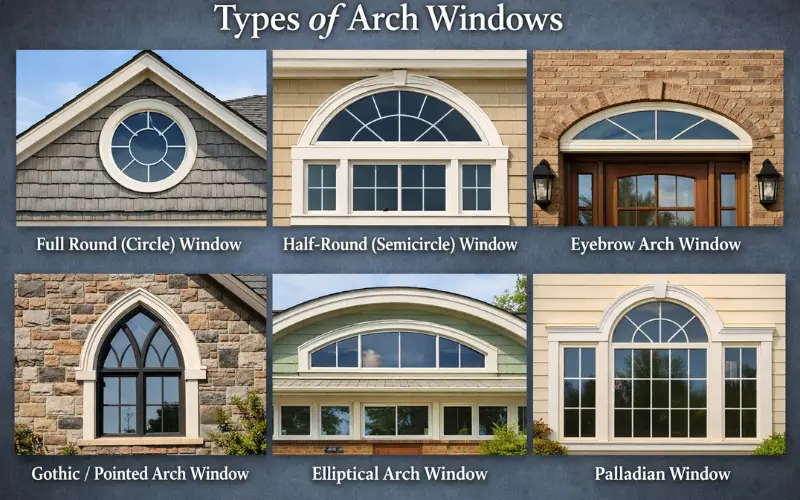
Not all arch windows are the same. Understanding the different styles helps you choose the right fit for your home.
1. Full Round (Circle) Windows A complete 360-degree circle, often used as an accent window in gables or above entryways. These are purely decorative and fixed (non-operable).
2. Half-Round (Semicircle) Windows The most classic arch window style — a perfect half-circle sat atop a rectangular window. Commonly seen in Colonial and Federal-style homes.
3. Eyebrow Arch Windows A low, subtle curve that appears like a gently raised eyebrow above a door or standard window. These have a more understated elegance compared to bold semicircles.
4. Gothic / Pointed Arch Windows Inspired by cathedral architecture, these arched windows come to a point at the top. They’re stunning in Tudor, Gothic Revival, and Craftsman-style homes.
5. Elliptical Arch Windows A flattened oval curve that’s wider than it is tall. These work especially well over wide openings like three-window combinations or above garage doors.
6. Palladian Windows A triple-window combination featuring a central arched window flanked by two narrower flat-topped windows. One of the most iconic arched window configurations in American architecture.
Benefits of Arch Windows
Beyond aesthetics, arched windows offer real, practical advantages:
- More Natural Light: The curved upper section captures light from angles that rectangular windows miss, especially during morning and evening hours when the sun sits lower in the sky.
- Architectural Character: An arch window instantly elevates the perceived quality and craftsmanship of a home. Real estate agents consistently note that distinctive architectural features like arched windows increase buyer interest.
- Versatility Across Styles: Whether your home is a classic Tudor, a Craftsman bungalow, or a sleek modern build, there’s an arch window style that fits seamlessly.
- Visual Height: The upward curve draws the eye vertically, making rooms feel taller and more spacious even without changing the actual ceiling height.
- Improved Ventilation Options: When combined with operable sections (like a double-hung or casement below the arch), these windows can bring in generous cross-ventilation.
Where to Use Arch Windows in Your Home
One of the most underappreciated aspects of arch windows is how many rooms they enhance. Here’s where they shine most:
- Entryways and Foyers: A single large arched window or a Palladian combination above a front door is one of the most striking architectural statements you can make. It welcomes guests with light and grandeur.
- Living Rooms: Floor-to-ceiling arch windows or large arched picture windows make living rooms feel like open, bright sanctuaries. They frame views beautifully while flooding the space with natural light.
- Stairwells: A stacked series of arch windows along a staircase wall is both dramatic and practical — it lights your path while creating a gallery-like effect.
- Bathrooms: A single arched window in a bathroom adds charm and brings in privacy-friendly light, especially when positioned high on a wall with frosted glass.
- Dining Rooms: Arched windows flanking a dining room create a symmetrical, intimate atmosphere perfect for evening entertaining.
- Home Offices and Libraries: The calm, scholarly quality of arch windows makes them ideal for study spaces. A tall arched window behind a desk adds quiet grandeur.
Arch Window Treatments: How to Cover Them Properly
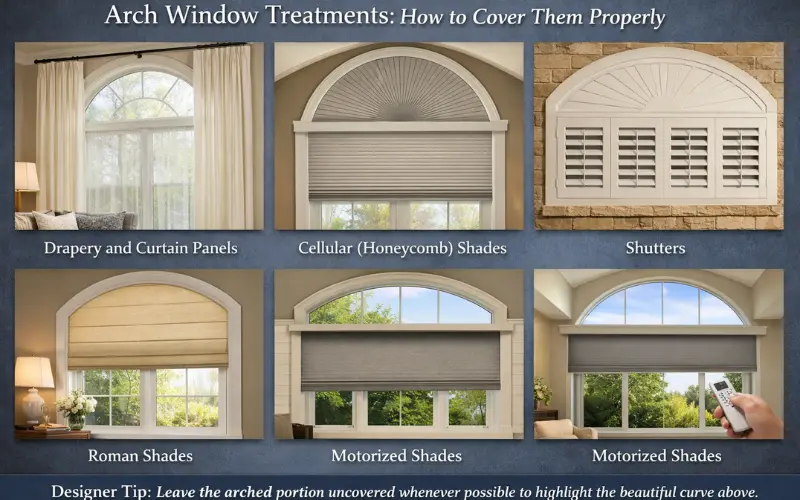
This is where many homeowners get stuck. Standard blinds and curtains weren’t made for curved tops, but you absolutely have options.
Drapery and Curtain Panels
The most popular choice among interior designers. Hang curtain panels from a rod mounted just above or below the arch — or even from the ceiling — to frame the window without covering the curve. This approach celebrates the arch while still giving you full light control and privacy for the lower rectangular section.
Cellular (Honeycomb) Shades
Custom cellular shades can be cut to fit the exact shape of an arch window, including the curved portion. They offer excellent insulation and a clean, modern look.
Shutters
Plantation shutters are a timeless treatment for the rectangular lower section of an arch window. The curved top is often left bare or fitted with a custom-shaped shutter panel that follows the arc precisely.
Roman Shades
Roman shades work beautifully on the flat portion beneath the arch. Choose a fabric that complements your room’s palette and mount the shade just below where the curve begins.
Motorized Shades
For large or high arch windows that are difficult to reach, motorized shades are a practical and sleek solution. Many can be programmed to adjust based on the time of day.
One designer tip many competitors miss:
leave the arched portion uncovered whenever possible. The curved shape itself is the design feature — covering it completely defeats the purpose. Treat the arch as an architectural crown and focus your window coverings on the rectangular section below.
Arch Window Installation: What You Need to Know
Installing arch windows is more complex than replacing a standard rectangular window. Here’s what to keep in mind before you start:
- Custom Sizing Is Almost Always Required Unlike standard windows, arch windows typically can’t be pulled off a shelf at a big-box store. They’re usually custom-ordered to fit your opening’s exact dimensions, which means longer lead times (often 4–8 weeks) and higher costs.
- Rough Opening Preparation Your contractor will need to frame the curved opening correctly. If you’re adding arch windows to an existing straight opening, this involves modifying the header framing — a job that requires a skilled carpenter or window installer.
- Weight and Support Larger arch windows are significantly heavier than standard windows. Proper structural support in the rough opening is essential to prevent settling, drafts, and eventual frame damage.
- Energy Efficiency Ratings Look for arch windows with double or triple-pane glass, low-E coatings, and quality weatherstripping. Since many arch windows are fixed (non-operable), their energy performance depends heavily on the quality of the glass unit and the seal between the frame and the wall.
- Professional Installation Is Strongly Recommended Unlike a simple window swap, arch window installation involves curved framing, custom flashing, and precise sealing. Most manufacturers will also void warranties if the window isn’t professionally installed.
Cost of Arch Windows
Arch window prices vary widely depending on size, material, glass options, and whether the window is operable. Here’s a general breakdown:
- Window Unit Cost: Custom arch windows typically range from $300 to $2,500+ per unit, depending on complexity and materials. Palladian combinations and very large units can exceed this range.
- Installation Labor: Expect to pay $200–$600+ per window for professional installation, depending on your region and the complexity of the opening modification required.
Window Materials:
- Vinyl arch windows are the most affordable and low-maintenance
- Fiberglass offers excellent thermal performance and durability
- Wood provides classic warmth and is highly customizable but requires more upkeep
- Aluminum is sleek and strong but less thermally efficient unless thermally broken
Arch Windows and Energy Efficiency
A question many homeowners overlook: are arch windows energy efficient?
The answer is — it depends on what you choose. Because most arch windows are fixed (they don’t open), they eliminate air leakage through operable hardware, which is actually a thermal advantage. The challenge is that the curved glass unit is harder to manufacture with the same multi-pane precision as rectangular units, so quality varies more between manufacturers.
What to look for:
- ENERGY STAR certification
- Low-E glass coating to reduce UV and infrared light transmission
- Argon or krypton gas fill between panes
- Warm-edge spacer technology to reduce condensation at the glass edges
- A proper installation with quality flashing and caulking
Arch Window Design Ideas Worth Stealing
Here are real-world design combinations that elevate arch windows from nice to unforgettable:
- The Grand Entry Statement: A large Palladian arch window centered above a front door, flanked by two sidelights. Paint the trim white against a dark exterior for maximum contrast.
- The Staircase Gallery Wall: Three or five arched windows of descending height following the slope of a staircase — no art needed.
- The Bathroom Privacy Solution: A single frosted-glass arched window positioned high on a wall over a soaking tub. Light, but no loss of privacy.
- The Library Nook: A built-in window seat with two tall arch windows on either side, filled with bookshelves between. The curved tops mirror the curve of the shelving arches above.
- The Living Room Statement Wall: A full-wall arrangement featuring one large central arch window flanked by two smaller ones at equal height. Works beautifully in both modern farmhouse and contemporary styles.
Frequently Asked Questions About Arch Windows
Q1: Can arch windows be opened for ventilation?
Yes, though most arch windows are fixed. The curved portion is almost always non-operable, but many arch window designs pair the arch with an operable double-hung, casement, or awning window beneath it. This gives you the visual appeal of the arch plus the practical benefit of fresh airflow.
Q2: How do you measure an arch window for replacement?
Measure the width of the opening at the widest point, the height from the sill to the top of the arch, and the rise (the height of the curved portion from the spring line — where the curve begins — to the peak). Always measure in at least two places and use the smallest measurement to ensure a proper fit. When in doubt, have a professional measure before ordering.
Q3: Are arch windows more expensive than regular windows?
Yes, generally. Because arch windows are almost always custom-made, they cost more than standard rectangular windows of a similar size. The curved frame requires specialized manufacturing, and installation is more labor-intensive. Budget roughly 20–50% more than you’d spend on a comparable rectangular window.
Q4: What is the best material for arch windows?
For most homeowners, fiberglass or vinyl offer the best balance of durability, thermal performance, and low maintenance. Wood is the most aesthetically traditional and customizable choice but requires periodic sealing or painting. If your priority is energy efficiency and longevity, fiberglass is hard to beat.
Q5: How do you treat an arched window for privacy without covering the arch?
Mount blinds, shades, or shutters only on the rectangular lower section of the window, leaving the curved portion uncovered. Alternatively, use frosted or decorative glass in the arch itself during the manufacturing or replacement process — this lets light in while blocking the view from outside.
Q6: Can I add an arch window to an existing rectangular opening?
Yes, but it requires structural work. A contractor will need to modify the framing above the window to create the curved rough opening. In load-bearing walls, this may also involve header modifications. It’s a bigger project than simply swapping a window, but it’s very doable for an experienced contractor.
Q7: Do arch windows reduce home energy efficiency?
Not if they’re properly made and installed. Fixed arch windows (which can’t be opened) actually reduce air infiltration compared to operable windows. Choose units with double or triple-pane glass, low-E coatings, and gas-filled cavities, and have them professionally installed with proper flashing and sealing.
Q8: What architectural styles suit arch windows best?
Arch windows are at home in a wide range of styles: Colonial, Federal, Victorian, Tudor, Mediterranean, Craftsman, and even Contemporary or Modern Farmhouse. The key is matching the arch profile to the architecture — gothic points for Tudor, clean semicircles for Federal, gentle eyebrow arches for Craftsman.
Q9: Can arched windows be double-pane?
Absolutely. Most quality manufacturers offer double or triple-pane glass options for arched windows. The curved insulated glass unit (IGU) is manufactured to match the exact shape of the frame, providing the same thermal performance as rectangular double-pane windows.
Q10: How long does it take to order and install arch windows?
Custom arch windows typically have a lead time of 4–8 weeks from order to delivery. Installation itself usually takes one to three days depending on the number of windows and the complexity of the rough opening work. Plan your project timeline accordingly, especially if you’re doing a larger renovation.
Final Thoughts
Arch windows are one of those rare architectural details that pay dividends in every direction — aesthetically, functionally, and in long-term home value. Whether you’re drawn to the classical elegance of a Palladian arrangement, the understated sophistication of an eyebrow arch, or the bold drama of a floor-to-ceiling semicircle, there’s an arch window solution that fits your home and budget.
The key is approaching them with intention: choose the right style for your architecture, invest in quality glass and framing, hire an experienced installer, and resist the urge to cover that beautiful curve entirely. When you treat arch windows as the architectural stars they are, your home becomes a place people genuinely remember.