
If you love the look of natural stone but want something that ages with character instead of showing every mark, a soapstone benchtop deserves a spot on your shortlist. This soft, dense stone has been used in kitchens for generations, and it is having a real moment again thanks to its warm, matte finish and low-fuss reputation.
This guide covers what the average buyer actually needs to know, including a few details most articles on this topic skip entirely.
What Is a Soapstone Benchtop?
A soapstone benchtop is cut from steatite, a natural metamorphic rock made mostly of talc, along with magnesite, dolomite, and chlorite. That high talc content gives the stone its trademark soft, soapy feel, which is exactly where the name comes from.
Unlike engineered stone, no resins or synthetic binders go into this material. It comes straight out of the ground and gets cut, honed, and installed with very little processing. That simple origin is part of why so many homeowners want a genuinely natural surface in their kitchen.
Colour-wise, expect a range from pale grey through to deep charcoal and black, often with soft green or blue undertones and gentle veining. No two slabs look identical, so your benchtop will always be one of a kind.
Why Homeowners Choose It
A soapstone benchtop earns its loyal following for a few solid reasons:
- Non-porous surface. Unlike granite or marble, it does not need sealing, and it will not soak up wine, coffee, or lemon juice.
- Heat resistant. You can set a hot pan straight onto the stone without leaving a scorch mark.
- Chemical and acid resistant. Vinegar, citrus, and household cleaners will not etch or discolour the surface.
- Naturally antibacterial. The dense mineral structure does not give bacteria much to cling to.
- Ages beautifully. The surface darkens gradually over time, developing a rich patina that many homeowners prefer to the original pale grey.
- Low ongoing cost. Beyond the occasional oiling, there is no annual sealing bill like you would face with granite or marble.
How Much Does a Soapstone Benchtop Cost?
Cost is where most articles get vague, quoting a huge range without explaining why. Expect to pay between $70 and $150 per square foot fully installed. For an average kitchen, that typically lands between $2,000 and $6,500 all up. A few factors explain the swing:
- Slab grade. Higher-talc, softer stone is easier to fabricate but shows marks faster, while denser architectural-grade material costs more and resists wear better.
- Thickness. Standard slabs run around 3cm, but thicker slabs cost more per square foot.
- Edge profile. A simple eased edge is usually included in the base price, while an ogee, bullnose, or chiselled edge adds $10 to $30 per linear foot.
- Drainboards and cutouts. Custom drainboard grooves, sink cutouts, and cooktop cutouts all add labour time and cost.
- Seams. Slabs tend to run smaller than granite or quartz, so larger layouts may need visible seams, which affects material use and fabrication time.
Getting two or three quotes from local fabricators is the only reliable way to pin down your actual number, since regional stone availability changes pricing significantly.
Soapstone Benchtop vs Granite, Marble, and Quartz
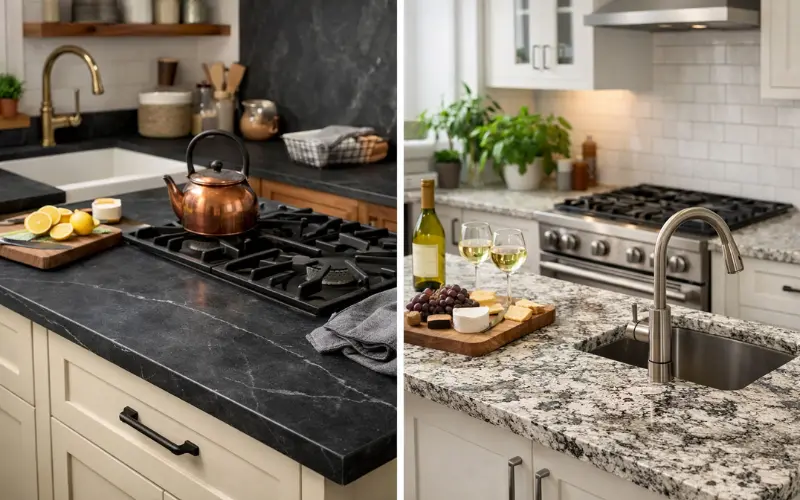
Choosing between natural stones gets confusing fast. Here is how it stacks up against the alternatives.
| Feature | Soapstone | Granite | Marble | Quartz |
|---|---|---|---|---|
| Needs sealing | No | Yes | Yes | No |
| Scratch resistance | Low | High | Medium | High |
| Heat resistance | Excellent | Excellent | Good | Fair |
| Stain resistance | Excellent | Good | Poor | Excellent |
| Colour range | Limited | Wide | Wide | Very wide |
| Repairable at home | Yes, easily | Difficult | Difficult | Not really |
The takeaway: it wins on low maintenance and stain resistance, but trades away scratch resistance and colour variety. If your household is hard on kitchen surfaces but you hate the idea of annual sealing, this option often makes more practical sense than granite or marble.
Talc Content: Soft vs Hard Grades
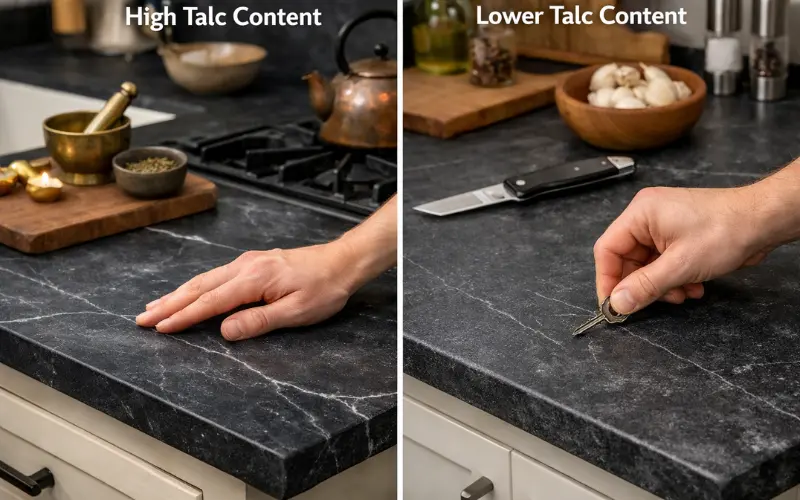
This is one detail most buying guides skip, and it changes what you should expect from your benchtop.
Soapstone generally falls into two categories:
- Artistic soapstone has a talc content of 80 percent or higher. It is very soft, easy to carve, and mainly used for sculpture rather than benchtops.
- Architectural soapstone has a talc content of roughly 50 to 75 percent. This is the grade used for kitchen surfaces, and it strikes a better balance between workability and durability.
Within architectural grade, there is still a spread. Lower talc content feels slightly harder underhand and resists scratching a bit better, while higher talc content develops its patina faster and feels noticeably softer to the touch. Ask your fabricator about the specific quarry source, since talc content varies by region and directly affects how your soapstone benchtop performs day to day.
Caring for Your Soapstone Benchtop
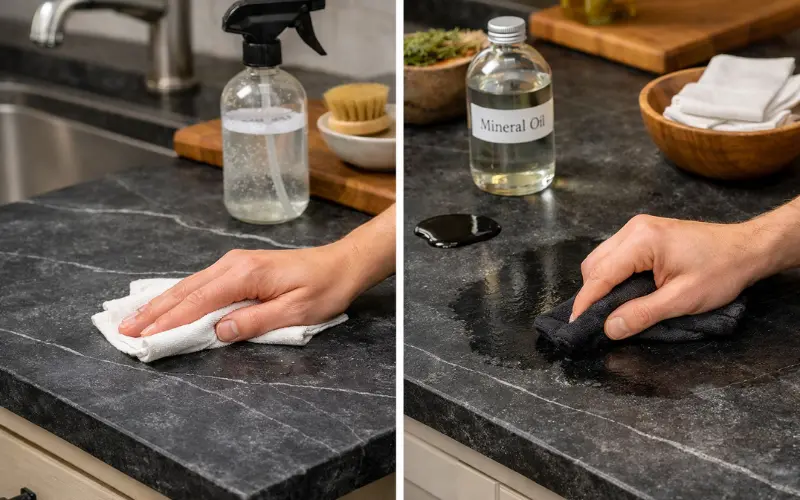
This surface is genuinely low maintenance, but “low maintenance” does not mean “no maintenance.” Here is the routine that keeps it looking its best.
Daily cleaning: Wipe spills with a soft cloth and mild dish soap. The stone will not stain, so there is no need to rush.
Oiling: Apply food-grade mineral oil to darken the surface evenly and enhance the natural veining. For a brand-new benchtop, oil it once a month for the first year. After that, oiling every two to three months is usually enough to maintain an even, rich colour.
How to oil it properly:
- Clean the surface thoroughly and dry it completely.
- Pour a small amount of mineral oil directly onto the stone.
- Rub it in with a lint-free cloth, using even, overlapping strokes.
- Let it sit for a few minutes, then wipe away any excess with a clean towel.
- Repeat if you want a deeper, darker finish.
Skip cooking oils and furniture polish. They can turn rancid or leave a sticky residue that is a pain to remove.
How to Fix Scratches
Scratches are the one real downside, but they are also the easiest natural stone damage to fix at home, which most competitor articles never actually explain.
For light scratches:
- Sand the area with 220-grit sandpaper, working in the direction of the scratch.
- Move to 400-grit sandpaper to smooth out the sanding marks.
- Wipe away the dust with a damp cloth and let it dry.
- Apply mineral oil to blend the repaired area with the surrounding stone.
For deeper gouges, start with 120-grit sandpaper before working your way up through the finer grits. If a scratch feels too deep or wide to handle confidently, a stone fabricator can resurface the area professionally in under an hour.
Choosing a Sink and Backsplash to Match
Most guides treat the benchtop as an isolated decision, but your sink and backsplash choice matters just as much.
- Integrated stone sinks create a seamless look with zero grout lines, and they age at the same rate as the rest of your surface.
- Undermount sinks in stainless steel or fireclay suit homeowners who prefer contrast over a monolithic stone look.
- Matching slab backsplashes eliminate grout lines and echo the veining of your soapstone benchtop for a polished finish.
- Tile backsplashes in white or cream brighten a kitchen and let the darker stone stand out as the visual anchor.
Ordering your sink and backsplash from the same slab guarantees a consistent colour match, since natural stone varies between blocks.
Is a Soapstone Benchtop Right for Your Kitchen?
It suits busy households that want a natural stone without a strict maintenance schedule. It is a strong choice if you cook often, worry about acidic spills, or want a surface that only improves with age.
It is a less obvious fit if you want bright colours, a flawless glossy finish, or zero risk of surface scratches. In that case, quartz or granite may serve you better.
From a sustainability standpoint, there are genuine advantages. It requires no resins or chemical binders during manufacturing, and because it is so durable, a well-maintained soapstone benchtop can easily outlast the kitchen it was installed in, reducing landfill waste compared to shorter-lived engineered surfaces.
Frequently Asked Questions
Does a soapstone benchtop need to be sealed?
No. The stone is naturally non-porous, so sealing is not necessary. This is one of the biggest practical advantages over granite or marble.
Is it food-safe?
Yes. The material is chemically inert and does not react with food or leach anything into it, which is why it has long been used for laboratory and chemistry bench surfaces.
Can I use it outdoors?
Yes. It handles temperature swings, moisture, and UV exposure well, making it a solid choice for outdoor kitchens as well as indoor ones.
Why does it feel soft to the touch?
That soapy texture comes from the high talc content and is completely normal. It is also why the stone resists cracking even though it scratches more easily than granite.
How long does a soapstone benchtop last?
With basic care, it can last 50 years or longer. Many century-old soapstone sinks and counters are still in daily use today.
Will the colour change over time?
Yes, and this is expected. It gradually darkens with use and oiling, developing a deep charcoal patina that many homeowners consider more attractive than the original pale grey.
Can water marks be removed?
Yes. Light sanding followed by a fresh coat of mineral oil will usually blend water marks back into the surrounding stone within minutes.
Is it more expensive than granite?
It depends on the grade and source, but the two are generally comparable in price, typically falling between $70 and $150 per square foot installed.
Final Thoughts
A soapstone benchtop is not the flashiest countertop option on the market, but it might be the most honest one. It does not pretend to be scratch-proof, and it will show its age, just in a way most homeowners end up loving rather than dreading. If you want a natural stone surface that gets more character with every year of use, it is hard to beat.

