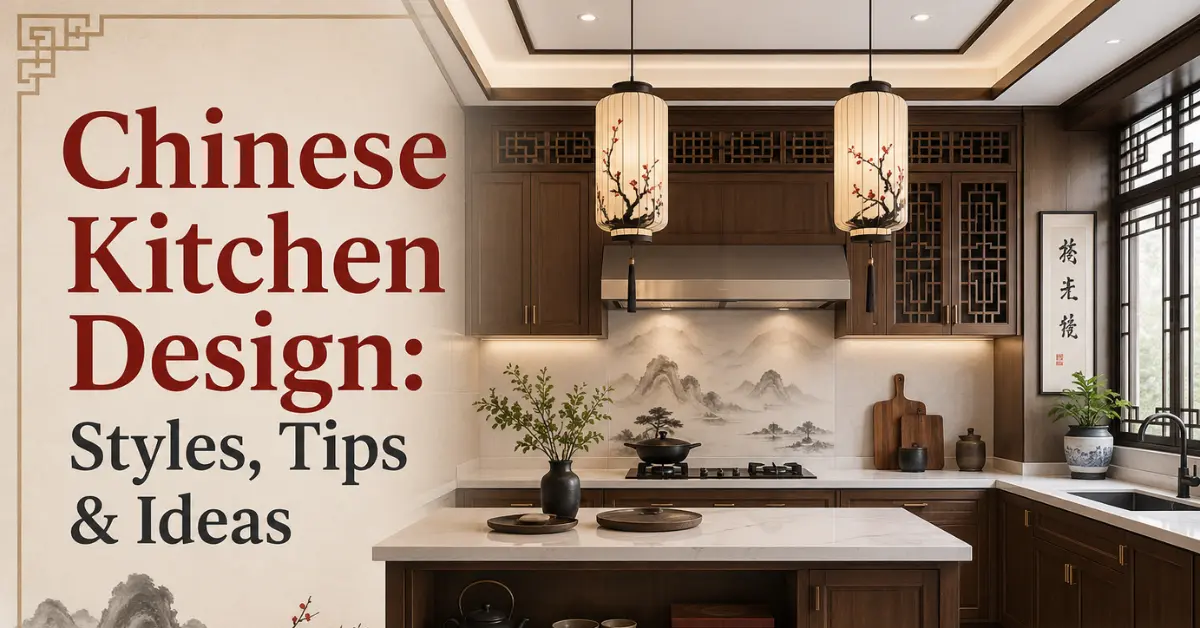
A Chinese kitchen is more than just a place to cook. It carries culture, philosophy, and centuries of design wisdom into one of the most important rooms in your home. Whether you want a fully traditional look or a sleek modern version with Chinese influences, this guide walks you through everything you need to know.
From materials and colors to feng shui layout rules and ventilation — this is the complete guide your competitors forgot to write.
What Is Chinese Kitchen Design?
Chinese kitchen design refers to kitchens that draw from Chinese cultural aesthetics, architectural traditions, and functional cooking needs. The term covers two overlapping ideas:
- Traditional Chinese kitchens — rooted in cultural motifs, natural materials, and feng shui principles
- Modern China-made kitchens — cabinetry and interiors manufactured in China, known for quality craftsmanship and affordability at scale
Both share a focus on balance, practicality, and visual harmony. A well-designed Chinese kitchen feels intentional — nothing is random, and everything serves a purpose.
Traditional vs. Modern Chinese Kitchen Design
Understanding the difference between traditional and modern helps you figure out which direction is right for your home.
Traditional Chinese Kitchen Design
- Rich wood tones (rosewood, walnut, dark mahogany)
- Carved cabinet details and decorative hardware
- Red, black, and gold color schemes
- Lantern-style pendant lights
- Feng shui layout principles
- Hand-painted tiles or ceramic backsplashes
Modern Chinese Kitchen Design
- Clean lines and minimalist cabinetry
- Matte or lacquered finishes
- Neutral palettes with subtle warm accents
- Hidden handles and push-to-open drawers
- Smart storage systems
- High-gloss or sintered stone countertops
Most homeowners today blend both. They use a modern layout and sleek cabinetry while adding traditional touches through lighting, textiles, or decorative elements.
Top Chinese Kitchen Styles — And Which One Suits You
1. Minimalist Chinese Kitchen
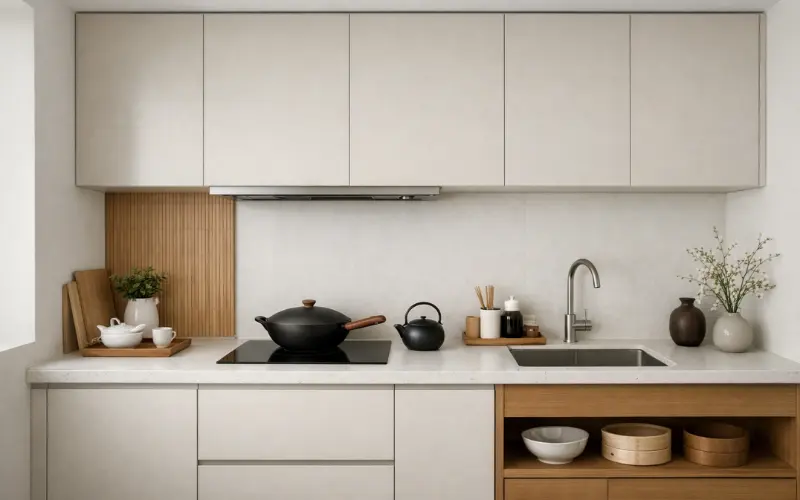
Clean surfaces, handleless cabinets, and a calm neutral palette. This style strips the kitchen back to its essentials while keeping subtle Asian design cues — like bamboo textures or a carefully placed stone countertop.
Best for: Small kitchens, modern apartments, or anyone who prefers low visual clutter.
2. Zen-Inspired Kitchen
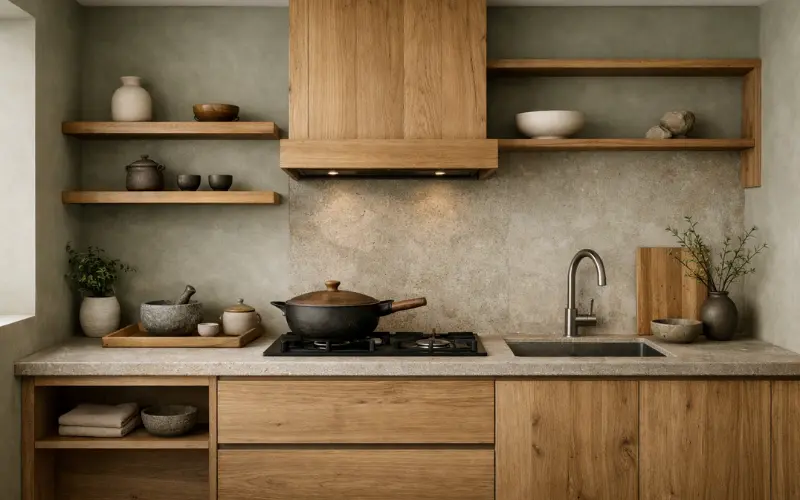
Built around stillness and natural materials. Think raw wood, stone, muted greens, soft lighting, and open shelving with very few items on display. The goal is a kitchen that feels peaceful to be in.
Best for: Homeowners who want a calm, spa-like cooking environment.
3. Traditional Chinese Kitchen
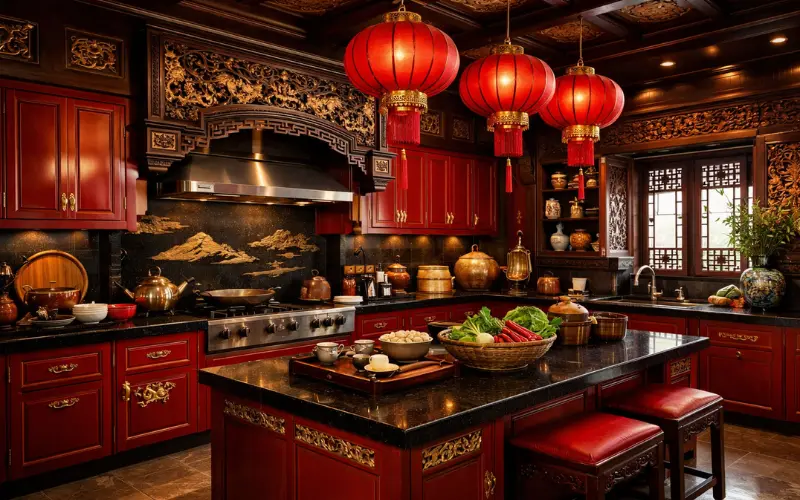
Full cultural expression — red lacquered cabinets, carved wooden panels, gold hardware, and lantern pendants. This style makes a strong visual statement and works best in larger kitchens with high ceilings.
Best for: Larger homes, dining rooms adjacent to open kitchens, or heritage-style properties.
4. Light Luxury Chinese Kitchen
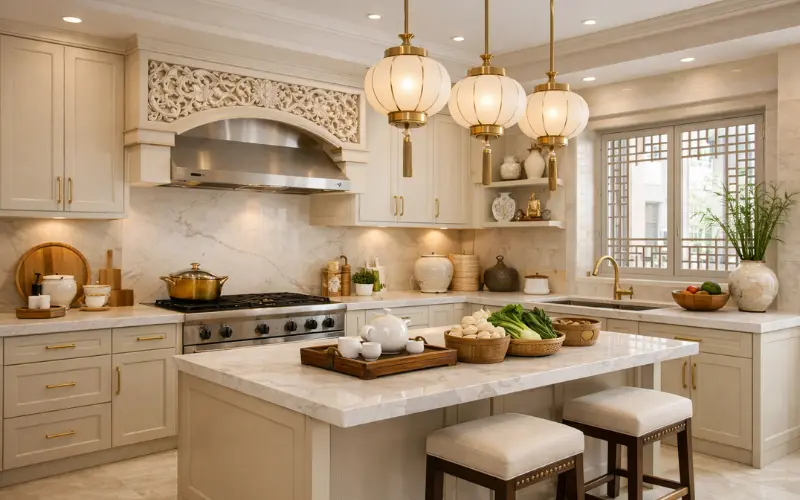
A popular modern style that blends soft color palettes (cream, beige, warm grey) with premium materials — marble countertops, brushed brass fixtures, and high-quality lacquered cabinetry. It feels sophisticated without being heavy.
Best for: Mid-to-large kitchens where elegance is the priority.
5. Industrial Chinese Kitchen
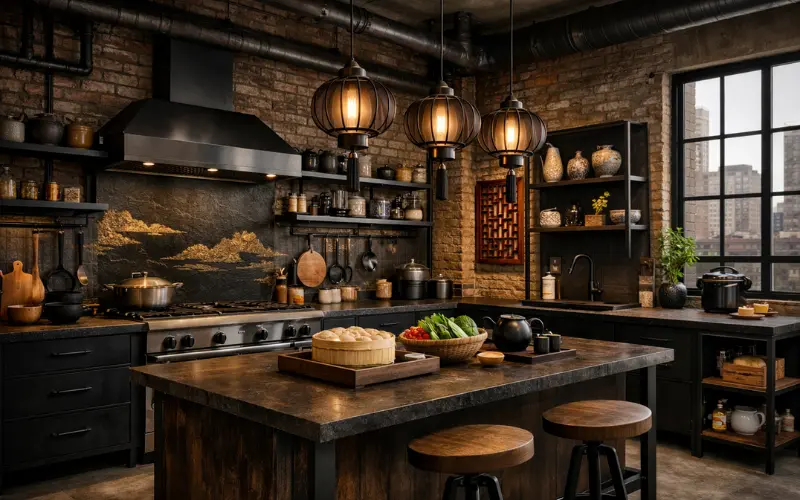
Dark tones, exposed pipes or brick, matte black hardware, and open shelving mixed with Asian design details. It is bold, practical, and increasingly popular in urban homes.
Best for: Loft-style apartments or open-plan kitchen-living spaces.
6. Smart Tech Chinese Kitchen
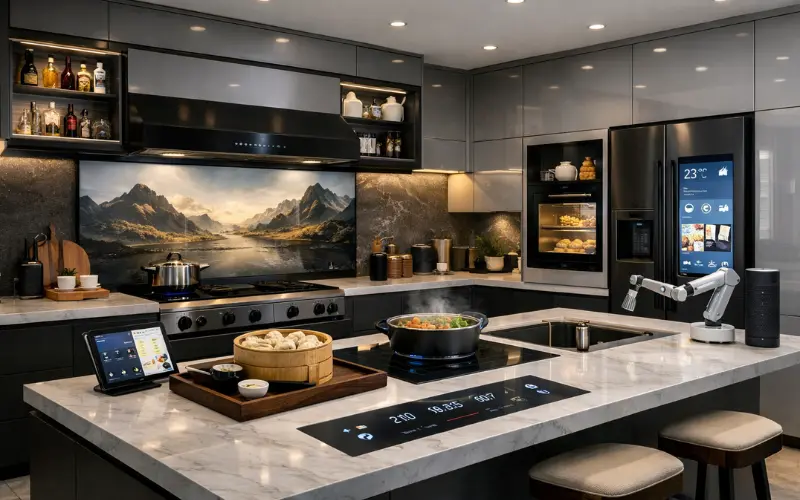
The future of Chinese kitchen design. Built-in touch controls, motorized cabinets, smart appliances, and seamless surfaces. Chinese manufacturers lead the world in integrating technology into kitchen cabinetry systems.
Best for: Tech-forward homeowners or new-build kitchen renovations.
Core Design Elements of a Chinese Kitchen
Color Palettes
Color carries deep meaning in Chinese design. Here is what each major color choice communicates and where it works best:
- Red — luck, energy, warmth; use as an accent or on lower cabinets only
- Black — power and sophistication; works well with gold or natural wood
- Gold/Yellow — prosperity; best as hardware, lighting fixtures, or trim details
- White and cream — cleanliness and calm; ideal for modern or minimalist kitchens
- Warm grey — contemporary and versatile; pairs well with walnut or bamboo
- Soft green — nature and renewal; works beautifully in Zen-inspired designs
Avoid using heavy red or black across an entire small kitchen — it can feel overwhelming and visually shrink the space.
Materials — With Pros and Cons
Bamboo
One of the most popular materials in Chinese kitchen design. Sustainable, warm-looking, and durable.
- Pros: Eco-friendly, affordable, unique grain texture
- Cons: Sensitive to humidity; needs sealing in wet climates
Lacquered Wood
High-gloss or matte lacquer over MDF or solid wood. Common in both modern and traditional styles.
- Pros: Wide color range, sleek finish, easy to wipe clean
- Cons: Scratches can show on high-gloss; repairs can be tricky
Granite and Quartzite
Heavy-duty countertop materials that handle high-heat Chinese cooking well.
- Pros: Heat resistant, long-lasting, beautiful natural veining
- Cons: Heavy, expensive, needs periodic sealing (granite)
Sintered Stone (Porcelain Slab)
Increasingly popular in modern Chinese kitchens. Made from compressed minerals at high heat.
- Pros: Non-porous, scratch and stain resistant, very low maintenance
- Cons: Higher cost, professional installation required
Marble
Elegant and timeless, often used in light luxury Chinese kitchens.
- Pros: Stunning appearance, cool surface good for pastry work
- Cons: Porous, can stain, requires regular sealing
Ceramic and Hand-Painted Tiles
Common in traditional Chinese kitchen backsplashes.
- Pros: Durable, heat resistant, huge variety of patterns
- Cons: Grout lines can collect grease in cooking-heavy kitchens
Feng Shui in the Kitchen — Practically Applied
Feng shui is not just decoration. In Chinese kitchen design, it directly affects layout decisions. Here are the rules that actually matter:
The Stove Position
The stove represents wealth and health in feng shui. Never place it directly facing the sink or refrigerator — fire and water elements in direct opposition create conflict energy. If your layout forces this, place a wooden element (a butcher block island or a wood-toned cabinet) between them as a buffer.
The Sink Placement
The sink belongs along a wall — not in the center island if you are following traditional feng shui. It should not be positioned directly under a window if possible, as this is said to drain energy outward.
Command Position
Wherever possible, the cook should face the room entrance while cooking, not stand with their back to the door. If this is not possible, a small mirror above the stove can be used to reflect the entry.
Colors and Elements
- North-facing kitchen: use metal tones (white, grey, silver)
- South-facing kitchen: balance fire energy with earth tones (yellow, beige)
- East/Southeast: wood energy; use greens and browns
Declutter as a Rule
A cluttered kitchen blocks chi (energy flow). Built-in storage, closed cabinetry, and organized countertops are not just aesthetic choices — they are feng shui fundamentals.
The Ventilation Factor (What Competitors Miss)
This is one of the most important — and most overlooked — aspects of Chinese kitchen design. Chinese cooking is high-heat, high-smoke, and high-aroma. Stir-frying, wok cooking, and deep frying produce intense steam and airborne grease.
If your ventilation is not designed for this, you will have:
- Grease on every surface within months
- Persistent cooking odors throughout the home
- Yellowing on cabinetry and ceilings near the stove
- Poor air quality in the kitchen
What to do:
- Choose a high-CFM range hood — for serious wok cooking, look for a range hood rated at 600 CFM or higher. Many Chinese kitchen designs use a professional-grade wall-mount chimney hood.
- Ducted over recirculating — always choose a ducted (vented to the outside) range hood over a recirculating one for Chinese cooking. Recirculating hoods are not powerful enough.
- Side-draft extractors — a popular option in modern Chinese kitchens where wall-mounting is not possible. These sit beside or behind the cooktop and pull smoke sideways.
- Ceiling and cabinet placement — keep upper cabinets at least 75–85 cm above the cooktop to allow heat and steam to dissipate before reaching surfaces.
- Separate wok burner area — in larger kitchens, some designs create a dedicated high-heat wok zone with its own overhead extractor, separate from the main cooking surface.
Good ventilation is not optional in a Chinese kitchen — it is infrastructure.
Layout Principles for a Chinese Kitchen
The Work Triangle
Chinese kitchen design respects the classic work triangle — stove, sink, and refrigerator form the three points. The total perimeter of this triangle should be between 4 and 9 meters. Anything larger creates unnecessary movement; anything smaller feels cramped.
Open vs. Closed Kitchen
Traditional Chinese homes typically feature a closed kitchen to contain cooking smells and keep the dining area separate. Modern Chinese design often opens the kitchen to living spaces — but with one caveat: if you cook high-heat Chinese food regularly, a semi-open layout with a glass partition or island barrier is a smarter compromise.
Small Kitchen Adaptations
Chinese apartments are often compact, and Chinese design has evolved specifically to handle small spaces. Here is what works:
- Floor-to-ceiling cabinetry — maximizes vertical storage and makes ceilings feel taller
- Pull-out pantry towers — narrow pull-out columns between appliances use every centimeter
- Under-sink storage systems — clever organizers that work around the plumbing
- Folding or extending countertops — provide prep space when needed without permanently taking up floor space
- Light-colored cabinets — keep the kitchen feeling open in a small footprint
- Mirrored or high-gloss cabinet doors — reflect light and visually double the space
Lighting in a Chinese Kitchen
Lighting in Chinese kitchen design is layered — not just a single overhead fixture.
Ambient lighting: Recessed ceiling lights or a central pendant provide overall brightness. In traditional kitchens, red paper lantern pendants or brass-framed fixtures add cultural warmth.
Task lighting: Under-cabinet LED strips illuminate countertops for safe prep work. This is non-negotiable in a kitchen where knife work and high-heat cooking happen simultaneously.
Accent lighting: Inside glass-front cabinets, above open shelving, or beneath floating islands. This adds depth and highlights decorative items like ceramic pieces or tea sets displayed in the kitchen.
Natural light: Chinese design — particularly Zen and minimalist styles — prioritizes natural light. If you have the option, position the main prep area near a window and use sheer curtains rather than heavy drapes to diffuse light without blocking it.
Cost Breakdown for Chinese Kitchen Design
Nobody else gives you this. Here is a realistic cost framework:
Budget Tier ($5,000–$15,000)
- Factory-direct Chinese cabinetry (MDF with laminate or basic lacquer)
- Granite or quartz countertops
- Standard hardware and fittings
- Basic pendant lighting
- Best for: Smaller kitchens or rental renovations
Mid-Range Tier ($15,000–$40,000)
- Higher-quality lacquered or solid wood cabinetry
- Sintered stone or premium quartz countertops
- Branded appliances with smart features
- Layered lighting design
- Professional range hood installation
- Best for: Primary family kitchen renovations
High-End / Luxury Tier ($40,000+)
- Full custom cabinetry with hand-finished details
- Natural marble or rare quartzite countertops
- Integrated smart home kitchen systems
- Professional-grade wok burner setup with industrial ventilation
- Custom millwork, carved panels, or bespoke hardware
- Best for: Luxury homes, full kitchen builds, or heritage-style restorations
Note: Costs vary significantly by region, materials availability, and labor rates. These figures are general estimates for a mid-size kitchen in most Western markets.
Common Mistakes in Chinese Kitchen Design
These are the errors that ruin an otherwise well-planned Chinese kitchen:
1. Over-decorating
More is not more in Chinese design. Stacking too many cultural motifs — dragon handles, red walls, carved panels, AND lantern lights all at once — creates visual chaos. Pick two or three signature elements and let them breathe.
2. Ignoring ventilation
Already covered above, but worth repeating: under-powered range hoods will destroy your cabinets and your kitchen air quality within a year.
3. Wrong counter height
Chinese cooking often involves wok work, which requires more downward force than standard Western cooking. Counter height should be slightly lower than Western standard — around 85 cm vs. the typical 90–92 cm — to give cooks better leverage over the wok.
4. Choosing gloss finishes near the stove
High-gloss cabinet doors near a high-heat cooking zone collect grease and show every fingerprint and steam mark. Use matte finishes close to the stove and save the gloss for island units or storage areas.
5. Placing the fridge next to the stove
This forces the fridge to work harder and can reduce its lifespan. Always place a buffer unit — a cabinet, dishwasher, or panel — between the two.
6. Skipping a dedicated prep zone
Chinese cooking often involves a lot of pre-prep — slicing, marinating, portioning. Design a dedicated prep counter that is separate from the cooking zone. This makes the workflow dramatically easier.
7. Forgetting about grease-proof backsplash materials
Tile grout and certain painted surfaces trap grease from wok cooking. Use full-slab sintered stone, stainless steel, or large-format tiles with minimal grout lines behind and around the stove.
FAQs About Chinese Kitchen Design
1. What makes a kitchen “Chinese” in design?
A Chinese kitchen is defined by its use of traditional color palettes (red, black, gold), natural materials like bamboo and wood, feng shui layout principles, and design elements rooted in Chinese cultural aesthetics. Modern versions often strip back ornamentation while keeping the underlying principles of balance and harmony.
2. Is feng shui important in a Chinese kitchen?
Yes — feng shui directly influences placement of the stove, sink, and refrigerator. The core principle is that fire (stove) and water (sink/fridge) elements should not face each other directly. Even if you are not superstitious, these layout rules often produce kitchens that feel naturally balanced and functional.
3. What are the best cabinet materials for a Chinese kitchen?
Lacquered wood, bamboo, and solid hardwoods like walnut and rosewood are the most popular choices. For modern Chinese kitchens, high-quality MDF with lacquer finish is widely used — it is cost-effective, durable, and available in many colors.
4. How do I ventilate a Chinese kitchen properly?
Use a ducted range hood rated at 600 CFM or higher. Position it 75–85 cm above the cooktop. For heavy wok cooking, consider a professional-grade chimney hood or a side-draft extractor. Recirculating hoods are not suitable for high-heat Chinese cooking.
5. Can I apply Chinese kitchen design in a small space?
Absolutely. Chinese design is particularly well-adapted to small spaces. Use floor-to-ceiling cabinetry, light-colored finishes, pull-out storage towers, and high-gloss or mirrored door panels to maximize both storage and perceived space.
6. What colors work best in a Chinese kitchen?
It depends on the style. Traditional kitchens use red, black, and gold. Modern Chinese kitchens favor cream, warm grey, and matte white with warm wood accents. Zen styles work best with soft greens, stone tones, and natural wood. Avoid using dominant dark colors in small kitchens.
7. What is the difference between Chinese kitchen design and Asian kitchen design?
Chinese kitchen design is specific to Chinese cultural aesthetics and feng shui principles. Asian kitchen design is a broader term that includes Japanese, Korean, Thai, and other Asian influences. Chinese kitchens tend to be bolder in color and more ornate in traditional versions; Japanese-inspired kitchens lean heavily minimalist and wabi-sabi.
8. What countertop material is best for Chinese cooking?
Sintered stone (large-format porcelain slab) and granite are the top choices. Both are heat resistant, which matters when you are dealing with hot woks and high-heat cooking. Marble is beautiful but too porous for heavy cooking use — reserve it for non-cooking surfaces like islands.
9. Should a Chinese kitchen be open or closed?
If you cook high-heat Chinese food regularly, a closed or semi-open layout is better. It contains cooking smells and protects living areas from airborne grease. If the kitchen is used for lighter cooking, an open-plan layout with an island barrier works well aesthetically and socially.
10. How much does a Chinese kitchen design renovation cost?
Costs range widely. A budget renovation using factory-direct Chinese cabinetry can start from $5,000–$15,000. A mid-range kitchen renovation typically runs $15,000–$40,000. Full custom luxury Chinese kitchens can exceed $40,000 depending on materials, location, and labor.
Final Thoughts
A well-designed Chinese kitchen balances beauty, function, and cultural meaning in a way few other design traditions achieve. Whether you are working with a compact apartment kitchen or a large open-plan space, the principles of Chinese kitchen design — harmony, purpose, and careful material selection — give you a clear framework to build from.
Start with your style direction, get your ventilation right early, apply feng shui where it makes sense for your layout, and avoid the common mistakes that trip most people up. The result will be a kitchen that not only looks extraordinary but genuinely works for the way you cook.