
If you’ve got an awkward, unused corner in your kitchen, a corner pantry might be the smartest fix you haven’t tried yet. It turns dead space into serious storage, and when it’s designed well, it can hold more groceries than a standard closet twice its size.
This guide covers everything the other corner pantry articles skip: real dimensions, layout comparisons, lighting tricks, budget ranges, and the mistakes homeowners make most often. Whether you’re renovating from scratch or reworking what you already have, you’ll walk away knowing exactly how to plan yours.
What Is a Corner Pantry, and Why Do People Love Them?
A corner pantry is a storage space built into the corner of a kitchen, either as a walk-in room, a tall cabinet, or a set of angled shelves. Instead of wasting that hard-to-reach 90-degree angle, builders turn it into usable square footage.
Corner pantries have become a top request in new home builds because they solve a problem almost every kitchen has: corners are awkward to use for anything else. A cabinet in a corner usually means reaching into a black hole. A pantry, on the other hand, makes that same space fully functional.
Here’s why homeowners keep choosing this layout:
- More storage per square foot. Corners are typically wasted space in a straight-line kitchen layout.
- Better traffic flow. Placing a pantry in the corner keeps it out of the main walking path.
- Flexible sizing. A corner pantry can be a small cabinet insert or a full walk-in room, depending on your space.
- Resale value. Buyers actively search for kitchens with dedicated pantry storage.
Corner Pantry Layout Options: Which One Fits Your Kitchen?
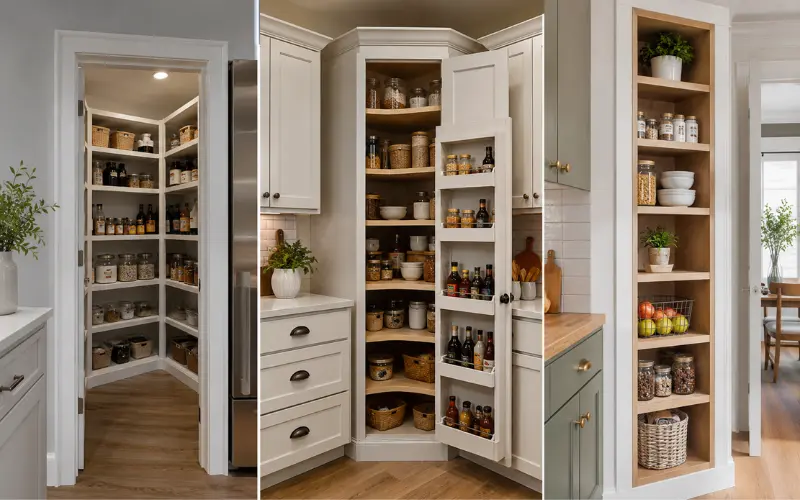
Not every corner pantry looks the same. Before you plan shelving or paint colors, decide which structural type works for your space.
Walk-in corner pantry. This is a small room you physically step into, usually accessed through a door or open doorway placed diagonally across the corner. It offers the most storage and works well in kitchens with extra square footage to spare.
Corner pantry cabinet. This is a tall, freestanding or built-in cabinet that fills the corner without requiring a separate room. It’s the most common choice in smaller kitchens or condos where a walk-in simply isn’t possible.
Reach-in corner pantry. A shallower option, usually 12 to 24 inches deep, with open or door-front shelving. It’s less roomy than a walk-in but far easier to retrofit into an existing kitchen.
Each layout solves the same problem: making a corner pantry work without stealing counter or cabinet space elsewhere.
Corner Pantry Dimensions: How Much Space You Actually Need
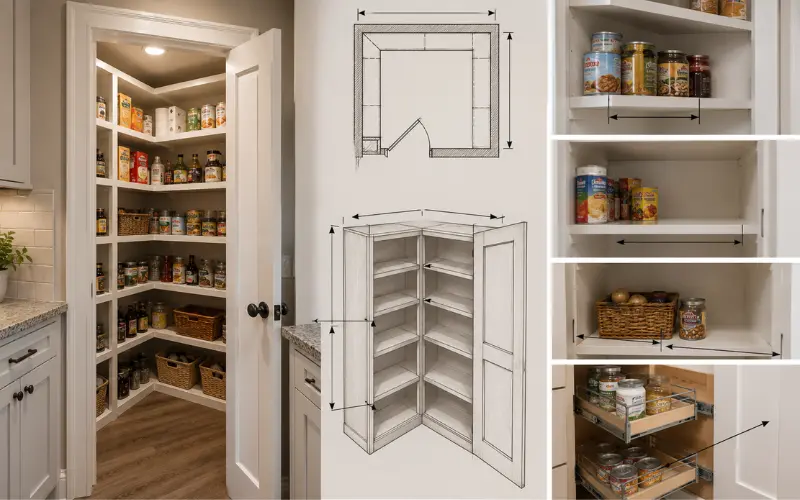
This is the detail most articles leave out entirely, and it’s the one homeowners ask about the most.
- Minimum walk-in corner pantry: around 5 feet by 5 feet gives you enough room to open the door, stand inside, and access shelves on two walls.
- Comfortable walk-in size: 6 to 8 feet across allows a center aisle plus shelving on three sides.
- Corner pantry cabinet width: typically 24 to 36 inches per cabinet face, with a diagonal front between 24 and 30 inches.
- Shelf depth: 12 to 16 inches for canned goods and boxed items, and up to 24 inches for bulk storage or small appliances.
- Ceiling height use: plan shelving all the way to the ceiling. A corner pantry that stops at 6 feet wastes valuable vertical storage.
If you’re working with a deep corner pantry, meaning anything over 24 inches from front to back, plan for pull-out shelving. Without it, items at the back become impossible to see or reach, which is one of the biggest complaints homeowners have about deep pantry corners.
Modern Corner Pantry Ideas for a Clean, Updated Look
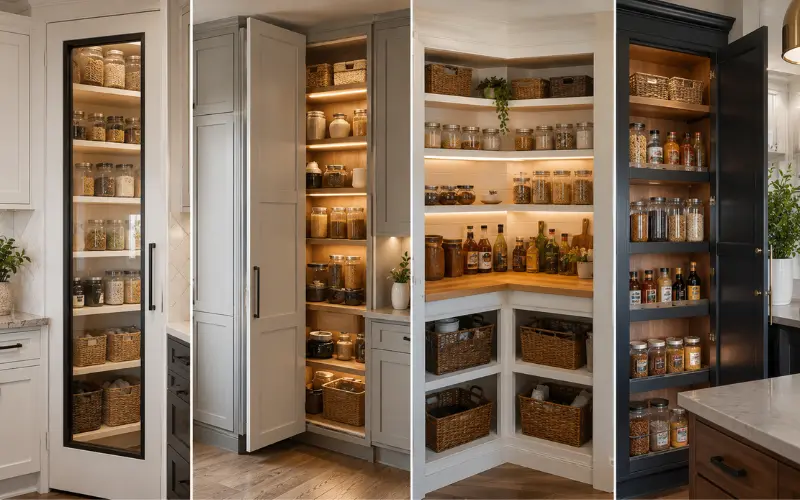
If you want your corner pantry to feel like part of the kitchen design rather than an afterthought, these modern corner pantry ideas make a real difference:
- Glass-front doors that show off organized, labeled containers instead of hiding clutter behind solid panels.
- Matching cabinetry fronts so the pantry blends seamlessly into the rest of the kitchen instead of standing out as a separate closet.
- Open shelving with a curated look, using matching jars, baskets, and labels for a boutique-style pantry wall.
- Warm under-shelf lighting that adds both function and a soft, high-end glow.
- Two-tone finishes, pairing a light interior with a darker exterior door to match current kitchen trends.
Small Corner Pantry Ideas That Maximize Every Inch
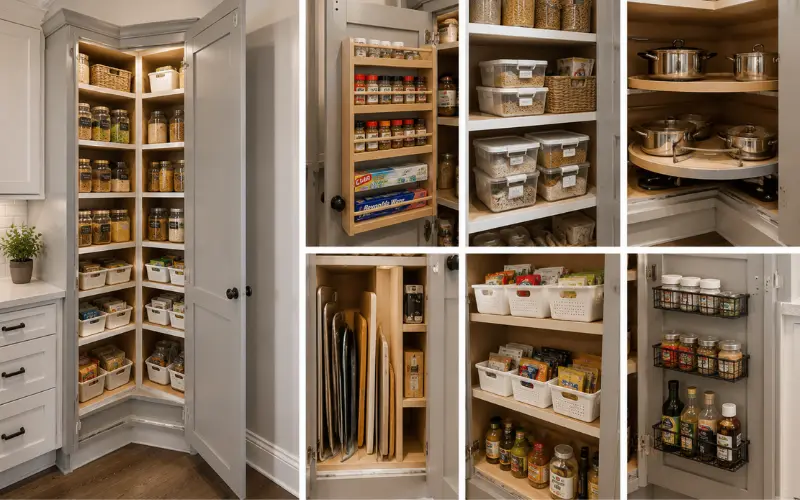
Not everyone has room for a walk-in. If your kitchen is tight, these small corner pantry ideas stretch limited square footage:
- Diagonal cabinet fronts that angle across the corner, giving you a wider opening than a straight door would allow.
- Door-mounted racks for spices, foil, wraps, and small jars, which can double your usable storage without adding a single shelf.
- Stackable bins instead of loose items, since bins make better use of shelf height than boxes of varying sizes.
- A single pull-out lazy Susan for pots, lids, or bulky items that don’t stack well.
- Slim vertical dividers for trays, cutting boards, and baking sheets tucked along one side wall.
Small corner pantries ideas work best when every shelf has a defined purpose. Randomly placed items eat up far more space than categorized ones.
Corner Pantry Shelving Ideas and Deep Corner Pantry Storage Solutions
Shelving is where most corner pantries succeed or fail. Fixed, flat shelves waste depth and make corner items nearly invisible. Instead, try these corner pantries shelving ideas:
- L-shaped shelving that follows the natural angle of the corner instead of cutting it off with a straight shelf.
- Adjustable shelf pins so you can change spacing as your storage needs shift.
- Pull-out wire baskets for deep corner pantry storage, giving you full access without unloading the whole shelf.
- Rotating corner shelving units, similar to a Lazy Susan, that spin items toward you instead of forcing you to reach in.
- Angled shelf inserts designed specifically for corner cabinets, sold by most major cabinet and hardware brands.
For genuinely deep corner pantry storage, anything past 20 inches deep, a rotating or pull-out system isn’t optional. It’s the difference between a pantry you actually use and one where food gets forgotten and expires.
IKEA Corner Pantry Ideas on a Budget
If you’re not doing a full renovation, IKEA corner pantry ideas offer an affordable way to get similar results:
- The UTRUSTA corner shelf fits many IKEA base cabinets and rotates for easier access.
- PAX wardrobe frames, repurposed as a tall corner pantry cabinet, are a popular budget hack among home renovators.
- VARIERA shelf inserts add a second storage tier to any flat shelf without permanent installation.
- Stackable SAMLA bins keep bulk items organized on open shelving.
These options let you build a functional corner pantry cabinet for a few hundred dollars instead of several thousand.
Corner Pantry Ideas With Doors vs. Open Shelving
This is a decision every homeowner faces, and it comes down to lifestyle more than style.
corner pantries ideas with doors work best if you:
- Want a clean, closed-off kitchen look
- Store items you’d rather not have on display
- Need to hide inconsistent packaging or bulk buys
Open shelving works best if you:
- Enjoy an organized, visible pantry as part of your decor
- Access items multiple times a day and want zero friction
- Have the discipline to keep things tidy and labeled
A lot of kitchens land on a middle ground: solid doors for the lower half and open shelving up top, which hides the mess while still showing off the pretty stuff.
Common Corner Pantry Mistakes to Avoid
Before you commit to a layout, watch for these common corner pantries mistakes:
- Skipping pull-out shelving in deep corners. Fixed shelves in a deep space almost guarantee lost or expired food.
- Ignoring lighting. Corners are naturally darker, and a corner pantry without dedicated lighting is frustrating to use.
- Undersizing the door swing. A door that can’t open fully wastes the pantry’s usable width.
- Choosing style over function. A beautiful pantry with poor shelf depth planning still won’t solve your storage problem.
- Forgetting ventilation. Enclosed pantries need airflow to prevent moisture buildup, especially near a kitchen sink or dishwasher wall.
Avoiding these mistakes upfront saves you from an expensive redo later.
What to Use Instead of a Corner Cabinet
If a full corner pantries isn’t possible, there are still smart alternatives:
- Blind corner pull-out systems that extract shelving from an existing cabinet
- A narrow pantry tower placed along an adjacent wall instead of directly in the corner
- Freestanding pantry cabinets, which require no renovation and can be moved later
- Open corner shelving, which is cheaper to install than a full cabinet system
These options give you similar storage gains without the cost of restructuring your kitchen’s layout.
Corner Pantry Cost: What to Expect
Budget varies widely depending on the type you choose:
- Freestanding corner cabinet: $150 to $600
- Custom-built cabinet insert: $800 to $2,500
- Full walk-in corner pantry (renovation): $3,000 to $10,000 or more, depending on framing, electrical, and finishes
Getting quotes from at least two contractors is worth the time, since corner pantry pricing can swing significantly based on framing complexity and cabinetry quality.
Frequently Asked Questions
Are corner pantries a good idea?
Yes, for most kitchens. A corner pantries makes use of a space that’s otherwise hard to work with, and it typically adds more storage than a standard cabinet layout in the same footprint.
What are some creative corner pantry layouts?
Diagonal walk-in entries, L-shaped shelving that follows the room’s angle, and rotating cabinet inserts are among the most creative and functional corner pantries layouts available today.
What are common corner pantry mistakes?
The biggest ones are skipping pull-out shelving in deep spaces, underestimating door clearance, and adding no lighting, all of which make the pantry harder to use day to day.
What to use instead of a corner cabinet?
Blind corner pull-out systems, freestanding pantry towers, and open corner shelving are solid alternatives when a built-in corner pantries isn’t an option.
How deep should a corner pantry be?
Most shelves work best between 12 and 16 inches deep. Anything beyond 20 inches should include pull-out or rotating shelving to stay usable.
Can I add a corner pantries to an existing kitchen without renovating?
Yes. Freestanding cabinets, IKEA-based builds, and blind corner pull-out inserts all work without structural changes.
Do corner pantries need their own lighting?
Yes. Corners tend to be the darkest part of a kitchen, so under-shelf LED lighting or a small ceiling fixture makes a noticeable difference in usability.
Is a walk-in corner pantries worth the extra cost?
If you have the square footage, it’s usually worth it. Walk-in pantries offer significantly more storage and tend to increase a home’s resale appeal.
Final Thoughts
A well-planned corner pantry does more than store groceries. It fixes one of the most awkward spots in any kitchen and turns it into the most useful. Whether you go with a small cabinet insert, a budget-friendly IKEA build, or a full walk-in room, the details, depth, shelving, lighting, and door style, are what separate a pantry you love from one you avoid opening.

