
A Rectangular Pool Landscaping Ideas for Your Space works with almost any backyard because its straight edges are easy to plan around, whether your lot is a quarter acre or a narrow city lot. The fastest way to landscape one well is to divide the space into three zones: a splash zone right at the coping, a buffer zone for plants and hardscape, and an outer zone for shade, seating, or a fence line. Get those three zones right and the rest of the design, from plant choice to lighting, tends to fall into place on its own.
Why the Straight Lines Actually Make Planning Easier
A lot of guides treat Rectangular Pool Landscaping Ideas like a limitation to work around. In practice, the opposite is true. Because every edge runs parallel or perpendicular to another, you can plan sightlines, paver patterns, and planting beds using simple grid logic instead of guessing at curves. I laid out my own pool deck by extending the long axis of the pool straight to the fence line, then mirrored the planting beds on both sides. It took an afternoon with stakes and string, no software required.
A quick expert note: the biggest planning mistake I see homeowners make isn’t picking the wrong plants, it’s skipping the layout step entirely and going straight to shopping for pavers. Decide your three zones on paper first. Everything downstream gets cheaper and faster once that’s settled.
Matching the Layout to Your Yard’s Proportions
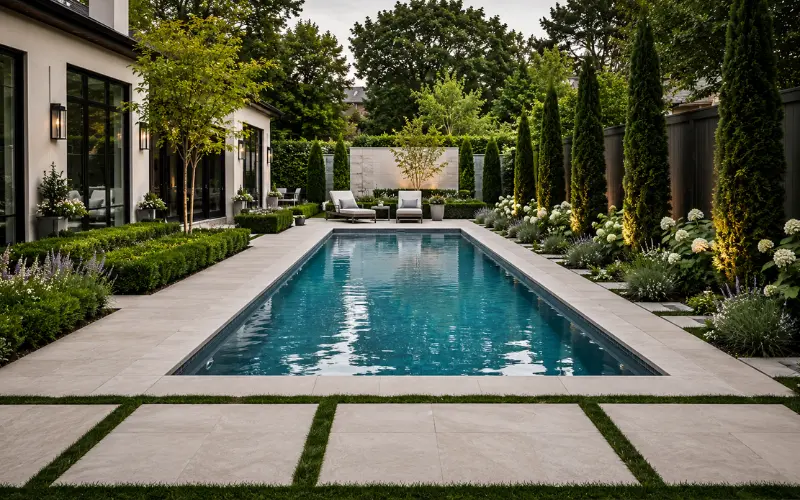
Most articles on this topic ” Rectangular Pool Landscaping Ideas ” assume you have a large backyard. Plenty of readers don’t, so here’s how the zoning changes by lot size.
- Small or narrow yards (under 30 feet wide): Keep the buffer zone to 18-24 inches on the long sides and push all seating and shade to one short end. A single row of columnar plants, like Italian cypress or narrow arborvitae, reads as intentional instead of cramped.
- Mid-size suburban lots: A 3-4 foot buffer on all sides gives room for layered planting without eating into usable deck space.
- Large or estate lots: You can afford a full perimeter path outside the buffer zone, which is where a lot of the “resort” look in high-end photos actually comes from. It’s the outer path, not the pool itself, that reads as luxury.
If your pool sits close to the house, mirror the window and door lines of the house in your planting bed edges. It sounds minor, but it’s the difference between a yard that looks designed and one that looks assembled from a catalog.
Planting Strategy Beyond “Add Some Greenery”
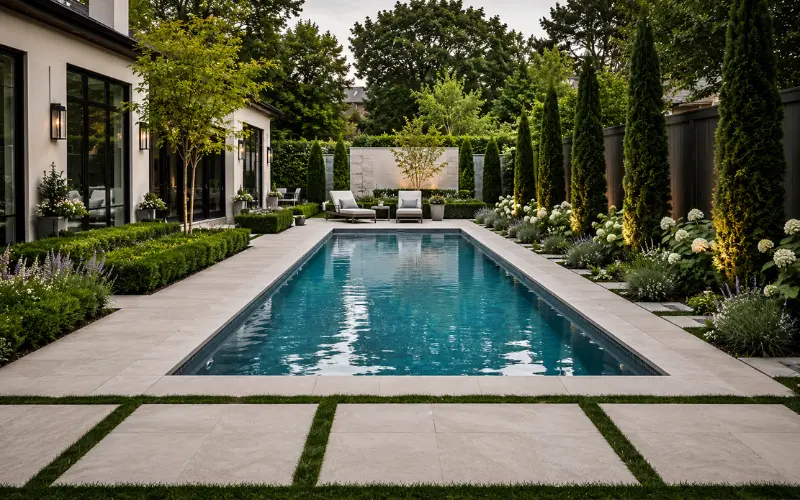
Every competitor list tells you to use non-shedding plants near the water. That part is true, but it skips the harder question: which plants actually hold up in your specific climate without turning into a maintenance chore.
- Hot, dry climates (Southwest, parts of Texas): Agave, red yucca, and dwarf Mediterranean fan palm handle reflected pool heat well and shed almost nothing.
- Humid Southeast and Gulf climates: Dwarf podocarpus, clumping bamboo, and bird of paradise tolerate splash and chlorine drift better than most flowering shrubs.
- Temperate Northeast and Midwest: Boxwood, dwarf hydrangea, and ornamental grasses like blue fescue give structure without constant leaf drop.
- Pacific coastal climates: New Zealand flax and dwarf olive trees handle salt air and mild winters without complaint.
One detail almost nobody mentions: plant your tallest specimens on the side that gets afternoon sun for the pool, not the side that looks best from the kitchen window. Shade thrown across the water in the late afternoon cuts evaporation and keeps the pool a few degrees cooler, which matters more than most people expect once August hits.
Hardscaping That Frames the Rectangle Instead of Fighting It
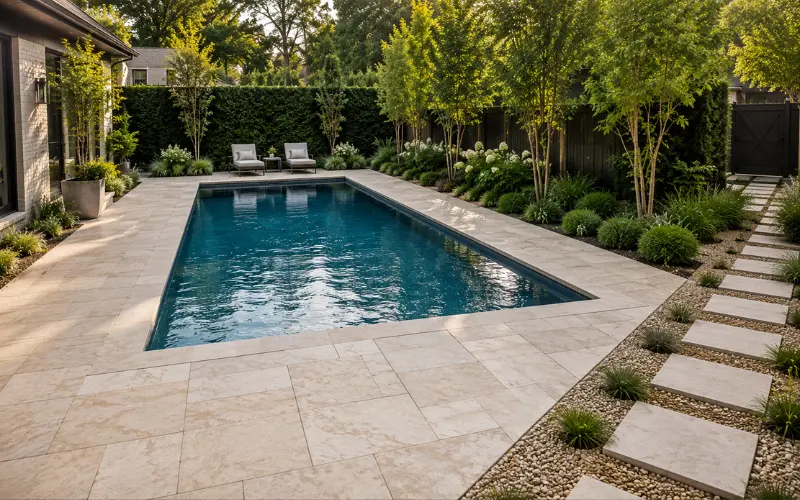
Straight coping lines look best paired with materials laid in a matching grid pattern rather than a running bond or herringbone, which visually competes with the pool’s edges. Travertine and large-format porcelain pavers are the two most common choices right now because both stay noticeably cooler underfoot than poured concrete or natural bluestone in direct sun, a real consideration if you’re barefoot half the year.
For walkways connecting the pool to the house or a side gate, keep the width at a minimum of 36 inches. Anything narrower feels like a service path rather than part of the design. If you’re working with a tight budget, a garden path idea using gravel-set stepping pavers can deliver a similar effect for a fraction of the cost of full paving.
Shade, Privacy, and the Safety Fence Nobody Wants to Talk About
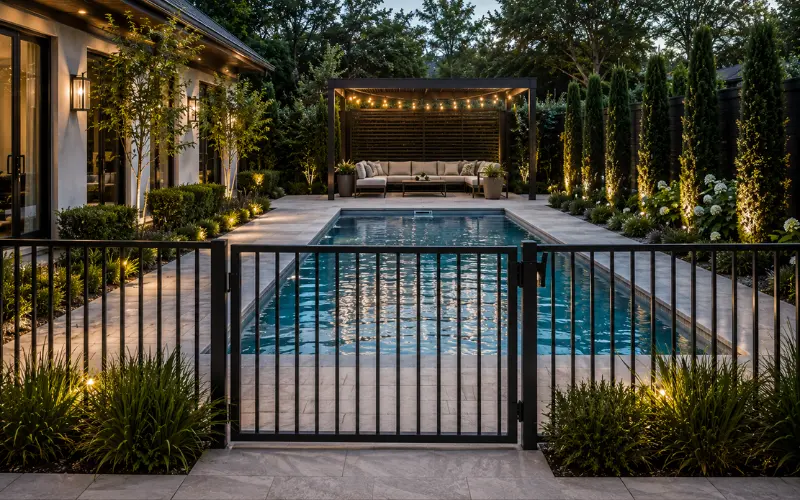
Shade structures get a lot of design attention, and rightly so. A pergola with retractable canopy panels lets you dial sun exposure up or down through the day, and it’s usually cheaper than a permanent cabana while giving nearly the same visual weight. For covered outdoor living space that doubles as a dining or lounge area, position it at the short end of the pool so it doesn’t block the main sightline down the length of the water.
Privacy screening matters more with rectangular pools than curved ones, because the straight sightlines that make the pool look sharp also give neighbors a clear view straight down its length. A privacy screen panel or a tight hedge row on the long side facing a neighboring window solves this without blocking airflow the way a solid wall does.
What almost every landscaping article skips entirely is pool fencing, and it’s the one design element with legal teeth. In most US jurisdictions, a code-compliant pool barrier needs to stand at least 48 inches tall (60 inches in California and a handful of other states), have no gaps wider than 4 inches, and use a gate that swings away from the pool with a self-closing, self-latching mechanism.
A decorative privacy fence built for looks alone usually fails at least one of these requirements, most often the gate hardware, so if your landscaping plan includes a fence anywhere near the water, check it against your local code before you fall in love with the design. Requirements vary enough by state and even by county that it’s worth a call to your local building department rather than assuming a neighbor’s fence height applies to you.
Water Features, Lighting, and the Sun Shelf Question
A sun shelf (also called a tanning ledge) changes your landscaping needs because it puts people sitting at water level for hours at a time, right at plant height. Skip anything with thorns or heavy pollen near a sun shelf, and favor low, soft textures like creeping thyme in the surrounding planters instead of taller shrubs that would block the view from a lounge chair.
For lighting, layer three types rather than relying on one: underwater LED fixtures for the pool itself, low-voltage path lights along any walkway, and uplighting on two or three specimen plants or trees. That third layer is the one most backyards skip, and it’s what makes a pool area photograph well after dark instead of looking like a single lit rectangle in a dark yard.
Small-Yard and Above-Ground Rectangular Pool Ideas
Above-ground Rectangular Pool Landscaping Ideas get almost no landscaping coverage anywhere online, which is strange given how common they’ve become. A few things that actually work:
- Build a low deck around at least two sides at the pool’s rim height, even if it’s only 3-4 feet wide. It visually “sinks” the pool into the yard and gives you a place to set drinks without balancing on the pool wall.
- Skirt the exposed pool wall with lattice panels or a slim planting bed of ornamental grasses rather than leaving the liner visible. It’s a small cost that changes the whole look.
- Use container plants instead of in-ground beds if you’re renting or might move the pool later. Potted dwarf citrus or hydrangea can be repositioned in a weekend if your plans change.
A Quick Zone Reference
| Zone | Distance from Water | Best Materials/Plants | Main Purpose |
|---|---|---|---|
| Splash zone | 0-3 ft | Non-slip pavers, non-shedding groundcover | Safety, easy cleanup |
| Buffer zone | 3-6 ft | Layered shrubs, ornamental grasses, seating | Visual softening, shade |
| Perimeter zone | 6+ ft | Fencing, hedges, pergola, fire feature | Privacy, gathering, code compliance |
Low-Maintenance and Budget-Tiered Approaches
Not every project needs the full hardscape overhaul. If you’re phasing the work Rectangular Pool Landscaping Ideas:
- Under $1,500: Container plants, a gravel-set garden path, and a rock garden border instead of full planting beds.
- $1,500-$6,000: Add a paver walkway, a mid-size shade sail, and low-voltage path lighting.
- $6,000 and up: Full paver decking, a pergola or cabana, layered planting beds, and a proper safety fence with self-latching gate hardware.
Whatever tier you start at, drainage is the detail that gets skipped most often and costs the most to fix later. Grade planting beds so water runs away from the pool deck, not toward it, before you plant a single shrub.
Common Mistakes Worth Avoiding
- Planting anything with heavy seasonal leaf or flower drop directly beside the water.
- Choosing a paver pattern that runs diagonally, which fights the pool’s straight lines instead of complementing them.
- Skipping a code check on fence height and gate hardware because “the yard already has a fence.”
- Placing tall shade structures where they block the low winter sun, which many pool owners actually want for warmth on cooler swim days.
FAQ on Rectangular Pool Landscaping Ideas
How wide should the planting buffer be around a Rectangular Pool Landscaping Ideas?
For most residential yards, 3 to 4 feet works well. Narrow lots can go down to 18-24 inches on the long sides as long as the plants chosen stay compact.
What is the cheapest way to landscape around a Rectangular Pool Landscaping Ideas?
Container plants, gravel paths, and a rock garden border cost the least while still finishing the look. Full paver decking and structures come later once budget allows.
Do above-ground Rectangular Pool Landscaping Ideas need the same approach as in-ground pools?
The zoning logic is the same, but above-ground Rectangular Pool Landscaping Ideas benefit specifically from a low perimeter deck and wall skirting to visually integrate the pool into the yard.
What plants should never go right next to a pool?
Avoid anything with thorns, heavy pollen, or frequent leaf drop, such as roses, bougainvillea, or most deciduous flowering trees, directly at the coping edge.
Does a Rectangular Pool Landscaping Ideas need a different fence height than other pool shapes?
No, fence height requirements are based on the Rectangular Pool Landscaping Ideas itself and local code, typically a 48-inch minimum with some states requiring 60 inches, not the pool’s shape.
How do I stop a Rectangular Pool Landscaping Ideas from feeling like a plain box in the yard?
Layered planting on at least one long side, a shade structure at one end, and lighting that highlights two or three focal points usually solves this without a full redesign.
What is the best material for decking around a Rectangular Pool Landscaping Ideas?
Travertine and large-format porcelain pavers are popular because they stay cooler underfoot in direct sun compared to poured concrete or natural bluestone.
Can I landscape close to a sun shelf without blocking the view?
Yes, stick to low groundcover like creeping thyme instead of taller shrubs, since anyone sitting on the sun shelf is at plant height for hours at a time.

