
A Coastal Kitchen Designs goes wrong the moment it starts looking like a beach gift shop. The fix is simple: build the space around light, natural materials, and a restrained palette, then let one or two intentional details carry the “coastal” identity instead of stuffing the room with anchors, shells, and rope trim. Done right, the style should read as calm and collected, not costume-themed.
That distinction is where most coastal kitchens fall apart, and it’s the gap this guide fills.
Why So Many Coastal Kitchens Look Overdone
Most coastal kitchen guides hand you a mood board: blue cabinets, white subway tile, a woven pendant light. What they skip is why those choices work in some homes and read as kitsch in others.
The overdone look almost always comes from stacking too many literal references in one room. A striped rug, a rope-wrapped mirror, shell-shaped cabinet knobs, and a nautical clock in the same kitchen isn’t coastal design, it’s a theme park. Real coastal interiors borrow the feeling of the shoreline through texture and light, not through literal props.
I’ve walked through enough client kitchens to notice a pattern: the ones that age well pick a single strong coastal cue (usually the color palette or the countertop material) and let everything else stay quiet. The ones that feel dated in three years tried to say “beach” in every single element.
Color Palettes That Hold Up Long-Term
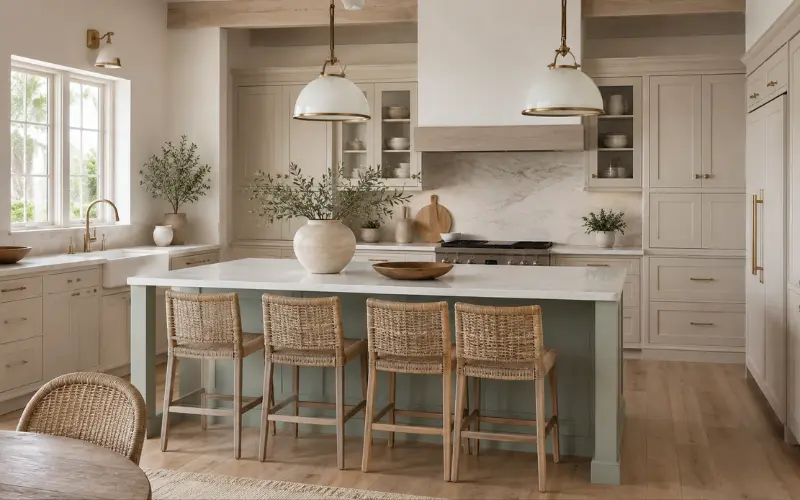
Skip pure white and true navy if you want longevity. Both photograph well but wear poorly in daily use.
- Warm whites over stark white, since they hide fingerprints and don’t turn clinical under LED lighting
- Sandy taupes and greiges for cabinetry, which pair with almost any counter material
- Muted seafoam or sage as an accent, usually on an island or lower cabinets only
- Soft driftwood-gray wood tones, which read coastal without a single blue in the room
A common mistake is treating blue as mandatory. Some of the most convincing coastal kitchens I’ve seen have zero blue in them. The coastal feeling comes from brightness and airiness more than any single hue.
Materials That Actually Survive a Coastal Climate
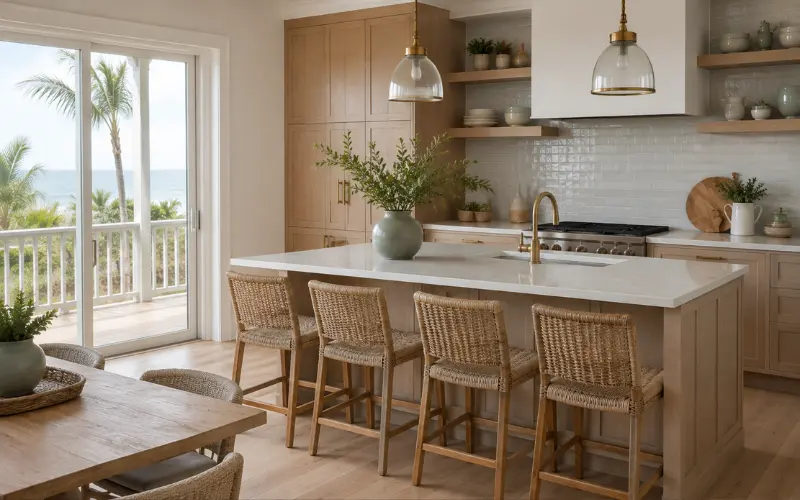
This is the part most competitor articles skip entirely, and it’s the part that matters most if the kitchen is anywhere near real salt air or humidity, not just styled to look “beachy” inland.
Salt air corrodes metal hardware faster than standard warranties account for. Humidity pushes moisture into cabinet boxes and drawer bottoms that weren’t built for it. UV exposure fades finishes and breaks down adhesives over time. If the kitchen is in a genuine coastal zone, cosmetic choices need to be backed by material choices that hold up.
Practical swaps worth knowing:
- Plywood cabinet boxes instead of particleboard, which resists swelling from humidity
- Moisture-resistant MDF for painted door fronts, since solid wood can warp near the coast
- Marine-grade sealants and finishes on any exposed wood, including timber flooring that continues into the kitchen
- Solid brass or stainless-steel hardware, which resists pitting far better than plated finishes
- Quartz over natural marble for most counters, since quartz doesn’t need sealing against humidity the way marble does
If a kitchen sits directly on the coast, treat these as functional decisions first and style decisions second. Inland “coastal-inspired” kitchens have more flexibility here, since they’re chasing the look without the climate.
Layout Choices That Reinforce the Style Without Trying Too Hard
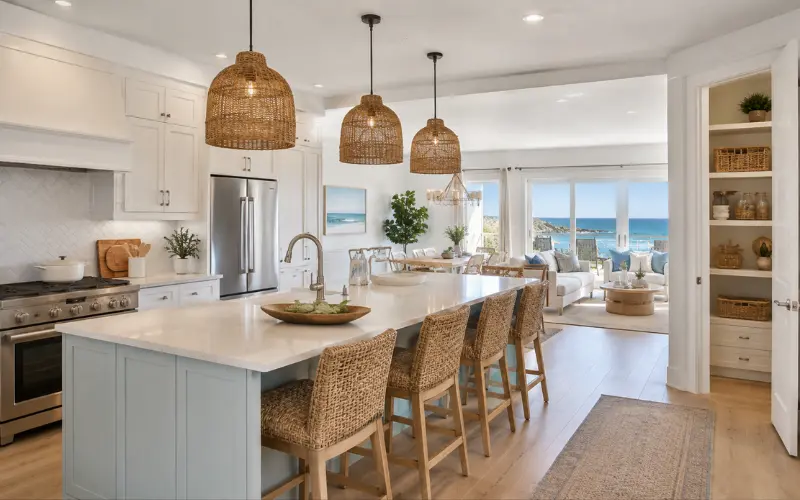
An open, light-filled layout does more for the coastal feel than any accessory. A closed-off, dark galley kitchen with beach decor bolted onto it will never read as coastal, no matter what’s on the walls.
Layout moves that reinforce the style naturally:
- Keeping sightlines open toward windows or an outdoor living area
- Using a kitchen peninsula instead of a full wall of upper cabinets when the room allows it, to keep the space from feeling boxed in
- Choosing an open floor plan so the kitchen flows into the living space rather than being sealed off
- Adding a corner pantry to clear countertop clutter, since a busy counter undercuts the airy feeling coastal kitchens depend on
Cabinet Hardware and Lighting Details That Signal Restraint
Hardware and lighting are where a lot of kitchens either stay tasteful or tip into theme territory. Woven or rattan pendant lights are a strong, restrained choice because the material itself is coastal without being literal. The same goes for layered kitchen lighting that mixes a statement fixture over an island with simple recessed lighting elsewhere, rather than a row of matching nautical pendants that all point back to the same reference.
For cabinet hardware, brushed nickel, unlacquered brass, and matte black all work in a coastal kitchen. What doesn’t work as well long-term is anything overtly shaped like a boat cleat, anchor, or shell. It reads as a costume piece the moment trends shift, while a simple bar pull ages indefinitely.
Storage That Keeps the Look From Feeling Cluttered
Open shelving is a coastal kitchen staple, but it only looks intentional when what’s on it is curated. An enclosed pantry cabinet for everyday clutter, paired with open shelves for a handful of ceramics or glassware, keeps the room from tipping into visual noise. A kitchen drawer organizer does the same job for utensils that would otherwise pile up on the counter.
Quick Comparison: Overdone vs. Timeless Coastal Choices
| Element | Overdone Approach | Timeless Approach |
|---|---|---|
| Color | Bright navy and white everywhere | Warm white or sandy neutral with one muted accent |
| Decor | Shells, anchors, rope trim as focal points | One or two natural-texture pieces, nothing literal |
| Hardware | Shell or anchor-shaped pulls | Brushed nickel, brass, or matte black bar pulls |
| Countertops | Bright blue resin or faux-wave patterns | Quartz or honed stone with subtle veining |
| Lighting | Matching nautical pendants in a row | One statement woven fixture, simple lighting elsewhere |
Countertops Worth Considering
If the goal is a subtle nod to the ocean without going literal, look at quartz slabs with movement that resembles water, such as pale gray or soft blue-green veining. A soapstone benchtop is another underused option; it develops a natural patina over time that suits a relaxed coastal home better than a perfectly uniform surface. For a brighter approach, a white kitchen with a grey stone benchtop keeps the palette calm while still adding contrast.
Cabinets Worth Considering
Slim-profile Shaker doors are edging out wide-frame Shaker in 2026, since the narrower rail creates a softer look without losing the classic silhouette. If a full remodel is on the table, modern kitchen cabinet styles that lean toward flat-panel or slim Shaker doors tend to hold up better against passing trends than heavily detailed or ornate fronts.
For homeowners drawn to a Southern or Lowcountry coastal feel specifically, a Carolina-style kitchen blends that regional warmth with the same restrained coastal palette, which is a good reference point if “coastal” alone feels too generic for the home’s character.
Frequently Asked Questions on Coastal Kitchen Designs
What are the best colors for a Coastal Kitchen Designs?
Warm whites, sandy taupes, and muted sage or seafoam accents hold up better long-term than stark white or bright navy, which can feel dated or clinical within a few years.
What is the new Coastal Kitchen Designs trend for 2026?
Panel-ready appliances that hide behind cabinetry, slim Shaker cabinet profiles, and quartz counters with subtle water-like veining are leading coastal kitchen trends this year.
What are some ideas for a beachy, Coastal Kitchen Designs without it looking themed?
Lean on natural textures like woven light fixtures and rattan stools, keep decor to one or two curated pieces, and avoid literal beach props like shells or anchors as focal points.
What are the Coastal Kitchen Designs interior design trends for 2026?
Warm neutral palettes, natural fiber textures, hidden appliances, and materials chosen for humidity and salt-air resistance are shaping coastal interiors this year, alongside a move away from purely nautical themes.
Do I need blue in a Coastal Kitchen Designs?
No. Many convincing coastal kitchens use zero blue and rely instead on light, warm neutrals and natural textures to create the airy feeling associated with the style.
Is white subway tile too overdone for a Coastal Kitchen Designs in 2026?
It’s not overdone on its own, but it needs a supporting texture, like a woven light fixture or wood shelving, to avoid feeling generic or copied from a template.
How do I make a small Coastal Kitchen Designs feel bigger?
Prioritize light, warm cabinet colors, keep upper cabinets minimal or open, and use a peninsula instead of a full wall of storage to maintain sightlines to a window or adjoining room.
What cabinet material holds up best in a real coastal climate?
Plywood boxes with moisture-resistant MDF doors and marine-grade finishes outperform particleboard and standard finishes when the kitchen faces genuine salt air and humidity.

