
Yes, timber art is still worth it in 2026, but only if you match the timber type to your climate and wall placement. A live-edge slab in a humid coastal bathroom will cup and crack within a year, while the same piece in a dry-climate living room can outlast the paint job. The value comes down to where you hang it, not whether the trend itself has faded.
I’ve fitted timber art pieces in three separate renovations over the past few years, and the biggest lesson wasn’t about style. It was about moisture, weight, and wall type. Most articles on this topic show you pretty photos and stop there. This one covers what actually determines whether your timber art holds up or ends up in landfill within eighteen months.
What Counts as Timber Art in an Australian Home
Timber art isn’t one product. It’s a category that splits into several genuinely different techniques, and mixing them up is where a lot of buyers go wrong.
- Live-edge slices: cross-sections of a trunk or branch, often resin-filled or wax-sealed, showing natural bark or grain edges.
- Pyrography panels: designs burned into timber with a heated tip, common for botanical or map-style wall pieces.
- Reclaimed timber assemblages: offcuts, fence palings, or old floorboards arranged into geometric or map-of-Australia patterns.
- Marquetry and inlay: thin veneers cut and glued into pictorial designs, usually framed.
- Chainsaw or chisel carvings: sculptural, three-dimensional pieces, often freestanding rather than wall-mounted.
Each of these behaves differently once it’s on your wall, which is exactly why a single “is timber art worth it” answer doesn’t hold up. A pyrography panel and a live-edge slab have almost nothing in common structurally.
Why It Still Earns Wall Space in 2026
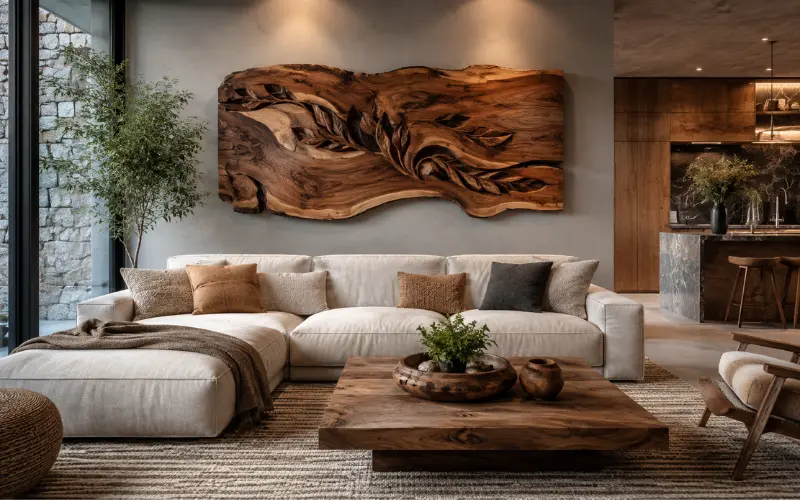
Most write-ups on this topic repeat the same line about timber bringing “warmth” into a space. That’s true, but it’s not the whole story, and it’s not why designers keep specifying it.
Timber art does something acoustically that flat art can’t. A textured live-edge or carved piece breaks up sound reflection in open-plan rooms with hard floors, the same principle behind acoustic timber slat walls. It’s a small effect on one piece, but noticeable across a room that’s otherwise all glass, tile, and plaster.
It ages instead of dating. Painted trends shift every few years. A well-sealed timber piece develops a slightly deeper patina over a decade, which reads as intentional rather than outdated, unlike a lot of the neon or geometric wall prints from five years ago.
It suits the shift toward mixed-material interiors. Where a decade ago rooms leaned heavily on one material, current Australian interiors mix stone benchtops, matte black fixtures, and natural timber accents in the same space. A single strong timber art piece can anchor that mix without needing to match anything exactly.
The Real Cost of Timber Art in Australia
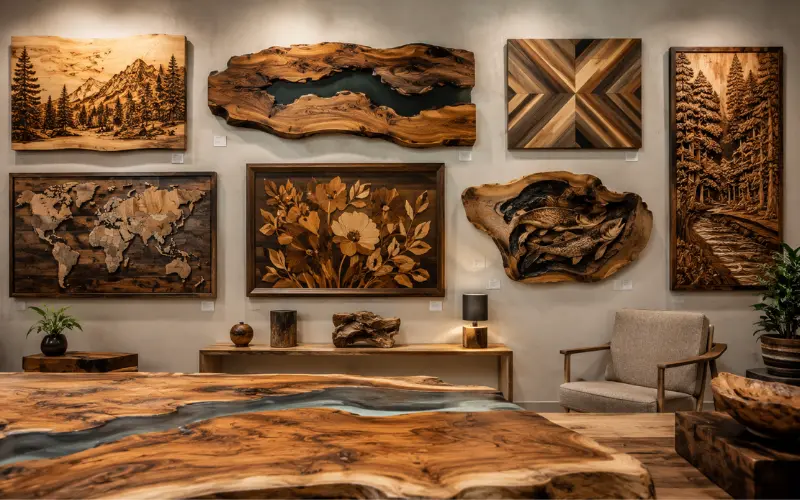
Pricing gets glossed over on most retailer sites because they’re only listing their own stock. Here’s a realistic spread based on what pieces actually go for across Australian makers and marketplaces.
| Type | Typical Price Range (AUD) | Expected Lifespan Indoors |
|---|---|---|
| Small pyrography panel (30–50 cm) | $80–$250 | 15+ years |
| Live-edge slab with resin river | $400–$1,800 | 8–15 years (climate dependent) |
| Reclaimed timber map or geometric art | $150–$600 | 10–20 years |
| Marquetry framed piece | $300–$1,200 | 20+ years |
| Custom carved sculptural piece | $600–$3,500+ | 15–25 years |
Marquetry and pyrography last the longest because they’re thin, stable, and don’t move much with humidity. Live-edge slabs are the riskiest investment purely because they’re a full cross-section of trunk, and full cross-sections are the part of a tree most prone to cracking as it continues to dry over years, even after kiln treatment.
Where It Works and Where It Falls Flat
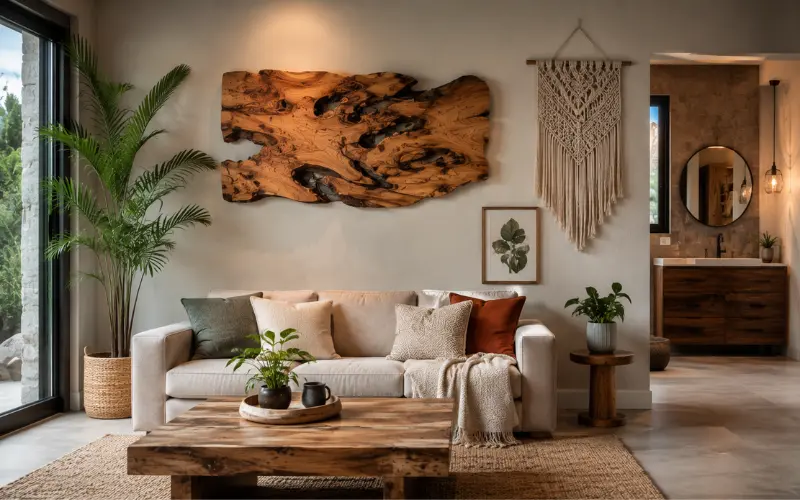
This is the part almost nobody covers properly, and it’s the part that actually determines whether your money was well spent.
Bathrooms and ensuites: skip anything thicker than a thin veneer piece unless it’s fully resin-sealed on all sides. Steam cycles daily, and even sealed timber will eventually absorb moisture through an unsealed back or edge.
Coastal homes: salt air is harder on timber than most people expect, even indoors, because it gets into the airflow through open windows. A marquetry or pyrography piece behind glass handles this fine; an open-grain live-edge slab in a beach house hallway will need re-oiling every six months rather than the usual twelve.
North-facing walls with direct afternoon sun: timber art fades unevenly if one section gets direct light and another doesn’t. Hang it on a wall that gets indirect light, or accept the patina will change faster on one side.
Rental properties or plasterboard-only walls: heavier carved or live-edge pieces need a stud or appropriate wall anchor. A lot of buyers learn this only after a piece has already come off the wall.
If you’re weighing timber art against other natural wall treatments, it’s worth looking at how it compares to options like macramé wall decor or a botanical wall decor arrangement, both of which carry less weight and fewer humidity risks in tricky rooms.
Caring for Timber Art So It Actually Lasts
From experience: the single biggest mistake I see is people treating timber art like a framed print, checked once and forgotten. Timber keeps moving with the seasons even after it’s mounted. Treat it more like you’d treat a timber floor.
- Re-oil or re-wax exposed grain every 6–12 months depending on climate; more often in humid or coastal areas.
- Dust with a dry microfibre cloth only. Avoid furniture spray, which builds up on textured surfaces and dulls detail.
- Keep at least 30 cm clearance from direct heating vents or reverse-cycle units, which dry timber unevenly and accelerate cracking.
- Check mounting hardware annually on anything over 3 kg. Wall anchors loosen with vibration from doors closing nearby.
This same seasonal-check logic applies to engineered timber flooring too, since the wood is reacting to the same humidity swings, just on a different surface.
How to Pair Timber Art With Your Existing Decor
Timber art doesn’t need a fully rustic or Scandinavian room to work. It pairs cleanly with several current Australian interior styles when the tone is matched rather than matched to a theme.
- Contemporary or minimalist spaces: choose one statement piece, not several. A single live-edge slab against a plain wall reads as intentional; three smaller pieces in the same room start to look cluttered.
- Coastal interiors: pale, driftwood-toned pieces work better than dark walnut, which can look heavy against light coastal palettes. See our guide on handmade wood home decor for tone-matching tips.
- Industrial or warehouse-style rooms: darker reclaimed timber with visible saw marks or old nail holes suits exposed brick and black steel fixtures far better than a polished, resin-finished piece.
- Rustic or farmhouse interiors: this is the easiest pairing, and it’s covered well in most rustic home decor guides, so the main risk here is over-matching rather than under-matching.
FAQ
Is timber art out of style in 2026?
No. It’s shifted from a rustic-only trend to a material used across contemporary, coastal, and industrial interiors, largely because it pairs well with the current mix of stone, matte black, and natural textures.
How do I know if a timber art piece is properly sealed?
Check the back and edges, not just the front. A properly sealed piece has visible resin or oil finish on every surface, including the mounting side, not just the display face.
Can timber art go in a bathroom?
Only thin, fully sealed pieces like framed marquetry or pyrography behind glass. Open-grain live-edge or unsealed carved pieces will absorb steam over time and warp.
Why did my live-edge slab crack after a year?
Full cross-sections of trunk continue releasing internal moisture for years after kiln drying. Cracking along the pith (the centre) is common and usually cosmetic rather than structural, but it can be minimised by choosing slabs cut away from the centre.
Is reclaimed timber art more sustainable than new timber?
Generally yes, since it reuses material that’s already been milled, though transport and any resin or finish added during restoration also factor into the overall footprint.
Does timber art fade like fabric or canvas art?
Yes, but unevenly rather than uniformly. UV exposure lightens the surface grain over time, which is why placement away from direct sun matters more for timber than it does for most printed art.
What’s the difference between timber art and a timber feature wall?
A feature wall covers a full wall surface with timber panelling or slats, usually for acoustic or textural effect. Timber art is a standalone piece treated the same way you’d treat a painting or print, just made from wood.

