
A hampton style balustrade combines slim, evenly spaced vertical pickets with a clean top and bottom rail, usually finished in crisp white or a soft coastal tone, to recreate the relaxed Long Island look that gives the Hamptons style its name. In Australia it is most often made from powder-coated aluminium rather than timber, because aluminium holds its colour and shape through coastal salt air, UV exposure and heavy rain without the sanding, sealing and repainting timber demands. Whether you are fitting it to a balcony, staircase, front verandah or pool area, the style works because it lets light and views through while still meeting Australian safety standards.
What Makes a Balustrade “Hampton Style”
Most articles on this topic stop at “white pickets equal Hamptons style,” which is only half the picture. What actually separates a genuine hampton style balustrade from a generic picket fence is the picket-to-gap ratio and rail proportion, not just the colour.
A traditional hamptons profile uses square or slightly rounded pickets, typically between 25mm and 40mm wide, set with consistent gaps that read as rhythmic rather than random. The top rail sits slightly proud of the pickets, and the bottom rail is often boxed in rather than left as a simple flat bar. That detail is what gives the style its finished, almost joinery-like appearance compared to a standard aluminium slat balustrade.
You will also see two common picket widths sold commercially in Australia:
- Wide picket – a broader, more substantial picket that suits Federation, heritage and larger acreage homes
- Square picket – a slimmer, more contemporary profile that suits townhouses, courtyard homes and coastal builds
Neither is more “authentic” than the other. The choice comes down to how the rest of your home’s facade is detailed. A heritage home renovation generally reads better with the wider picket, while a newer, pared-back facade suits the square profile.
Materials: Why Aluminium Has Overtaken Timber
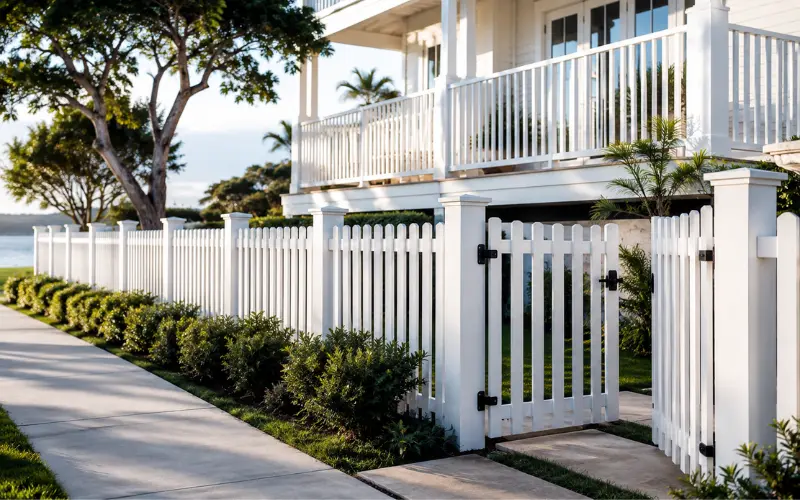
This is where most competitor guides skip an important nuance. They mention that aluminium is “low maintenance” without explaining why the material choice actually matters for a hamptons-specific build, where the whole appeal rests on crisp, unblemished white lines.
Timber was the original material for this look, and it still appears in high-end heritage restorations. But timber pickets move with humidity, and in a coastal climate they can cup, split or grey within a couple of seasons if the paint film fails even slightly. Because hampton style balustrades rely so heavily on that flawless white finish to read correctly, any imperfection is far more visible than it would be on a stained timber deck rail.
Powder-coated aluminium solves that problem structurally rather than cosmetically. The coating is baked onto the metal rather than sitting on top of it, so it does not peel the way paint does, and the aluminium core will not rot, warp or attract termites. Most Australian suppliers now offer a 10 to 15 year warranty on the coating itself, provided it is installed correctly and kept clear of standing water or trapped debris.
| Material | Typical Lifespan | Maintenance | Best Suited To |
|---|---|---|---|
| Powder-coated aluminium | 20+ years | Occasional hose down | Coastal, high-rainfall or low-maintenance builds |
| Painted timber | 8–15 years (with upkeep) | Annual sanding and repainting | Heritage restorations, inland properties |
| PVC/vinyl | 15–20 years | Minimal, occasional wipe down | Budget-conscious renovations |
| Glass and aluminium combo | 20+ years | Regular glass cleaning | View-focused balconies and pools |
If you are pairing your balustrade with fencing at the front of the property, the same material logic applies. A white picket fence built in aluminium will hold its line far longer than a timber equivalent, and it keeps the whole street-facing facade consistent when you extend the palette to front fence ideas and a matching front gate.
Spacing and Safety Rules You Cannot Skip
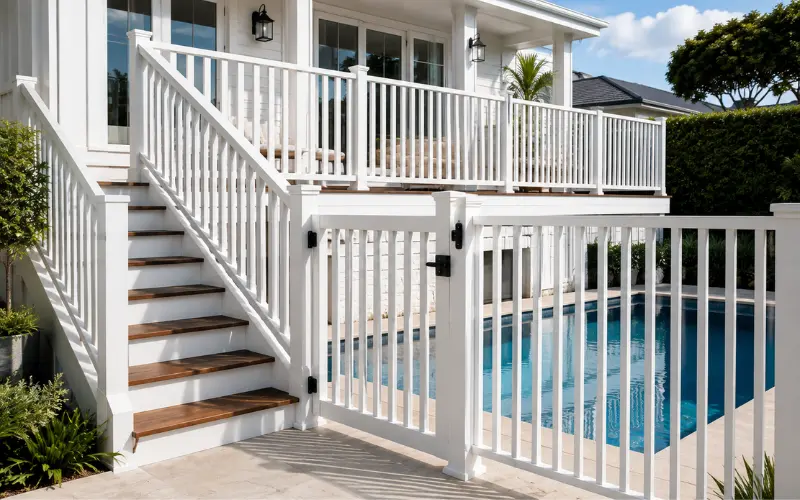
None of the competitor pages I reviewed for this topic mention the compliance side in any detail, which is a genuine gap given how many homeowners get caught out at final inspection.
Under the National Construction Code, a balustrade on any elevated area, including balconies and stairs, must not allow a 125mm sphere to pass through any gap. This applies to the spacing between pickets and to any gap under the bottom rail. If you are fencing a pool, the requirement is stricter again under AS1926.1, which also governs the height of the barrier, the “non-climbable zone” around it, and self-closing gate hardware.
A few practical points that get missed:
- Balustrade height must generally be at least 1000mm for balconies and decks over one metre off the ground.
- Pool barriers need a minimum height of 1200mm, measured from the finished ground level.
- Horizontal rails on a pool fence can actually work against you, since a child can use them as a foothold. This is why most hampton style pool balustrades use vertical pickets only, with no mid-rail.
- Local council requirements can add to the national baseline, so it is worth a quick call before ordering, particularly in bushfire zones where non-combustible materials may be mandatory.
Skipping this step is the single most common reason homeowners end up paying twice, once for the balustrade and again to modify it after a failed inspection.
Where Hampton Style Balustrades Work Best
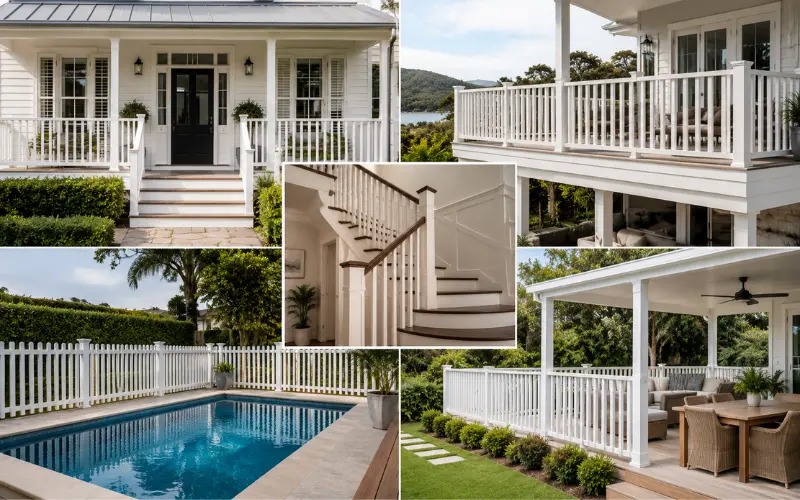
The style was originally developed for verandahs and porches, but in Australian homes it has expanded well beyond that.
Front verandahs and porches. This is the classic application, and it pairs naturally with a symmetrical facade, dark front door and manicured hedging.
Balconies and upper-level decks. A modern balcony railing built in hampton pickets softens what would otherwise be a very contemporary elevation, which is useful if you are renovating an older home with a newer addition.
Staircases. Internally, hampton style balustrades are almost always paired with a dark timber handrail and treads against white balusters and risers, the contrast is what reads as “coastal” rather than the white alone. This works equally well on a traditional staircase or a more sculptural curved staircase, because the picket rhythm carries the eye along the line of the stair regardless of shape.
Pool areas. As covered above, the vertical-only picket layout suits pool compliance while still giving the coastal look around a modern pool design.
Alfresco and outdoor living zones. Around a modern alfresco or a covered outdoor living space, the balustrade can double as a wind and privacy screen without fully blocking the garden view, which keeps the space feeling open rather than boxed in.
If your broader renovation is leaning into a full coastal home decor direction, the balustrade is usually one of the cheapest ways to commit to the look, since it is a relatively small material spend compared to cladding or roofing changes.
Colour Choices Beyond Plain White
Pure white (typically a Dulux or Colorbond equivalent to “Surfmist” or “Whitehaven”) is still the most requested finish, but it is not the only option that reads as authentically Hamptons.
- Off-white or oyster tones soften the contrast against a rendered facade and show less dust build-up than stark white in dry inland regions.
- Charcoal or black pickets against a white weatherboard home flip the traditional contrast and suit a more modern coastal build.
- Matching the window frames rather than the walls is a detail a lot of homeowners miss. If your windows are a soft grey or black, running the balustrade in the same tone ties the whole facade together far more convincingly than matching the wall colour.
Cost Expectations
Pricing varies by state and supplier, but as a rough guide, powder-coated aluminium hampton style balustrading in Australia typically runs from around $250 to $450 per linear metre installed, depending on picket profile, height, and whether the job includes stairs or angled sections, which cost more to fabricate than straight runs. Glass infill panels combined with a hampton-style aluminium frame will push the price higher again. Getting at least three quotes is worth the time, since fabrication and installation labour, not the raw material, usually accounts for the bigger share of the cost difference between suppliers.
Frequently Asked Questions
Is hampton style balustrade only suitable for coastal homes?
No. While it originated as a coastal look, it is now used across Federation homes, new-build estates and inland properties simply for its clean, classic appearance.
Can I install a hampton style balustrade myself?
Straight fence-line sections are sometimes DIY-friendly with a pre-fabricated kit, but any balustrade on a balcony, staircase or pool area should be professionally installed to meet National Construction Code and AS1926.1 compliance.
What is the difference between wide picket and square picket hampton balustrades?
Wide pickets are broader and suit heritage or larger homes, while square pickets are slimmer and better suited to contemporary or smaller-footprint builds.
Do hampton style balustrades rust in coastal areas?
Powder-coated aluminium does not rust, since aluminium naturally resists corrosion and the coating adds further protection against salt air.
How wide can the gaps be between pickets?
Under the National Construction Code, gaps must not allow a 125mm sphere to pass through, which generally limits picket spacing to around 100mm or less depending on picket width.
Can hampton style balustrades be used around a pool?
Yes, provided the design meets AS1926.1, which typically means vertical pickets only, no climbable horizontal rails, and a minimum 1200mm height.
How long does a powder-coated aluminium balustrade last?
Most suppliers warrant the powder coating for 10 to 15 years, with the aluminium frame itself lasting 20 years or more with basic upkeep.
Does a hampton style balustrade add resale value?
Real estate agents commonly cite improved street appeal and a more finished facade as a factor in faster sales, though the exact value impact varies by suburb and property type.

