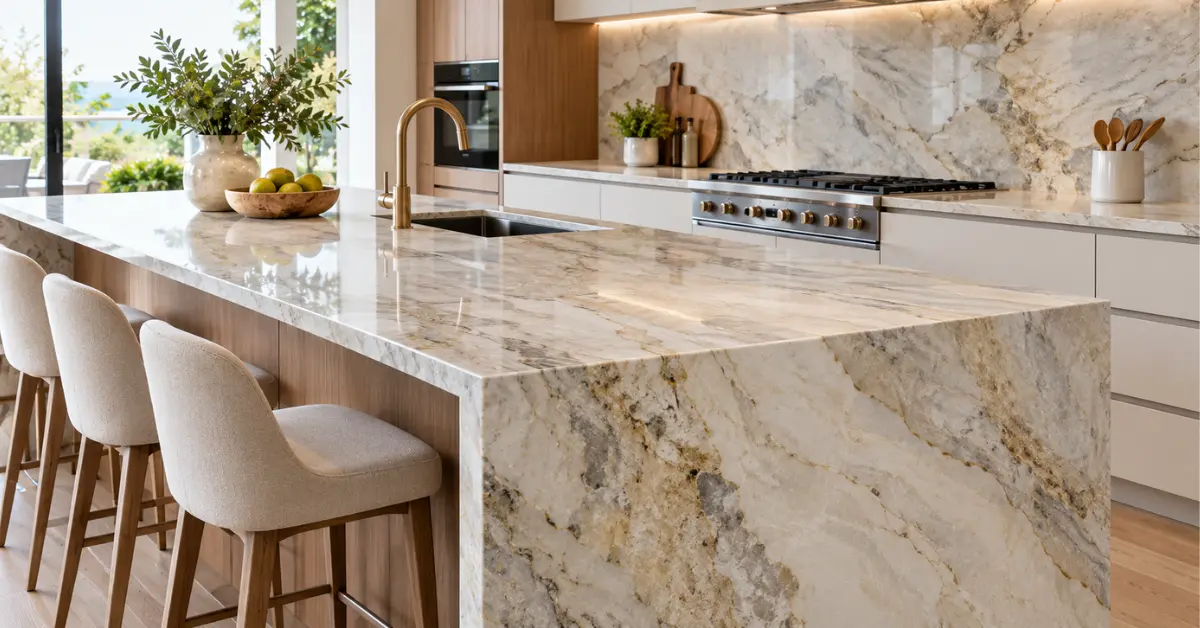
A quartzite benchtop is worth the extra cost if you want natural stone that handles heat, scratches and daily wear better than marble, and you’re happy to seal it once a year. Expect to pay roughly $450 to $900 per square metre installed in most Australian cities, which is above standard engineered stone but often below premium marble. If you want zero maintenance and a perfectly uniform look, it may not be the right fit.
What Actually Drives the Price
The slab is only part of the bill. Quartzite is dense and hard, so fabricators go through blades faster and charge more for cutting, polishing and edge work.
Here is what pushes a quote up or down:
- Slab rarity: Common whites and greys sit at the lower end. Rare colours with dramatic veining, like Taj Mahal or Fusion, can double the material cost.
- Slab size and wastage: Large veined slabs often need book-matching to look right, and that means buying extra.
- Edge profile: A simple 20 mm pencil edge costs far less than a mitred 40 mm waterfall.
- Cutouts: Sink, cooktop and tap holes add labour, and quartzite takes longer to cut than engineered stone.
- Location: Quartzite benchtop prices in Melbourne tend to be competitive because of high fabricator volume. In Perth, slab freight can add to the total, so quotes vary more from shop to shop.
My practical tip: Always ask for the slab number and visit the yard in person. Two slabs sold under the same name can look completely different. I have seen a “Taj Mahal” slab that was more beige than cream, and the buyer only noticed after installation.
Quartzite Benchtop Pros and Cons
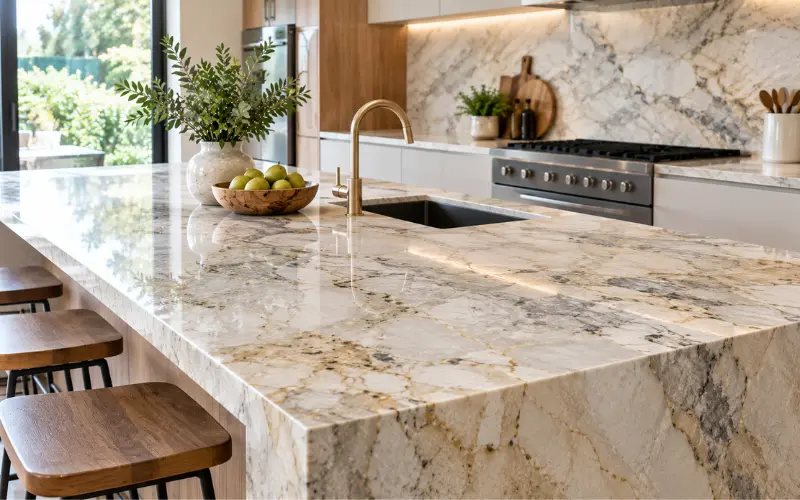
I tell clients to weigh these honestly before falling for a showroom sample.
Pros
- Excellent heat tolerance. A hot pan placed down by mistake is unlikely to leave a mark, though I still recommend a trivet.
- Very hard. It resists scratching better than marble and most granite.
- Real natural variation. No two slabs match, which gives your kitchen a one-off look.
- Good UV stability. It suits sunny kitchens and outdoor-facing benches better than many resin-based surfaces.
- Strong resale appeal. Buyers recognise natural stone as a premium feature.
Cons
- It needs sealing. Most slabs should be sealed at install and about once a year after.
- Higher upfront cost. Fabrication and slab pricing both run above entry-level engineered stone.
- Quality varies. Some stones sold as quartzite are actually soft dolomitic marble. More on that below.
- Limited colour range. You get whites, greys, creams, soft golds and a few dramatic darks, but not the endless palette of engineered options.
The Fake Quartzite Problem Most Guides Skip
This is the single most useful thing I can tell you. Some stones sold as quartzite behave like marble. They etch when lemon juice or vinegar touches the surface, and they scratch more easily than true quartzite.
You can run a quick test at the yard or at home on an offcut:
- Ask the supplier for a small sample piece.
- Put a few drops of lemon juice on the polished face.
- Leave it for 10 to 15 minutes, then wipe and check under bright light.
- A dull patch means the stone is likely a soft or calcareous variety.
- Also try scratching the sample with a steel knife tip. True quartzite should not mark.
Ask for the stone’s geological name and a written spec sheet. A reputable supplier will provide it without fuss.
Quartzite vs Marble Benchtop: Which One Suits Your Kitchen?
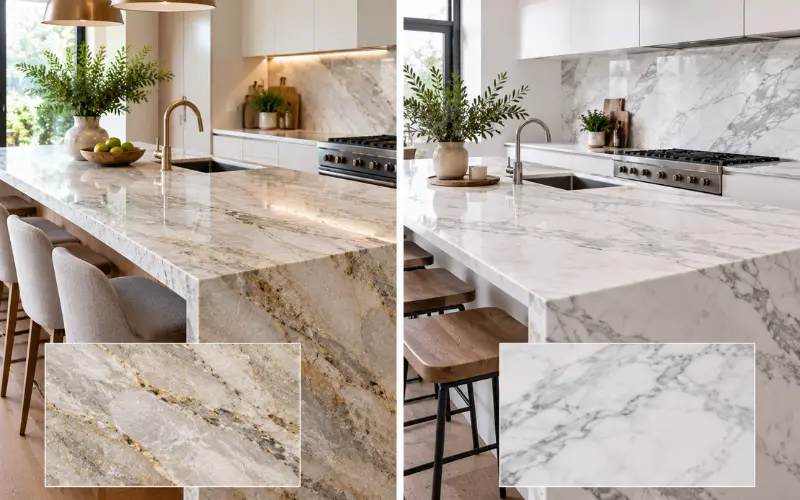
If you love the marble look but cook a lot, quartzite is the safer choice. Marble is calcium-based, so acids like tomato, wine and citrus will dull it over time. Some people accept that and call it patina. Others hate it.
Quartzite gives you similar soft veining with far better resistance to everyday splashes. If you already have a white kitchen with a grey stone bench, you might like seeing how a white kitchen with a grey stone benchtop comes together before picking your slab.
Quartzite Benchtop vs Engineered Stone
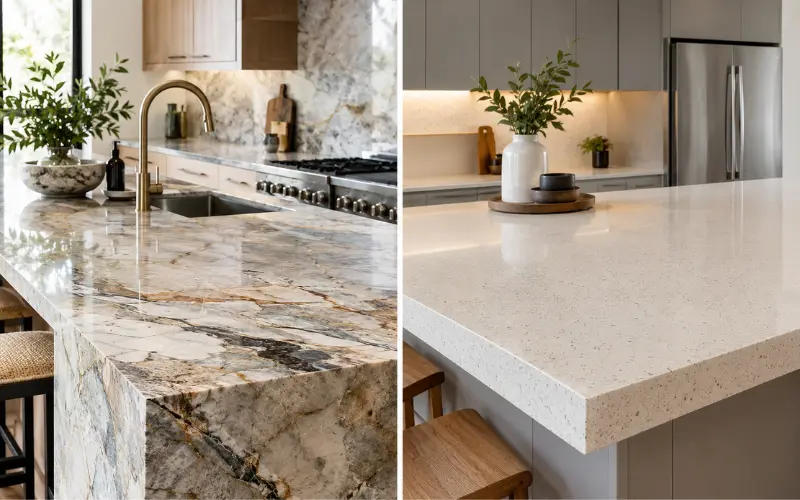
Engineered stone is cheaper, consistent and low-maintenance. Quartzite is natural, more heat tolerant and, in my experience, ages with more character. Safety is also a factor: engineered stone with high crystalline silica content has been subject to restrictions in Australia, so check current rules before you commit to anything in that category.
| Feature | Quartzite | Engineered Stone |
|---|---|---|
| Origin | Natural stone | Man-made (resin and stone) |
| Heat resistance | Very good | Moderate, resin can mark |
| Sealing needed | Yes, annually | Usually no |
| Appearance | Unique, veined | Uniform, predictable |
| Typical price | Mid to high | Low to mid |
| Best for | Statement kitchens, outdoor-facing benches | Budget builds, consistent colour runs |
Quartzite Benchtop Colours and the Taj Mahal Question
Most quartzite comes in white, grey, cream and soft gold. Darker options exist but are rarer and pricier.
Taj Mahal quartzite is the one everyone asks about. It has warm cream tones with soft grey veining and suits timber cabinetry, brass tapware and relaxed coastal or Hamptons styles. If you’re planning timber details, awesome timber floors can help you judge how warm and cool tones play together.
Always view slabs in daylight. Showroom spotlights flatter stone and hide undertones that appear in your own kitchen.
How to Care for Quartzite So It Lasts
Good care is simple, and it protects your investment.
- Seal on install, then reseal about once a year. Test by dropping water on the surface: if it beads, you’re fine. If it soaks in within a few minutes, reseal.
- Use pH-neutral cleaner. Skip bleach, vinegar and abrasive powders.
- Wipe spills quickly, especially oil, wine and coffee.
- Use chopping boards. Quartzite won’t be harmed by your knife, but your knife will go blunt.
For a full routine, this guide on how to clean stone bench tops covers products and technique.
So, Is Quartzite Benchtops Worth the Extra Cost?
It is worth it in these situations:
- You cook heavily and want a surface that tolerates heat and daily use.
- You want natural stone with marble-like looks but fewer worries.
- You plan to stay in the home long enough to enjoy it.
It is probably not worth it if:
- You want the cheapest possible upgrade.
- You hate the idea of annual sealing.
- You need a perfectly uniform colour across a large kitchen.
My view: For a family kitchen where looks and durability both matter, true quartzite is the best balance I’ve found. Just verify the stone first.
FAQ
1. How long does a quartzite benchtop last?
With proper sealing and reasonable care, it can last for decades. The stone itself is extremely durable, so the sealer is the only part that needs refreshing.
2. Does quartzite stain easily?
It is naturally low-porosity, but not stain-proof. Unsealed slabs can absorb oil and red wine. Sealing solves most of the risk.
3. Can I put a hot pan straight onto quartzite?
It handles heat well, but I’d still use a trivet. Sudden temperature shocks can stress any stone, and sealers can discolour.
4. Is quartzite harder than granite?
Generally yes, true quartzite ranks slightly harder, which is why it resists scratching so well.
5. Can quartzite be used outdoors?
Yes. It tolerates UV and temperature swings better than many engineered surfaces, which makes it suitable for covered alfresco kitchens.
6. How much extra does a waterfall edge cost on quartzite?
Expect a noticeable premium, since it requires mitred joins and extra slab. Request an itemised quote so you can see exactly what it adds.
7. Does quartzite need special cleaning products?
Use a pH-neutral stone cleaner or mild soapy water. Avoid acids and harsh abrasives.
8. Can I mix quartzite with other stone in the same kitchen?
Yes, many people use quartzite on the island and a quieter stone on the perimeter. If you’re planning a bench layout, a kitchen peninsula is a good place to feature a statement slab.