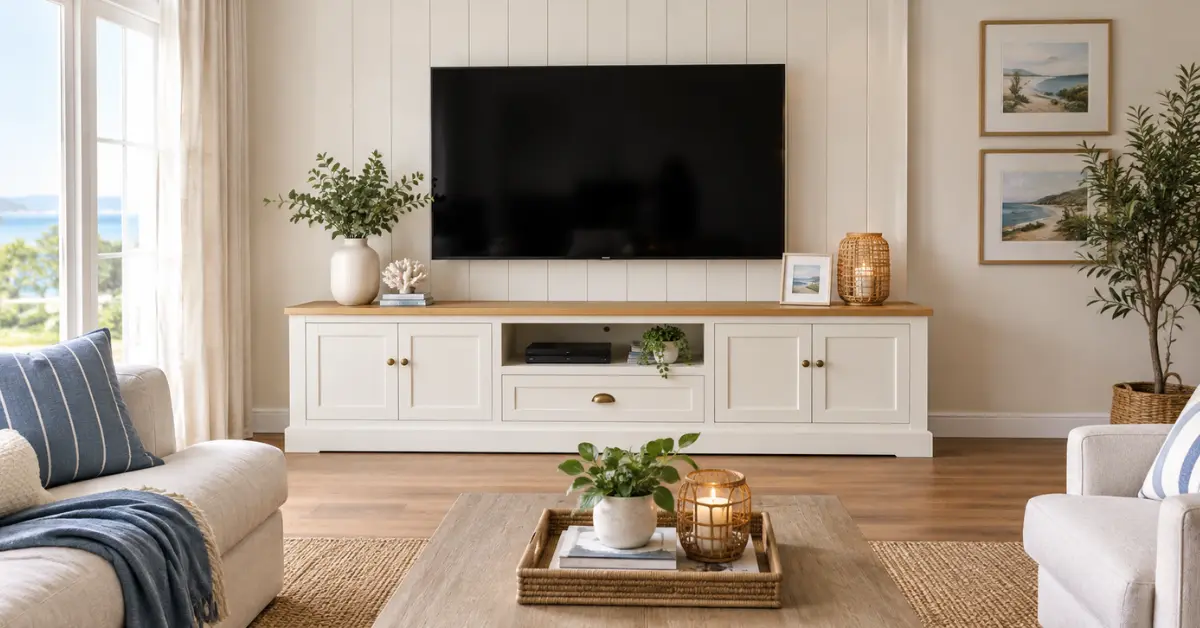
Yes, a Hamptons style entertainment unit is still on trend in Australian homes in 2026, but the version selling well now is warmer and less formal than the stark white-and-grey look from ten years ago. Shaker doors, generous storage and a light palette still carry the style, while buyers are shifting toward off-white or greige bodies, visible timber tops and quieter hardware. The pieces that date fastest are the ones treated as pure decoration rather than furniture built for daily use.
Why This Style Has Not Faded Out
Trends in furniture rarely die outright. They get edited. The Hamptons Style Entertainment Unit has survived because it solves a real problem that has nothing to do with fashion: modern lounge rooms are full of gear that nobody wants to look at.
Streaming boxes, gaming consoles, soundbars, routers, chargers and the odd stack of board games all need somewhere to live. A unit with closed cupboards handles that job better than open shelving or a slab-style floating console, which is why the style keeps reappearing in project briefs even when clients say they want something “more modern.”
What has actually shifted is formality. A decade ago, Hamptons meant bright white, heavy cornicing, brass everything and a strict coastal theme. Buyers now want the bones of that look (the panelled doors, the calm palette, the classic proportions) without the room reading as a themed beach house. That is a styling change, not a rejection of the style.
A quick reality check from site visits: clients who bought a heavily ornate Hamptons unit in 2015 are the ones asking to replace it now. Clients who bought a plainer, better-built version from the same era are usually just changing the handles.
What Separates a Current Piece From a Dated One
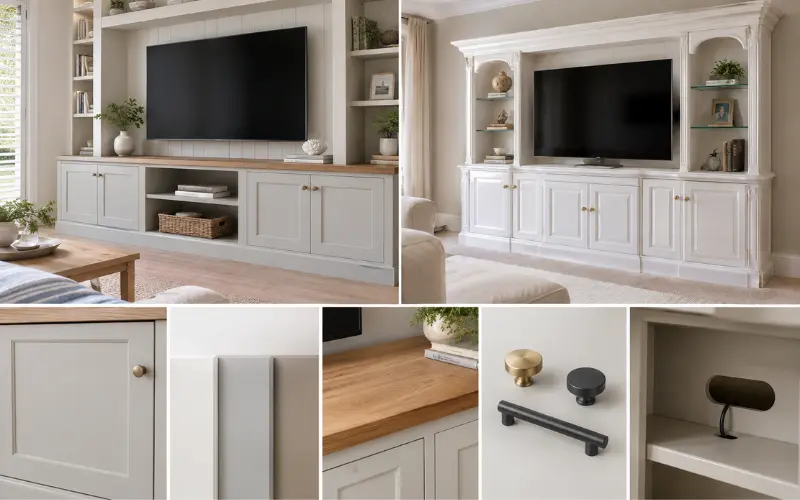
Not every white cupboard with a rectangle cut out for the TV counts as Hamptons, and not every Hamptons Style Entertainment Unit piece still looks right in 2026. The details that hold up:
- Simple shaker or recessed-panel doors, not heavy beading or carved trim
- A warm white, soft grey or greige body rather than stark brilliant white
- A timber top or timber accent to break up an all-painted look
- Understated hardware in brushed brass, pewter or matte black, matched to your existing door and tap hardware rather than bought in isolation
- Rear cable cut-outs built into the design, not drilled in as an afterthought
The pieces that read as dated tend to overdo two or three of these at once: full gloss white, ornate brass knobs and a heavily moulded cornice on top. One strong detail reads as classic. Four strong details together read as a theme.
Sizing for an Australian Lounge Room
This is where a lot of buyers guess and get it wrong, then wonder why the finished room feels off.
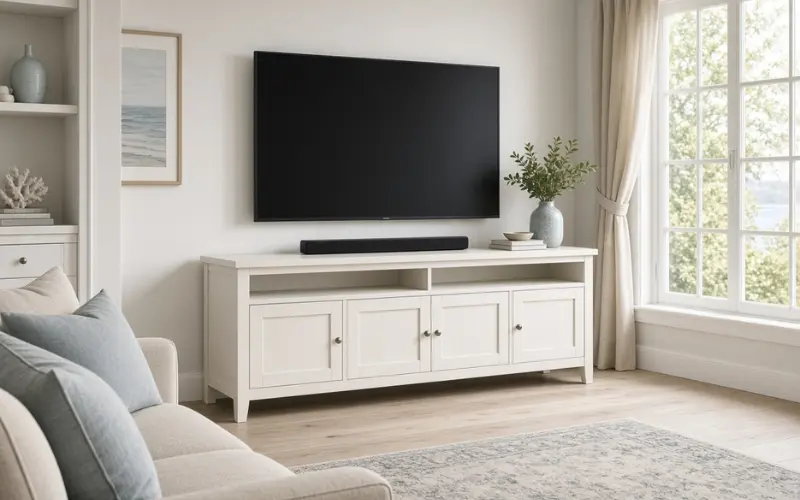
Work from the television, not the wall. A Hamptons Style Entertainment Unit should sit at least 10 to 15 centimetres wider than the screen on each side. For a common 65-inch television, that puts you in the 160 to 200 centimetre range for a freestanding piece. Depth of 40 to 45 centimetres is usually enough for a soundbar and a games console without the unit eating into walking space.
Height is a viewing comfort issue, not just a style one. If the television sits on top of the unit, aim for a cabinet height of 45 to 60 centimetres so the screen centre lands roughly at seated eye level. If the screen is wall-mounted, the unit can sit lower and work purely as a media console.
One detail competitors rarely mention: check the manufacturer’s weight rating, not just the shelf dimensions. A soundbar plus a 65-inch television can sit close to the unit’s stated load limit on cheaper particleboard tops. A rating of 50 kilograms or more gives you a safer margin.
Built-In, Freestanding or Wall-Mounted
| Best for | Watch out for | |
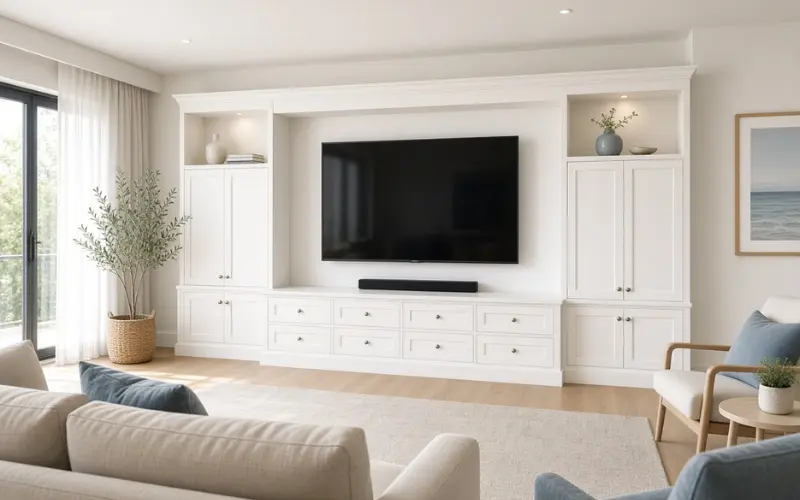
| Built-in | Awkward walls, renovations, maximum concealed storage | Higher cost, harder to change later |
| Freestanding | Renters, anyone likely to move house | Can leave dead wall space either side |
| Wall-mounted console | Small rooms, easier floor cleaning | Needs proper wall fixing for the TV bracket |
A built-in wall of joinery gives the strongest architectural result and hides cabling permanently, which matters if you are renovating anyway. If you want to see how that looks in practice, a built-in TV cabinet approach combines closed storage with a display niche rather than one long bank of doors.
Freestanding units remain the more common choice simply because most Australians rent or move within a decade. A well-proportioned freestanding piece that runs close to wall-to-wall can look almost as integrated, provided the styling either side is kept simple.
Materials That Actually Hold Up Here
Climate matters more than most buying guides admit. Coastal humidity from Cairns down to the Mornington Peninsula puts real stress on cheap particleboard, especially around the base where moisture from mopping or condensation collects.
Solid timber or a properly sealed timber veneer copes better over years of use than an untreated or thinly laminated surface. Ask specifically what the carcass, door faces and top are made from. “Timber look” and “solid timber” get used interchangeably in listings, and the difference shows up in year three, not on delivery day.
Inland and in drier states, sun exposure is the bigger risk. A unit positioned under a north-facing window can visibly yellow or fade within a couple of years if the finish is not UV stable. Positioning the piece out of direct afternoon sun is often a more effective fix than paying extra for a premium finish.
The Storage Planning Step Most People Skip
Before choosing a colour or handle style, list everything that actually needs to live inside the unit: console, modem, remotes, cables, board games, children’s devices. Then check ventilation. Electronics generate heat, and a fully sealed cupboard with no airflow can shorten the life of a router or games console sitting inside it for years at a time.
Good Hamptons Style Entertainment Unit now include rear cable cut-outs as standard, which stops the tangle of leads behind the TV from undoing all the visual calm the style is meant to create. If you are buying secondhand or having a piece custom made, confirm this detail specifically rather than assuming it.
Field note: the single upgrade that ages a Hamptons unit best is not the paint colour. It is soft-close hinges and solid drawer runners. Cheap runners sag within two or three years of daily use, and it is the first thing that makes an otherwise good-looking piece feel low quality.
Styling It Without Making the Room Look Staged
The fastest way to make a Hamptons Style Entertainment Unit feel current is restraint. Keep the top mostly clear so the television stays the visual anchor, then add two or three considered objects: a ceramic vase, a stack of hardcover books, one framed print. Perfect symmetry is optional. Slightly uneven groupings usually read as more lived-in than a matched pair on either side.
Resist filling every open shelf with coastal props. Nautical rope, matching blue-and-white ceramics and shell arrangements are what push a room from “classic” into “themed,” and themed rooms date the fastest of all. If you want the relaxed side of the look without the cliché, these coastal home decor ideas lean on texture and timber rather than motifs.
For smaller apartments or terraces, a 120 to 150 centimetre unit paired with a wall-mounted TV unit approach keeps the floor area open while still carrying the Hamptons detailing on a smaller footprint.
What It Actually Costs in Australia
Entry-level particleboard versions from major retailers start around $200 to $400. Mid-range pieces with better hardware and a timber top typically run $800 to $2,500. Custom or solid-timber Australian-made units usually sit between $2,500 and $5,000, more for full built-in joinery. Local makers in the major cities often have shorter lead times than imported pieces, and it is worth confirming delivery access through hallways and doorways before ordering anything over 180 centimetres wide.
Is It Worth Buying Now?
If the room needs storage as much as style, yes. A well-proportioned Hamptons Style Entertainment Unit with plain doors, a decent timber top and proper hardware is one of the few furniture styles that moves with a room rather than against it. Change the sofa, repaint the walls, swap the rug, and the cabinet still works. That flexibility is the real reason it has outlasted plenty of trends that arrived after it.
FAQ’s on Hamptons Style Entertainment Unit
Will a Hamptons Style Entertainment Unit clash with a modern black television?
No. The contrast usually works in the room’s favour. A plain white or timber-topped cabinet with a large black screen reads as a deliberate pairing rather than a clash, provided the hardware and styling around it stay simple.
Do I need matching furniture elsewhere in the room?
No. Coordinating the finish family, such as white, soft grey or light timber, and the hardware tone is enough. Matching every piece in the room to the cabinet tends to look like a showroom rather than a home.
Can a rental property still use this style without permanent changes?
Yes. A freestanding unit delivers the full look without any wall work. Renters generally get more resale flexibility from freestanding pieces than built-in joinery anyway.
Is glass-front cabinetry a good idea for families?
It depends on upkeep tolerance. Glass fronts show fingerprints and dust faster than solid doors, and in a busy household with children or pets, solid doors are usually the lower-maintenance choice.
What is the safest way to secure a freestanding unit against tipping?
Use the wall anchoring strap or bracket that should come with the unit, especially in homes with young children. This is a genuine safety step, not an optional extra, and it is required under Australian furniture stability guidance for larger pieces.
Does a two-tone unit (white body, timber top) look busy next to timber flooring?
Not if the timber tones relate to each other. Match the warmth of the top to the floor rather than trying to match the exact species. Two complementary timber tones in a room generally look more deliberate than three or four unrelated ones.
How do I stop the cabinet from looking too “beachy”?
Drop the nautical props. Keep the cabinetry detail, then style around it with plain linen, contemporary lighting and one or two muted accessories rather than shells, rope or striped textiles.
Is it better to buy off the shelf or have one custom made?
Off-the-shelf suits standard wall widths and faster timelines. Custom joinery is worth the extra cost when the wall is an unusual width, you need built-in ventilation for a large amount of equipment, or you want the piece to match existing skirting and cornices exactly.