
Assemble Homewares Australia pieces work best when you match the material, size and finish to how you actually use the space, not just how the product photo looks. Before buying, check the exact dimensions, the care instructions and whether the item does a real job in your home, whether that’s serving food, holding storage or adding a colour accent that ties a room together.
Why Collection Pages Alone Won’t Help You Choose Well
Search “Assemble Homewares Australia” and most of what comes back is retailer collection pages: Three Girls, Wile Away, LivingStyles, Victoria’s Basement, Cavania, Minimax and similar stockists all list the range, sorted by category or price. That’s useful if you already know what you want. It’s not much help if you’re standing in your kitchen wondering whether a resin platter or a ceramic bowl actually solves your problem.
A collection page shows you what exists. It doesn’t tell you whether a 46cm platter will swallow your dining table, whether a timber grinder can survive next to your cooktop, or whether the “coastal green” resin in the photo will look washed out under your kitchen downlights. That’s the gap worth filling here.
What the Assemble Range Actually Covers
Assemble Homewares Australia line spans ceramics, resin, glass, timber and a handful of woven or textile pieces. Each material has a different job:
- Ceramics (mugs, bowls, platters, oil bottles, brie bakers) in muted earthy tones like cocoa, olive and nougat, good for daily use and dishwasher-friendly in most cases, though not always.
- Resin (larger platters, trays, coasters, decorative bowls) in pistachio, sage, terracotta and charcoal, lightweight and shatter-resistant compared with ceramic or glass.
- Glass (butter dishes, jugs, egg trays, small vases) for a lighter visual accent.
- Timber (salt and pepper grinders, boards) for warmth against stone or stainless benchtops.
None of these materials behave the same way once they’re in daily use, and that’s where most buying mistakes happen.
Resin: The Piece That Gets Misunderstood Most Often
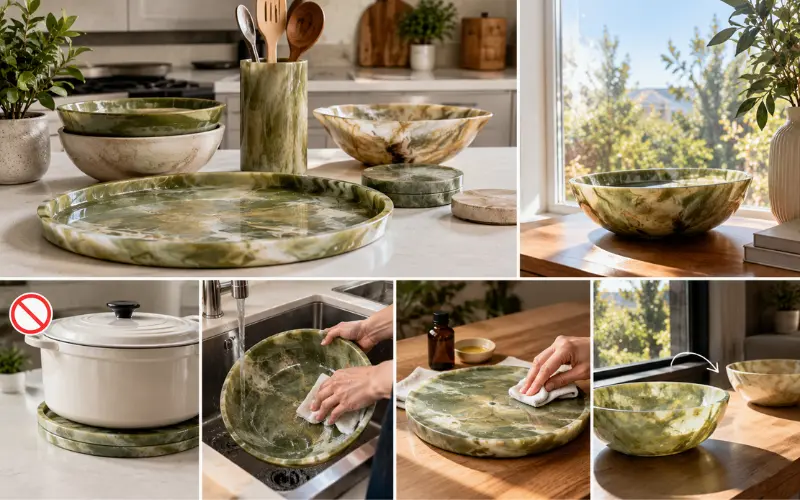
Resin is the material Assemble Homewares Australia is best known for locally, and it’s also the one people treat too casually. Good resin has a hand-poured, slightly marbled look where no two pieces are identical. It handles knocks far better than ceramic or glass, which makes it a genuinely sensible choice for busy kitchens, young families or anyone who entertains outdoors on the alfresco.
It does have limits though. Resin is a cold or room-temperature material. Don’t put a hot casserole dish straight onto a resin trivet expecting it to behave like stone, and skip the dishwasher entirely. Hand wash in lukewarm water, dry immediately and if the surface starts looking a bit dull after a few months, a drop of food-safe mineral or coconut oil buffed in with a soft cloth brings the sheen back.
Sun exposure matters more than most buyers expect. A resin bowl sitting in a north-facing window through an Australian summer can fade or dull faster than the same piece kept on a shaded sideboard. If your living room gets harsh afternoon light, rotate decorative resin pieces or keep them a metre or two back from the glass.
Matching Materials to Australian Timbers and Interiors
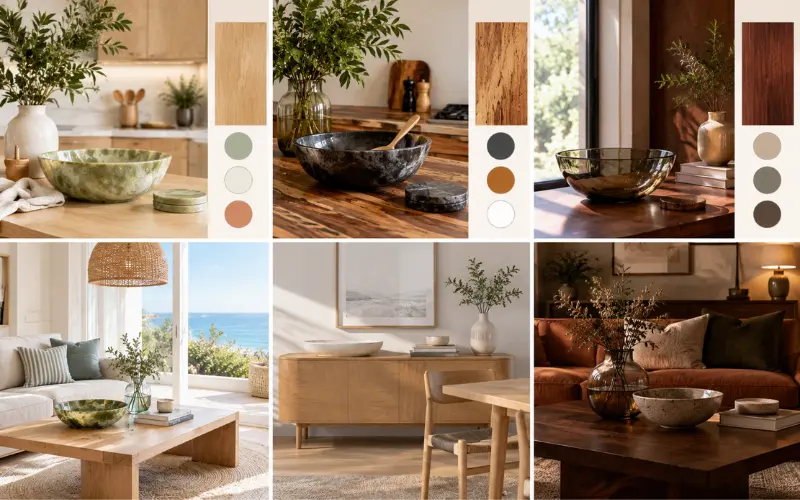
This is where a lot of styling advice online falls flat: it talks about colour without talking about undertone, and undertone is what actually makes a piece look intentional rather than randomly placed.
- Tasmanian Oak and light ash benchtops or flooring pair well with sage, cream or soft terracotta resin. The pale, straw-toned timber lets a pastel accent stand out instead of getting lost.
- Spotted Gum and Blackbutt, with their busier grain, need a grounding colour like charcoal, warm amber or crisp white rather than another patterned piece competing for attention.
- Jarrah and dark walnut benefit from warm beige or translucent smoke tones in resin or glass, which soften the depth of the red-brown timber instead of fighting it.
If your home already leans coastal, olive and sea-glass tones in resin or glass sit naturally alongside timber and linen. For a more minimalist or Scandinavian-leaning room, the nougat and cocoa ceramics stay quiet enough not to compete with clean lines. For broader direction on tying a whole room together rather than just one shelf, home décor in Australia covers the wider styling logic that a single homeware purchase sits inside.
A Buying Checklist That Actually Prevents Regret
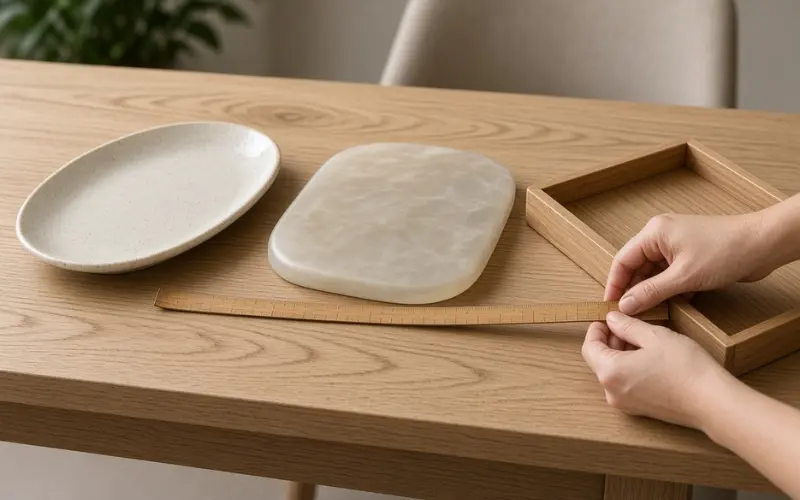
Run through this before adding anything to your cart, not after it arrives.
| What to check | Why it matters |
|---|---|
| Exact dimensions | Product photos routinely make items look bigger or smaller than they are |
| Material and finish | Determines cleaning method, durability and where it can safely live |
| Intended use | A “serving” label doesn’t automatically mean dishwasher-safe or heat-safe |
| Care instructions | Resin, timber and glazed ceramic each need different handling |
| Colour undertone | Cool grey resin can look flat against warm timber, and vice versa |
| Stock and delivery window | Fragile or collection-only items need extra lead time |
| Returns policy | Especially important for sale, clearance or fragile stock |
The dimensions line trips people up most. A platter listed as “medium” can still be 35cm to 40cm across, which is a lot of real estate on a standard four-seat dining table. Measure the actual surface before you buy, not after the box arrives.
Choosing by Room, Not by Colour
Kitchen and island bench: put the resin fruit bowl or ceramic vessel where it earns its space, holding actual fruit, keys or loose bits rather than sitting empty as decoration. Leave at least 30cm of clear bench around it so it doesn’t compete with prep space. If your kitchen storage is already tight, sorting that out first with something like a corner pantry or better kitchen cabinet hardware makes more difference to daily function than another decorative bowl.
Dining table: a low, wide platter works better than a tall centrepiece because guests need to see across the table and reach serving dishes without shuffling things aside constantly.
Bathroom and laundry: resin’s water resistance actually suits wet areas better than timber or unglazed ceramic. Small trays for rings, soap or perfume handle humidity without the swelling or corrosion risk that timber and untreated metal face. If you’re planning a fuller refresh, bathroom and laundry renovations and standard height for bathroom vanity cover the fixed elements worth sorting before the decorative layer.
Outdoor and alfresco: resin serving trays move easily between the kitchen and a covered patio and tolerate temperature swings far better than fine ceramic. Bring pieces back indoors after use rather than leaving them out permanently. If you’re building out that space, covered outdoor living space ideas and an outdoor privacy screen are worth looking at alongside the styling.
Building a Small Collection Instead of a Full Set
You don’t need every colourway in the range. Three or four well-chosen pieces, a pair of mugs, one serving platter and one smaller decorative bowl, usually cover more real use than a matching twelve-piece set that half sits in a cupboard.
Start with what you’ll actually reach for weekly. Add a statement piece only once you know it has a genuine spot. This is also where mixing brands works in your favour: Assemble’s neutral earthy palette sits comfortably next to items you already own, so you’re not locked into buying the whole collection to make one shelf look finished. If you like combining new pieces with older or handmade finds, handmade wood home décor is a useful companion read for that mixed approach.
Three Mistakes Worth Avoiding
Buying purely by colour. A shade that looks perfect on screen can clash with your benchtop or flooring undertone in person. Check it against a photo of your actual room if you can’t see the item in store.
Assuming every piece in a range shares the same care rules. Ceramic, resin, timber and glass in the same collection each have different heat, water and cleaning limits. Read the specific product page, not the category description.
Overfilling the surface. An empty patch of bench or shelf isn’t a styling failure. It gives the pieces you did choose somewhere to be seen properly, which matters more than cramming in every accessory that catches your eye.
Frequently Asked Questions
Is Assemble Homewares Australia made?
Don’t assume it based on where you’re shopping. Country of origin varies by product line, so check the individual listing or packaging rather than relying on the retailer’s location.
Where can I buy Assemble Homewares Australia?
Multiple homewares retailers list the range, including Three Girls, Wile Away, LivingStyles, Victoria’s Basement, Cavania and Minimax. Stock, pricing and colourways differ between them, so compare the exact product before assuming one retailer is cheaper overall.
Can Assemble Homewares Australia resin pieces go in the dishwasher?
No. Hand wash in lukewarm water and dry straight away. Dishwasher heat can warp or dull the resin finish over time.
Are Assemble ceramics oven or microwave safe?
It depends on the specific glaze and piece, not the collection as a whole. Check the product page or base markings rather than assuming everything in the range behaves the same way.
How do I stop resin Assemble Homewares Australia fading in Australian sun?
Keep them out of direct, prolonged sunlight, particularly through unshaded north-facing glass. Rotating a piece occasionally or moving it a metre back from the window slows fading noticeably.
What size platter suits a standard Australian dining table?
Somewhere between 35cm and 46cm generally leaves enough clear space for plates and movement without dominating a four to six seat table. Measure your table before ordering.
Can I mix Assemble Homewares Australia pieces with other brands?
Yes, and it’s usually the better approach. The neutral, earthy palette is designed to sit alongside timber, stone and other everyday tableware rather than requiring a full matching set.
Is resin homeware suitable for permanent outdoor use?
Not ideally. It handles occasional outdoor entertaining well, but continuous sun and rain exposure will dull or discolour it faster than indoor use. Bring pieces in after gatherings.

