
Swapping out kitchen cabinet hardware is one of the fastest ways to change how a kitchen feels. You do not need a full remodel to get a fresh look. A few new knobs or pulls can turn tired cabinets into something that feels current and cared for, often in a single weekend.
This guide goes beyond the usual style roundup. You will find real sizing numbers, placement measurements, cost ranges, and installation tips that most articles skip. By the end, you will know exactly what to buy, where to put it, and how to make it last.
What Counts as Kitchen Cabinet Hardware
Kitchen cabinet hardware refers to the knobs, pulls, handles, and hinges attached to your cabinet doors and drawers. It includes:
- Knobs: Small, round or geometric shapes with a single mounting hole.
- Pulls (handles): Longer pieces with two mounting holes, common on drawers.
- Cup pulls: Curved handles that sit flush against the drawer front.
- Backplates: Decorative plates placed behind a knob to add detail.
- Hinges: Often overlooked, but visible hinges on shaker or glass front cabinets count as hardware too.
Choosing the right combination shapes the whole personality of your kitchen, so it pays to think it through rather than grabbing the first set you see in a store.
Popular Finishes and What They Say About Your Kitchen
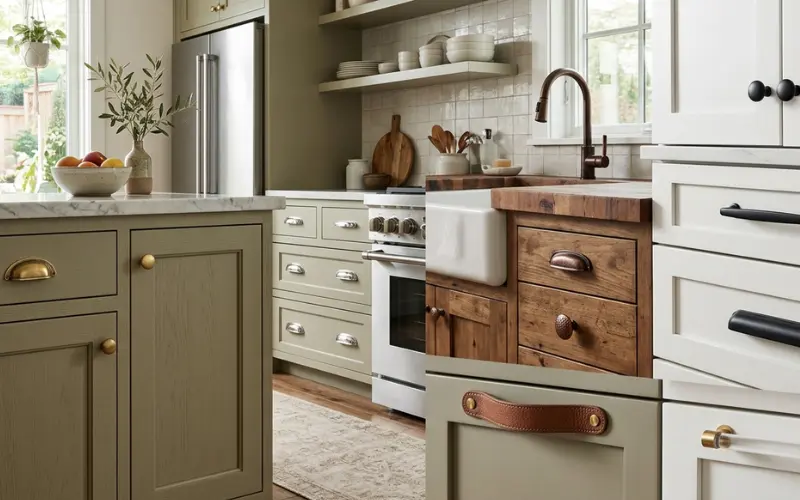
Finish choice affects mood as much as style. Here is what each popular option brings to a room.
Brass and gold tones Warm metals like unlacquered brass and brushed gold add a soft glow that works well against white, navy, or sage cabinets. Unlacquered brass will darken and develop a patina over time, which many homeowners actually prefer for the character it adds.
Matte black Matte black hardware creates sharp, graphic contrast. It reads modern on light cabinets and moody on dark ones, and it hides fingerprints better than shiny finishes.
Satin nickel and chrome These cooler metals pair naturally with stainless steel appliances. Satin nickel has a soft, brushed look, while chrome is brighter and more reflective.
Copper and bronze Deeper and more rustic than brass, these finishes suit traditional and transitional kitchens that want warmth without shine.
Unexpected materials Leather pulls, ceramic knobs, and lucite handles are gaining ground for kitchens that want texture instead of another metal finish.
Knobs vs Pulls: Which One Fits Your Cabinets
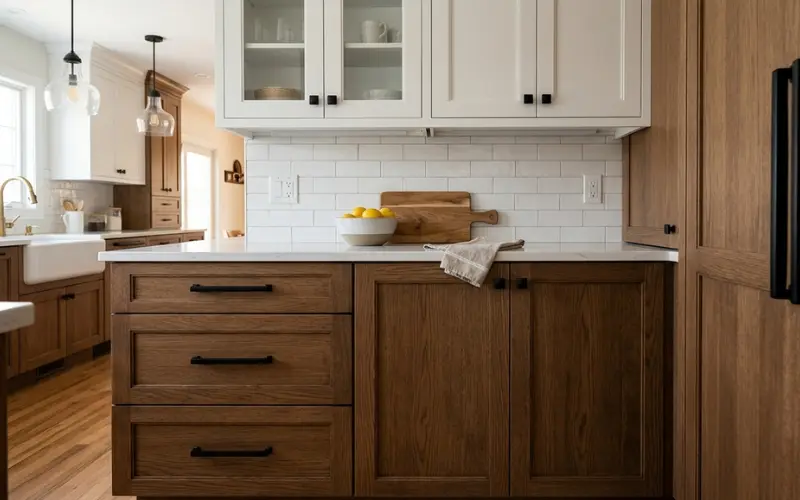
A common question homeowners ask is whether to use knobs, pulls, or both. Here is a simple rule that designers actually follow:
- Use knobs on doors where a small grip point is enough.
- Use pulls on drawers, especially wider ones, because a longer handle spreads the pulling force and puts less strain on the drawer box over time.
- On tall or heavy pantry cabinets, a pull gives you better leverage than a knob.
- If you prefer a uniform look, pulls can be used everywhere, including doors, for a clean, linear appearance.
There is no rule that says you must match every knob to every pull exactly. Many well designed kitchens use one finish across two different shapes.
Sizing and Placement: The Numbers Most Guides Skip
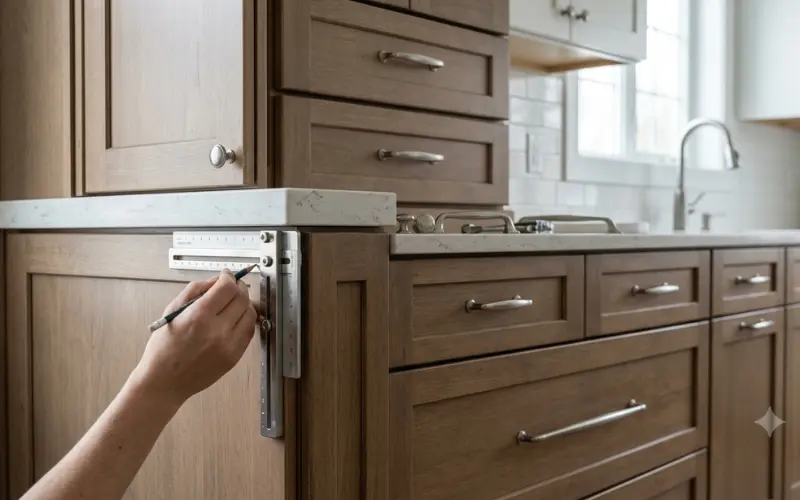
This is where a lot of kitchen cabinet hardware choices go wrong, not because of style, but because of measurement. Get these numbers right and your kitchen will look professionally finished.
Standard sizes
- Knobs typically range from 1 to 1.5 inches in diameter.
- Pulls for doors usually run 3 to 5 inches long.
- Pulls for drawers scale with the drawer width: 3 to 4 inches for small drawers, 5 to 8 inches for standard drawers, and 8 to 12 inches or more for wide drawers.
Placement guidelines
- On upper cabinet doors, place the knob or pull in the bottom corner nearest the counter.
- On lower cabinet doors, place it in the top corner nearest the counter, so everything sits at a comfortable reach height.
- Center pulls horizontally on drawer fronts, roughly 1 to 1.5 inches down from the top edge.
- Keep placement consistent from cabinet to cabinet. Even a quarter inch difference becomes noticeable once the whole kitchen is installed.
A simple installation jig, sold for under twenty dollars at most hardware stores, keeps every hole aligned and saves you from patching mistakes later.
Mixing Metals Without It Looking Messy
Mixing finishes has become one of the more popular kitchen cabinet hardware moves in recent kitchens, but it works best with a plan.
- Pick one dominant metal and one accent metal, not three or four.
- Repeat the accent metal somewhere else in the room, such as the faucet or light fixtures, so it feels intentional.
- Keep the same finish within a single zone, like all the island cabinets, even if the perimeter uses something different.
- Warm and cool metals can sit together nicely when the undertones do not compete, for example brass with matte black rather than brass with chrome.
What Kitchen Cabinet Hardware Costs
Budget expectations vary widely, so here is a realistic breakdown:
- Budget knobs and pulls: $2 to $8 each, typically stamped steel or zinc alloy.
- Mid-range hardware: $8 to $20 each, often solid brass or zinc with a quality plated finish.
- High-end or designer hardware: $20 to $60 or more per piece, usually solid brass, bronze, or hand finished designs.
For an average kitchen with 20 to 30 pieces, expect to spend anywhere from $100 for budget options to $1,000 or more for premium hardware. Buying directly from a manufacturer rather than a big box retailer can sometimes lower the per piece cost on bulk orders.
DIY Installation: A Quick, Practical Walkthrough
Replacing kitchen cabinet hardware is a manageable weekend project. Here is the process:
- Remove old hardware and fill existing holes with wood filler if the new hardware does not line up.
- Measure and mark new hole locations using a template or jig.
- Drill pilot holes slightly smaller than the screw diameter to avoid splitting the wood.
- Attach the new knob or pull with the included screws, checking that it sits flush and does not wobble.
- Step back after every few cabinets to check alignment across the whole run.
If your drawers or doors have existing holes in a nonstandard spacing, look for pulls sold in that exact center to center measurement rather than forcing a mismatched size.
Matching Hardware to Your Cabinet Style
- Shaker cabinets: Simple bar pulls or round knobs in brass, black, or nickel.
- Modern flat panel cabinets: Slim, linear pulls or integrated finger pulls for a seamless look.
- Traditional or ornate cabinets: Detailed knobs, backplates, and cup pulls with more decorative shaping.
- Farmhouse kitchens: Ceramic or matte black knobs paired with simple bin pulls.
Caring for Your Hardware
- Wipe kitchen cabinet hardware with a soft, damp cloth and mild soap to remove grease.
- Avoid abrasive cleaners on lacquered finishes, since they can strip the protective coating.
- Let unlacquered brass age naturally if you like a living, patina finish, or apply a light coat of wax to slow the process.
- Check screws periodically, since daily use can loosen them over time.
Common Mistakes to Avoid
- Choosing your kitchen cabinet hardware before finalizing cabinet color, which can make finishes clash.
- Ignoring the weight and size of drawers when picking knobs instead of pulls.
- Ordering online without measuring existing holes first.
- Overcrowding a kitchen with too many finishes at once.
Frequently Asked Questions
How many pieces of kitchen cabinet hardware do I need for an average kitchen?
Most kitchens need between 20 and 40 pieces, depending on the number of doors and drawers. Count each door and drawer individually before ordering.
What is the standard hole spacing for cabinet pulls?
Common spacing options are 3, 3.75, 4, 5, and 8 inches, measured center to center between the two screw holes.
Can I mix knobs and pulls in the same kitchen?
Yes. A popular approach uses knobs on doors and pulls on drawers within the same finish for a cohesive look.
Do I need to fill old holes when installing new hardware?
Only if the new hole spacing does not match the old one. Matching spacing lets you reuse existing holes.
What finish hides fingerprints best?
Matte black and oil rubbed bronze both hide smudges and fingerprints better than polished chrome or brass.
Is unlacquered brass hard to maintain?
Not really. It simply changes color over time as it patinas, which many homeowners consider part of its charm rather than a flaw.
Should hardware match my faucet and lighting?
It should complement rather than match exactly. Repeating a metal tone in at least one other fixture ties the room together.
What tools do I need to install new kitchen cabinet hardware myself?
A drill, a tape measure or installation jig, a screwdriver, and wood filler for any old holes that need patching.
Final Thoughts
Kitchen cabinet hardware is a small detail with a big visual payoff. Getting the finish, size, and placement right turns simple cabinets into a kitchen that feels finished and personal. Take your time with measurements, choose a finish that matches your daily life, and the results will hold up for years to come.

