
KD Archistyle is not a formally recognized architectural movement taught in design schools or documented in architecture history. It’s a term that gained traction online, mostly through blog content, to describe a loose set of design traits: natural materials, open layouts, restrained ornamentation, and a strong connection between indoor and outdoor space. If you’re searching for it, you’re likely looking for practical design inspiration rather than a textbook definition, and that’s exactly what this guide covers.
Where the Term Actually Comes From
Search “KD Archistyle” and you’ll find dozens of articles repeating the same phrase without ever pointing to a specific architect, firm history, or built project you can verify. That’s worth knowing upfront.
There’s no evidence of a founding architect, a school of design, or a documented body of work behind the name. What exists instead is a cluster of content sites using the phrase as a branded label for a mood board of ideas borrowed from established styles.
That doesn’t make the underlying ideas useless. It just means you should treat “KD Archistyle” as a descriptive shorthand, not a certified design category with rules and history the way Bauhaus or Brutalism have.
The Design Traits People Actually Associate With It
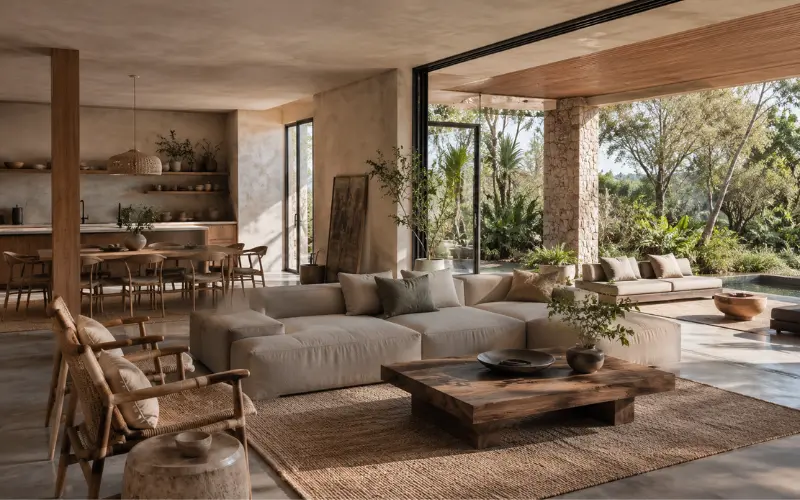
Strip away the marketing language and the traits attached to this term aren’t new. They’re a blend of things designers have used for decades:
- Natural, tactile materials. Stone, reclaimed wood, clay plaster, and bamboo show up constantly in this content, favored for how they age rather than how they look on day one.
- Open, flowing floor plans. Rooms connect instead of being boxed off, often with big sliding doors or partial walls instead of full partitions.
- Restrained ornamentation. Detailing is functional first. Trim, molding, and decorative flourishes are kept minimal.
- Strong indoor-outdoor connection. Courtyards, large glazing, and covered outdoor rooms treat the yard as another living space, not an afterthought.
- A muted, nature-derived palette. Earth tones, warm neutrals, and greens pulled from the surrounding landscape rather than trend-driven color schemes.
If that list sounds familiar, it should. It overlaps heavily with organic modernism, Japandi, and parts of contemporary residential design. The “KD Archistyle” label is essentially repackaging traits from those established approaches under one catchy name.
How These Ideas Compare to Real Architectural Styles
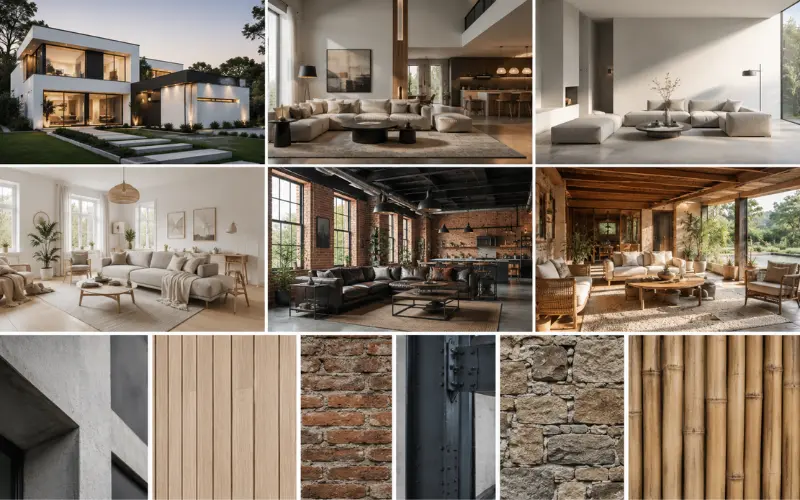
Here’s where the informal traits above line up (or don’t) against styles that do have documented histories, defining principles, and named practitioners.
| Style | Defining Trait | Materials | Best Fit For |
|---|---|---|---|
| Modern | Function over ornament, geometric clarity | Steel, glass, concrete | Homeowners who want a clean, timeless shell |
| Contemporary | Reflects current trends, evolves decade to decade | Mixed: glass, wood, metal | Buyers who want an updated look without going ultra-minimal |
| Minimalist | Reduction to essentials, hidden storage, monochrome | Concrete, painted drywall, glass | Small spaces or people who want visual calm |
| Scandinavian | Light-filled, functional, cozy warmth (hygge) | Pale wood, wool, linen | Cold climates, small footprints, warmth-focused design |
| Industrial | Exposed structure, raw and unfinished surfaces | Brick, steel, exposed ductwork | Loft conversions, urban renovations |
| KD Archistyle (informal) | Nature-connected, tactile, open, low-ornament | Stone, reclaimed timber, clay, bamboo | People drawn to a warm, organic take on modern living |
Where it overlaps most: Scandinavian design and the informal KD Archistyle traits share the “less is more” instinct and a preference for natural materials. The real difference is climate logic. Scandinavian design developed specifically to maximize scarce daylight and warmth through long winters. The KD Archistyle content doesn’t carry that climate-driven reasoning; it’s aesthetic first.
Where it diverges most: Industrial style leans into raw, unfinished, factory-derived surfaces as a deliberate contrast statement. KD Archistyle traits go the opposite direction, softening everything with natural texture. If you like exposed brick and visible ductwork, this isn’t your style.
Applying These Ideas in a Real Renovation or Build
This is the part most articles on this topic skip entirely: how to actually use these ideas without hiring an “architect” for a style that isn’t formally practiced.
- Start with your climate, not the mood board. Reclaimed timber cladding looks great in photos, but in humid climates it needs proper ventilation gaps and sealant maintenance or it warps within a few seasons. Talk to a local builder about material behavior in your specific weather before committing.
- Use natural materials as accents, not the whole envelope. A full stone facade is expensive and heavy on the structure. A stone feature wall, a timber entry canopy, or a clay-plastered accent wall gets you 80% of the look at a fraction of the structural and budget impact.
- Borrow the “rooms without walls” trick from open-plan Modern design. Instead of removing structural walls (costly, sometimes impossible), use half-height partitions, level changes, or furniture placement to define zones while keeping sightlines open.
- Bring the outdoors in through openings, not just decor. A single well-placed sliding door to a courtyard does more for that “connected to nature” feeling than any amount of plant styling indoors.
- Budget-check your palette early. Earth-tone paint is cheap. Natural stone and reclaimed wood are not. Decide which two or three materials matter most to you and use paint, tile, and fabric to fill in the rest of the palette affordably.
A Quick Primer on Recognized Architecture Categories
Since the search behind this topic often overlaps with general architecture questions, here’s a factual grounding you can rely on.
Architectural styles are typically grouped by historical period and design philosophy. Commonly cited “main” categories in residential and commercial design include: Classical, Gothic, Renaissance, Victorian, Modern, Postmodern, Contemporary, Minimalist, Industrial, and Sustainable/Green design. Different sources group these slightly differently, some collapsing related movements together and others splitting them into more granular subtypes (which is where you’ll see longer lists, like 15 to 20 types, that break Modern into Mid-Century Modern, Bauhaus, and International Style separately).
The typical architectural design process, regardless of style, moves through these phases: programming and research, schematic design, design development, construction documentation, permitting, bidding and negotiation, and construction administration. A named “style” like Modern or Scandinavian shapes decisions made mostly in the schematic design and design development phases, not the process itself.
FAQ
Is KD Archistyle a real architectural movement?
No. It’s not documented in architecture history or taught as a formal style. It functions as an informal, online-coined term describing a set of design traits borrowed from existing styles.
Who founded KD Archistyle?
There’s no verifiable founder, firm history, or documented body of work associated with the term. Treat claims of a specific founding architect or firm with caution unless you can independently verify them.
Is KD Archistyle the same as Japandi?
They overlap in spirit (natural materials, restraint, warmth) but Japandi has a clearer documented lineage, blending Japanese minimalism with Scandinavian functionality. KD Archistyle content doesn’t carry that same specific cultural pairing.
Can I hire an architect who specializes in KD Archistyle?
Not as a certified specialty, since it isn’t a recognized professional category. Instead, search for architects with portfolios in “organic modern,” “biophilic design,” or “contemporary natural materials,” which are the closest real, searchable specialties.
What’s the cheapest way to get this look without a full renovation?
Does this style work in small apartments?
Yes, though scale down the material choices. A reclaimed wood shelf, linen textiles, and one earth-toned accent wall bring the same feeling without the space or budget a full open floor plan needs.
How is this different from just “modern farmhouse” design?
Modern farmhouse leans on specific decorative markers (shiplap, black window frames, barn-style fixtures). The traits associated with KD Archistyle are less decorative and more about material honesty and spatial openness, closer to organic modernism than farmhouse styling.
Should I be skeptical of websites that present KD Archistyle as an established movement with a long history?
Yes. If a source claims specific founding dates, named pioneering architects, or awards without citing verifiable sources, treat that as marketing content rather than documented architecture history.

