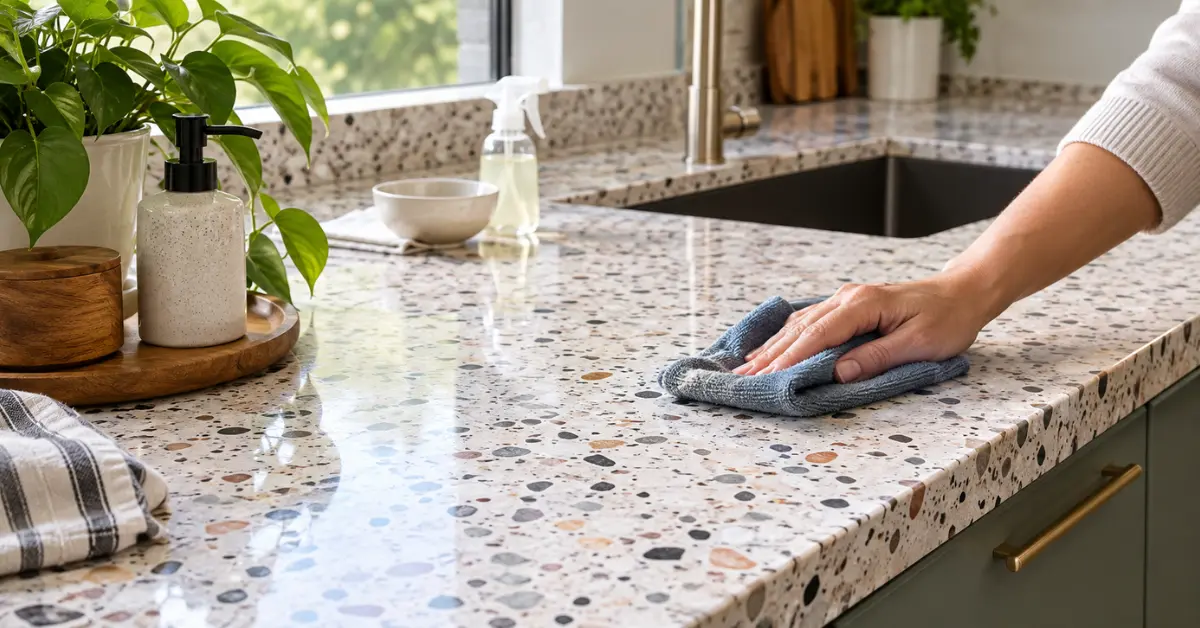
A terrazzo kitchen benchtop is cared for by wiping it daily with a pH-neutral cleaner, blotting spills the moment they happen, keeping acidic and abrasive products away from it, and resealing on a schedule that matches whether your slab is cement-bound or resin-bound. Get those four habits right and a terrazzo benchtop will comfortably outlast most kitchen renovations. Get them wrong, and you’ll be looking at a dull, etched surface within a year.
Work Out What Kind of Terrazzo You Actually Have First
This is the step almost every online guide skips, and it’s the one that decides everything else about your care routine.
Terrazzo Kitchen Benchtop isn’t a single product. It’s marble, granite, quartz or glass chips set into either a cement binder or an epoxy resin binder, then ground and polished flat. The binder is what matters, because it changes how the surface behaves in an Australian kitchen.
Cement-bound terrazzo is porous. It drinks up oil, wine and coffee if you leave a puddle sitting on it, and it needs a proper penetrating sealer to stay protected. Resin-bound terrazzo, which is what most Australian suppliers have sold over the past decade, is far denser and closer to engineered stone in how it resists liquid. It still needs care, just less frequent sealing.
Before you buy a single cleaning product, check your invoice, ask the fabricator, or look at the care card that should have come with the benchtop. If you’ve inherited a Terrazzo Kitchen Benchtop in a house you’ve just bought and there’s no paperwork, a simple check helps: cement-bound terrazzo feels slightly cooler and looks a touch more matte close up, while resin-bound terrazzo has a glassier, more uniform sheen. When in doubt, treat it as cement-bound and follow the more cautious routine below. It costs you nothing extra and protects you if you’ve guessed wrong.
The Daily Routine That Keeps It Looking New
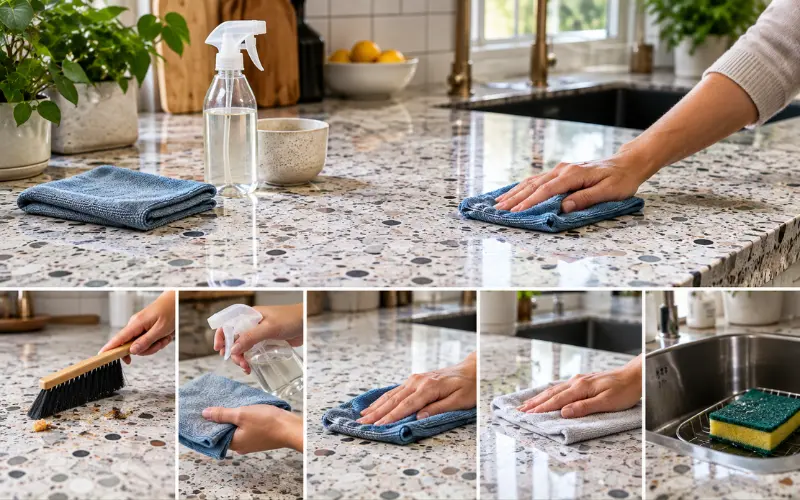
You don’t need a cupboard full of specialty stone products to keep terrazzo looking good. Three things do the job: a soft microfibre cloth, warm water, and a pH-neutral cleaner made for natural stone.
Wipe the Terrazzo Kitchen Benchtop after cooking, not just once a day. Dust, flour and grit act like fine sandpaper once you drag a wet cloth over them, so brush loose debris away first with a dry cloth before you introduce any liquid. Spray a small amount of diluted cleaner onto the cloth rather than the bench itself, wipe with the grain of the aggregate pattern, then go over it again with a cloth dampened in clean water to lift any soap residue.
The step people skip is drying it properly afterwards. Hard water in many Australian suburbs leaves faint white mineral spots if you let the surface air-dry, and on a dark-flecked terrazzo those spots are surprisingly obvious under kitchen downlights. A ten-second pass with a dry microfibre towel avoids the whole problem.
Skip the sponge sitting in your sink. It’s usually loaded with citrus dish soap and trapped food oils, both of which leave a greasy film on stone over time that’s genuinely hard to trace back to its source.
Handle Spills the Moment They Happen
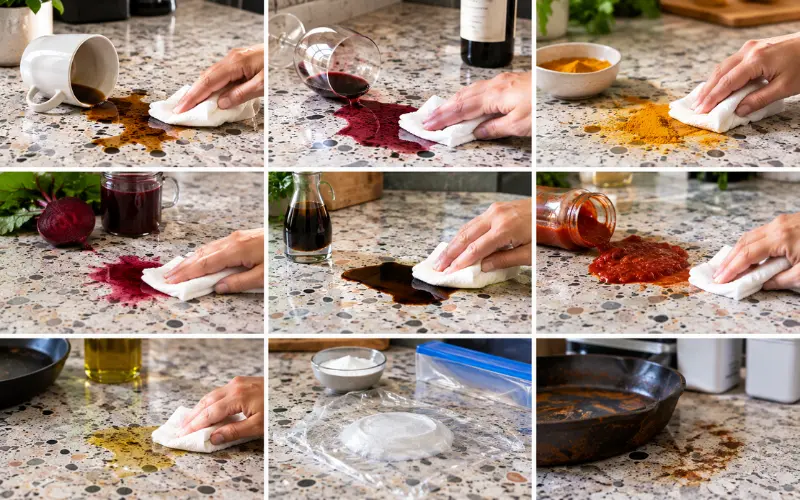
Coffee, red wine, turmeric, beetroot, balsamic vinegar and tomato-based sauces are the repeat offenders in most kitchens, and on cement-bound terrazzo they can travel into the surface within an hour if you leave them.
Blot with paper towel or a clean cloth first. Don’t wipe in circles, since that spreads the liquid further into the pores instead of lifting it out. Once the bulk of the spill is gone, clean the spot with your regular pH-neutral cleaner and dry it.
Oil behaves differently to coloured liquids. It doesn’t always show a mark straight away, but it keeps migrating deeper into the cement around the aggregate for hours after the spill, so a faint patch can turn darker the next morning even though you cleaned it properly the night before. If you know you’ve had a decent oil spill, a baking soda poultice left over the spot for an hour, covered loosely with plastic wrap, draws it back out before it sets in.
Rust is the one stain I’d never recommend tackling yourself. It usually comes from a cast-iron pan or a tin left sitting on the surface, and household rust removers are almost always too acidic for terrazzo. A stone specialist has products formulated specifically for this that won’t etch the marble chips in the process.
Why Acid Is the Real Enemy, Not Grime
Most of the damage I see on terrazzo benchtops after a few years didn’t come from stains at all. It came from cleaning products.
Marble and cement are both calcium-based, and calcium reacts with acid. Vinegar, lemon juice, most bathroom sprays and a surprising number of “natural” DIY cleaners will etch the surface if you use them repeatedly, even if nothing looks wrong after the first few times. The damage shows up as a slightly hazy, lighter patch where the polish has been chemically stripped rather than physically scratched. Once that happens, cleaning won’t fix it. It needs professional diamond polishing to bring the shine back.
This is worth remembering because etching and staining look similar to the untrained eye but need completely different fixes. A stain sits on top of, or just inside, the surface and can usually be lifted. An etch has changed the surface itself and needs to be reground and repolished. If a mark won’t budge after a gentle clean and a baking soda paste, stop escalating to stronger chemicals. That’s exactly the point where people make the damage permanent.
Sealing: Match the Schedule to Your Binder
Sealing frequency isn’t a fixed number, and treating it as one is where a lot of online advice goes wrong.
Cement-bound terrazzo generally needs a penetrating sealer reapplied every 12 to 18 months, sooner in a busy kitchen or a coastal home where humidity is higher. Resin-bound terrazzo can often stretch to 24 to 36 months, since the resin itself is doing most of the work that a sealer would otherwise do on cement.
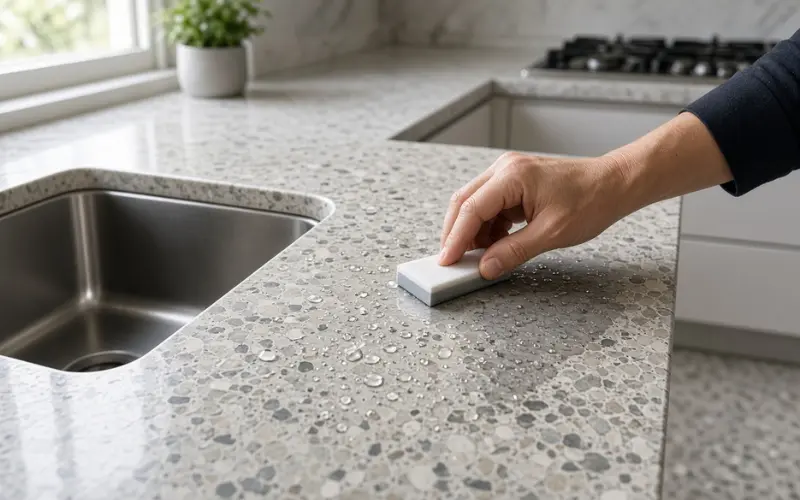
Test it rather than guessing. Drip a few drops of water onto an inconspicuous spot near the sink or cooktop and leave it for ten minutes. If it beads up cleanly, the seal is still doing its job. If it soaks in and leaves a darker patch, book a reseal.
When you do reseal, clean the surface thoroughly first and let it dry for a full 24 hours. Applying sealer over trapped moisture or grease traps the problem underneath the new coat, which defeats the purpose entirely. Use a penetrating sealer rather than a topical one for kitchen use, since topical coatings sit on the surface and tend to wear unevenly around high-traffic zones like the sink and the area in front of the cooktop.
Heat, Knives and the Habits That Cause Slow Damage
Terrazzo Kitchen Benchtop handles moderate warmth reasonably well, but sudden temperature changes are a different story. A cast-iron pan straight from the oven placed directly on the surface can create fine stress lines in the binder that you won’t notice immediately but that collect dirt and darken over months. Use a trivet every time, including for appliances that run hot underneath, like air fryers and slow cookers left running for a few hours.
Cutting boards matter for a similar reason. The knife doesn’t usually chip the terrazzo outright, but repeated pressure on the same spot leaves fine grooves that dull the finish and make that patch of benchtop look different from the rest of the slab within a year or two.
One thing most guides don’t mention: small abrasive particles trapped under appliances cause more wear than people expect. A coffee machine, toaster or ceramic canister dragged across the bench, rather than lifted, grinds any trapped grit into the surface like sandpaper. Lift, don’t slide, and you’ll avoid a whole category of scratches that build up so gradually you won’t notice until you compare the bench to how it looked when it was installed.
Terrazzo Care Schedule at a Glance
| Task | Cement-bound terrazzo | Resin-bound terrazzo |
|---|---|---|
| Daily wipe | Warm water + pH-neutral cleaner | Warm water + pH-neutral cleaner |
| Water bead test | Every 3 to 4 months | Every 6 months |
| Full reseal | Every 12 to 18 months | Every 24 to 36 months |
| Professional inspection | Every 3 to 5 years, or after any impact | Every 3 to 5 years, or after any impact |
When to Call a Professional Instead of DIY-ing It
Some jobs cost more to get wrong than they do to hand over. Call a stone or terrazzo specialist if you notice widespread etching, a stain that won’t lift after a poultice, a crack running through the aggregate, or a chip near a sink cut-out or unsupported edge. These spots concentrate stress and are more prone to spreading if left alone.
Repair is one of Terrazzo Kitchen Benchtop genuine advantages over engineered quartz. A scratched quartz benchtop generally stays scratched. Terrazzo can be reground, repolished and colour-matched by a fabricator, often for a fraction of what a full replacement would cost.
If you’re weighing up terrazzo against other benchtop materials for a renovation, our guide to white kitchen grey stone benchtops covers a different maintenance profile worth comparing, and our soapstone benchtop guide is useful if you’re still deciding between finishes. For general upkeep across different bench materials, see our broader guide to cleaning kitchen benchtops, and if your kitchen also has granite or marble elements, our guides on cleaning granite benchtops and cleaning marble benchtops cover the differences in approach.
FAQ’s on Terrazzo Kitchen Benchtop
Can I use vinegar or lemon juice on a terrazzo kitchen benchtop?
No. Both are acidic and will etch the marble chips and cement binder over repeated use, leaving a dull patch that needs professional repolishing to fix.
How do I tell if my terrazzo is cement-bound or resin-bound?
Check your supplier’s paperwork or ask the fabricator directly. As a rough guide, cement-bound terrazzo feels slightly cooler and looks more matte, while resin-bound terrazzo has a glassier, denser sheen.
Is terrazzo suitable for a busy family kitchen?
Yes, provided you reseal on schedule, use trivets and chopping boards, and clean spills promptly rather than letting them sit overnight.
How long does a Terrazzo Kitchen Benchtop actually last?
With proper sealing and gentle cleaning, terrazzo can easily last several decades, and unlike quartz, it can be reground and repolished if it ever looks tired.
Can I put a hot air fryer or slow cooker directly on terrazzo?
It’s best not to. Sustained heat from these appliances can stress the binder over time, so a heat-resistant mat underneath is worth the habit.
What’s the difference between an etch mark and a stain on terrazzo?
A stain sits in the pores and can usually be lifted with cleaning or a poultice. An etch is chemical damage to the polish itself and needs professional honing to correct.
Does terrazzo need a different cleaner to granite or quartz?
Yes, ideally. A pH-neutral cleaner labelled safe for natural stone works across most stone benchtops, but generic multi-surface sprays with citrus or ammonia are riskier on terrazzo because of its marble content.
Can a chip in a Terrazzo Kitchen Benchtop be fixed without replacing the whole slab?
Usually yes. A fabricator can fill small chips with colour-matched epoxy and polish the repair to blend in, which is far cheaper than replacing the entire benchtop.