
Patterned splashback tiles fit modern kitchen design because they give a flat, minimal room a focal point without adding clutter. A run of plain cabinetry and stone benchtop needs something to hold the eye, and a well-chosen pattern does that job while still wiping clean after a Sunday roast. Get the scale and colour right and the tile earns its place for a decade, not just for the reveal photos.
What Actually Happens on Site When You Add Pattern
Most kitchen renovations start with the big-ticket items: cabinets, benchtop, appliances. The splashback often gets chosen in the last fortnight, sometimes under pressure because the tiler needs an answer before Friday. That rush is exactly why so many kitchens end up with a plain white subway tile that nobody actually wanted.
A Patterned Splashback Tiles forces a slower decision, and that’s a good thing. It makes you look at cabinet colour, benchtop veining and floor tone as one system instead of three separate purchases. In a genuinely modern kitchen, where joinery is flat and handleless and the benchtop is a single calm slab, the splashback is often the only surface with room to carry personality.
I’ve seen tilers push back on Patterned Splashback Tiles jobs because the setout takes longer. Every pattern has a repeat, and if that repeat lands awkwardly at a power point or a corner, the whole wall looks off. Ask your supplier for the repeat size in millimetres before you order, not after. A 200mm repeat behaves very differently across a 2.4 metre wall than a 300mm one.
Choosing a Tile That Survives Real Cooking
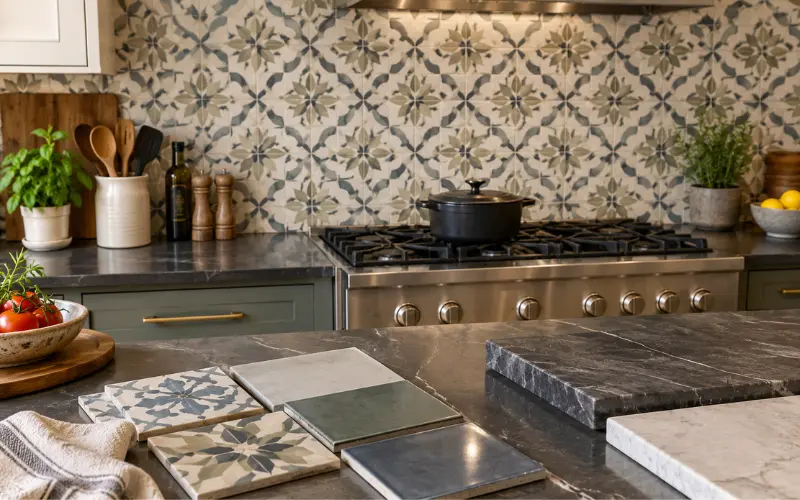
Glazed porcelain and glazed ceramic are the two materials that hold up best behind a stovetop. Porcelain has extremely low water absorption, generally under 0.5 percent, which means splattered oil and tomato sauce sit on the surface instead of soaking in. Ceramic performs well too, though the body underneath is more porous, so a chipped edge is more likely to stain over time than a chipped porcelain edge.
Encaustic cement tiles look stunning in photos and carry genuine heritage character, but they need sealing on installation and resealing every few years if they sit near a cooktop. That’s a maintenance commitment worth being honest about before you fall for a Pinterest board. If you want that handmade look without the upkeep, most tile ranges now print the same patterns onto porcelain, and the difference is hard to spot once it’s grouted.
For anyone comparing this against natural stone or engineered options for the benchtop itself, a piece like soapstone benchtop is worth reading alongside your splashback decision, since the two surfaces need to sit together without one overpowering the other.
A Quick Comparison Before You Commit
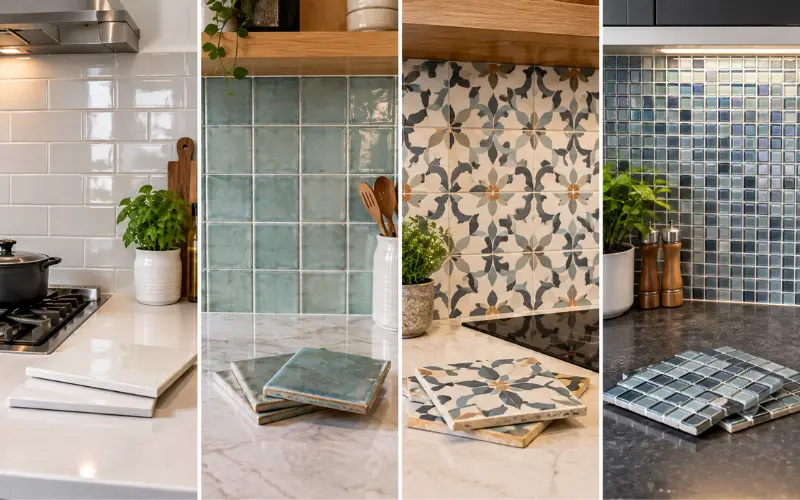
| Material | Typical cost per m² (AUD) | Heat tolerance | Maintenance | Best for |
|---|---|---|---|---|
| Glazed porcelain | $45–$130 | Excellent | Wipe clean, no sealing | Behind gas or induction cooktops |
| Glazed ceramic | $35–$100 | Good | Wipe clean, avoid chipping | Standard runs under wall cabinets |
| Encaustic cement | $60–$150 | Moderate | Requires sealing and resealing | Feature walls away from direct heat |
| Glass mosaic | $70–$180 | Good | Grout needs regular attention | Small alcoves and compact kitchens |
Is It Cheaper to Tile Than Use Glass or Stone?
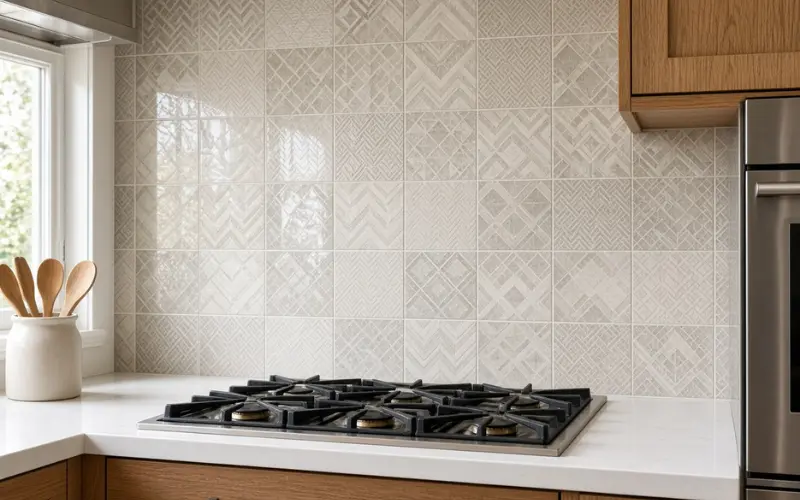
Tiling almost always comes out cheaper than a toughened glass panel or a stone slab splashback, and the gap is bigger than most homeowners expect. Custom glass panels run from roughly $300 to $500 per square metre once toughening and cutouts for power points are included, while stone slab splashbacks can climb past $600. Tiles, even mid-range patterned ones, rarely exceed $150 per square metre installed.
The other side of this that competitors rarely mention: repairability. If a glass panel cracks behind an appliance, you’re replacing the entire sheet, which usually means a fresh template and a wait for fabrication. A cracked tile can be chiselled out and swapped with a spare from the same batch in an afternoon, provided you kept a few tiles aside after the original install. Always ask your tiler for five to ten spares from the same dye lot, because pattern batches can shift slightly in colour between production runs.
Matching Pattern Scale to Your Kitchen
Small kitchens don’t need to avoid pattern, they need the right scale of it. A tight, high-contrast repeat under 100mm can genuinely make a narrow galley wall feel busier than it is. A softer, mid-scale motif around 150–200mm tends to read as texture from a normal viewing distance rather than as a hard graphic, which is far more forgiving in a compact space.
Large-format patterned porcelain, often 600mm x 1200mm panels with printed veining or geometric detail, works well in bigger open-plan kitchens because it reduces the number of grout lines across the wall. Fewer joints mean less visual noise and less grease collecting in grout over the years. It costs more per panel but can save on labour since fewer cuts are needed overall.
Grout Is Doing More Work Than You Think
Grout colour changes how sharp or soft a pattern reads on the wall, and this gets overlooked constantly. A grout that closely matches the tile’s background tone lets the pattern blend into a continuous surface, which suits busy or highly detailed motifs. A contrasting grout, dark against a pale tile for example, outlines every single shape and turns a subtle pattern into something much bolder than the showroom sample suggested.
Epoxy grout resists staining far better than standard cementitious grout in a working kitchen, particularly in humid coastal towns where mould can creep into porous joints. It costs more and is trickier to apply, so factor the extra labour time into your quote rather than being surprised later.
What Type of Tile Is Best for a Splashback?
Glazed porcelain remains the strongest all-round pick for the reasons above: low porosity, high heat tolerance and a huge range of printed pattern options that mimic encaustic, terrazzo or Moroccan styles without the ongoing sealing work. If budget is tight, glazed ceramic in a smaller format is a sensible step down, provided the area isn’t taking direct heat from an uncovered gas flame.
What Is a Patterned Splashback Tiles Called?
The naming depends on where the design comes from. Encaustic tiles get their pattern from layered coloured clay rather than a surface glaze. Zellige and Moroccan-style tiles are handcrafted-look pieces with slight tonal variation edge to edge. Azulejos, from Spanish and Portuguese tradition, usually mean tin-glazed blue and white botanical or geometric motifs. Anything factory-printed with sharp repeating shapes is generally just called a geometric or graphic tile.
What Is the Latest Trend for Kitchen Splashbacks?
Australian kitchens are moving away from stark white grids toward warmer, more textured surfaces. Kit-Kat tiles, thin vertical strips usually laid in a stacked bond, are turning up in a lot of new builds because they add texture without a loud print. Terrazzo-look porcelain, muted sage and terracotta palettes, and full-height splashbacks that run to the underside of the rangehood rather than stopping at 600mm are all gaining ground. Full-height in particular photographs better and avoids an awkward gap of painted wall above the tile line.
Practical Layout Advice From the Field
Decide the extent of the tiling before you order anything. Running tiles from benchtop to the underside of upper cabinets is the standard and most economical approach for a family kitchen. Taking the pattern full height to the ceiling, especially around a canopy rangehood, turns the wall into a genuine feature but adds cost in both tile and cutting labour.
Match your cabinetry to the pattern’s intensity rather than the other way around. If you’ve already committed to a busy pattern, flat, unadorned cabinet doors let it breathe. If your joinery has strong grain or veining, choose a quieter, smaller-scale tile so the two surfaces don’t fight for attention. For layout inspiration where the kitchen opens onto a living space, our guide to open-plan kitchen design covers how sightlines from the lounge affect these choices, and if your cabinetry is already set, modern kitchen cabinets has useful pairing notes.
Lighting changes everything about how a pattern reads once it’s installed. Under-cabinet strips wash colour and shadow across the tile in a way showroom lighting never shows you, so it’s worth reading through some kitchen lighting ideas before locking in a final tile choice. If your floors are timber, checking undertones against a sample of awesome timber floors prevents a warm pattern clashing with cool flooring, or vice versa.
If your benchtop is already a strong stone with visible movement, a guide like white kitchen with grey stone benchtop is a good sense check before adding a second busy surface to the same wall.
FAQ’s on Patterned Splashback Tiles
Do Patterned Splashback Tiles make a small kitchen look smaller?
Not usually. A fine, small-scale pattern in a light background tends to add depth rather than shrink the space. Problems only show up when the pattern is both large-scale and high-contrast in a genuinely tight galley kitchen.
How do I clean grease off Patterned Splashback Tiles without damaging the design?
Warm water and a mild dish detergent removes most cooking grease from glazed porcelain and ceramic without touching the printed pattern underneath. Avoid abrasive scourers, which can dull the glaze over years of use.
Can patterned tiles go behind a gas cooktop?
Yes, provided you choose glazed porcelain or ceramic and the installation follows AS/NZS 5601 gas fitting clearances. Confirm minimum clearances with your gas fitter before the tiler starts setting out the wall.
Are encaustic cement tiles safe directly behind a stove?
They can be used there but need professional sealing at installation and periodic resealing afterward, since the porous cement body will absorb hot cooking oil if left unsealed.
What tile size suits a standard 600mm splashback height?
Square tiles at 150mm or 200mm divide neatly into a standard 600mm gap between benchtop and wall cabinets, keeping cuts to a minimum along the top and bottom edges.
Will a Patterned Splashback Tiles date quickly?
Bold, trend-driven colourways can feel dated within five years. Muted geometric or heritage-inspired patterns in neutral tones have stayed in rotation for decades and are the safer long-term pick if you’re not planning to retile soon.
Is it worth ordering extra tiles beyond the calculated quantity?
Yes. Ask for five to ten spare tiles from the same production batch. Dye lots shift slightly between runs, so a replacement tile bought two years later may not match exactly.
Does a Patterned Splashback Tiles affect resale value?
A well-proportioned, tastefully scaled pattern is generally seen as a feature by buyers rather than a flaw. Extremely loud or highly personal motifs across an entire wall can narrow the buyer pool, so a contained feature area is the safer approach if resale is on your mind.

