
Circle wall decor works because it breaks up all the straight lines already sitting in your room, from door frames to window trim to sofa arms. A single well-sized circular piece, mounted at eye level, does more to soften a space than three smaller pieces scattered across the same wall. The trick isn’t finding a circle you like. It’s sizing it, placing it, and pairing it so it reads as intentional rather than accidental.
Most guides stop at “here are some pretty round mirrors.” This one goes further: the sizing math, the placement height that actually works for average ceilings, which materials hold up in humid rooms, and the mistakes that make round decor look like it was grabbed off a clearance shelf.
Why Circles Read as “Modern” When Done Right
A circle has no corners, so your eye doesn’t stop moving when it hits one. That’s the whole reason designers reach for round shapes in rooms full of rectangular furniture, square windows, and boxy shelving. The shape gives your eye somewhere to rest without creating a hard stop.
The catch is scale. A circle that’s too small next to a large sectional or a wide console just floats there, disconnected from anything around it. A circle that’s too large overwhelms the wall and makes the ceiling feel lower than it is. Neither looks modern. Both look like a guess.
From experience: I once hung a 24-inch metal circle over a sofa that was 84 inches wide. It looked like a coin taped to a bedsheet. Swapping it for a 36-inch piece, roughly two-thirds the sofa’s width, fixed the whole wall without touching anything else in the room.
The Sizing Formula Nobody Explains
Here’s the rule most retailers never mention on the product page: for wall decor hung above furniture, aim for a piece that spans 60 to 75 percent of the furniture’s width. For a sofa, that means measuring the sofa itself, not the wall.
- Sofa or console, 72–84 inches wide: look for a 36–48 inch circle
- Loveseat or narrow console, 48–60 inches wide: a 24–30 inch circle
- Bare wall with no furniture beneath it: size to roughly one-third the wall’s width, then check it against ceiling height before buying
If you land between two sizes, size up. An undersized circle is far more noticeable than one that’s slightly generous.
Placement Height: The Number That Actually Matters
Interior designers use 57 to 60 inches from the floor to the center of the piece as the standard eye-level height, the same guideline museums use for hanging art. Circle decor is less forgiving of guesswork than square frames because any tilt is immediately obvious on a round shape.
If the circle hangs above furniture, leave 6 to 8 inches of clearance between the top of the furniture and the bottom of the piece. Any tighter and the two elements compete instead of pairing.
For entryways and hallways with no furniture reference point, stick to the 57–60 inch center-height rule and don’t adjust it based on the ceiling. A vaulted ceiling doesn’t mean the art should climb; it means there will be more visible wall space above it, which is fine.
Grouping Circles Without It Looking Cluttered
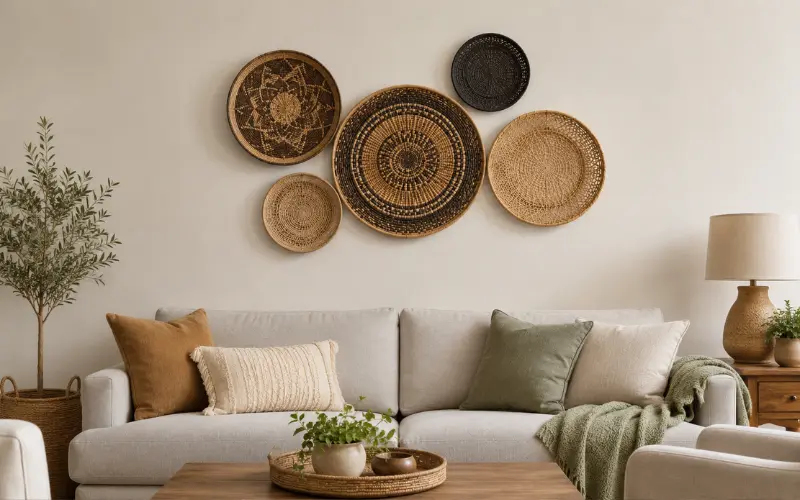
A cluster of circles is one of the few wall groupings that doesn’t need a rigid grid, but it does need a system. Odd numbers, three or five pieces, look more deliberate than even numbers because the eye can’t split them into equal halves.
Spacing that works:
- Leave 2 to 3 inches between the edges of adjacent circles, measured at their closest point
- Vary the sizes within the cluster; three identical circles read as a set from a store display, three different sizes read as curated
- Keep the visual weight (largest, darkest, or busiest piece) toward the center or slightly left of center, not at either end
Lay the pieces out on the floor first, tape the arrangement to the wall in paper cutouts, and live with it for a day before drilling anything. This single step prevents almost every regretted gallery wall.
Material Choices Competitors Rarely Compare
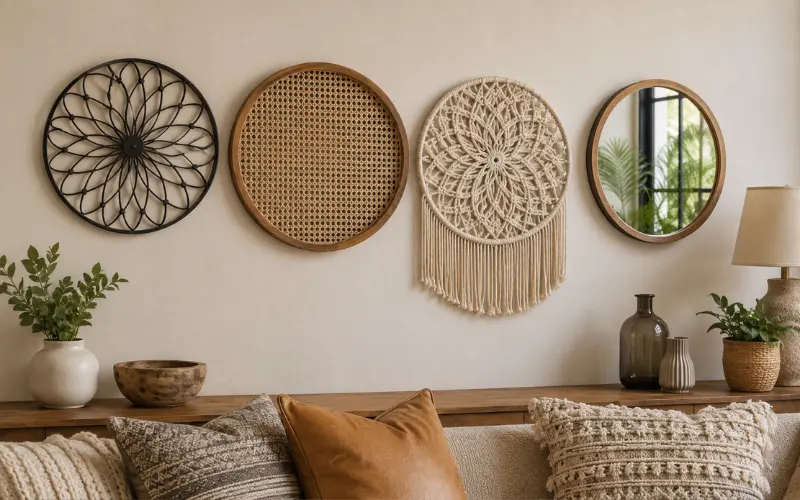
Most roundups list “metal, wood, macrame, rattan” without explaining why one might fail in your room. Here’s what actually matters:
| Material | Best For | Watch Out For |
|---|---|---|
| Metal (iron, steel) | Living rooms, entryways, sunny walls | Can feel cold in a room without warm textiles nearby |
| Wood or rattan | Bedrooms, reading nooks, boho or coastal styles | Warps or fades in direct sun and high humidity |
| Woven macrame or fiber | Low-traffic walls, textured neutral rooms | Collects dust; needs occasional gentle vacuuming |
| Mirrored circles | Small rooms, dark hallways, north-facing rooms | Shows fingerprints and smudges more than other materials |
Bathrooms and kitchens are the two rooms where material choice actually makes or breaks the piece. Skip untreated wood and natural fiber near steam or splash zones, and choose powder-coated metal or sealed resin instead. If you already have a mix of metal finishes in the room, such as Ashley wall decor pieces with black iron frames, matching finish saves you from a mismatched, thrown-together look.
Mixing Circles With Rectangular Art (Without a Clash)
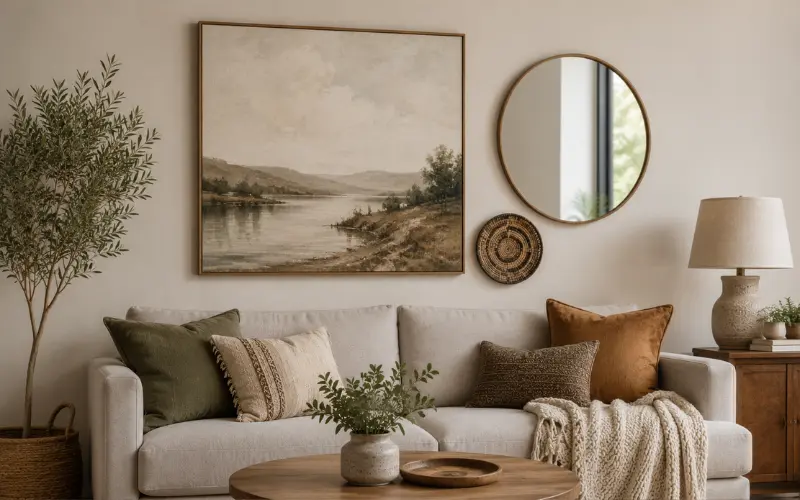
You don’t need an all-circle wall. In fact, an all-circle gallery wall is one of the harder looks to pull off well. A single round piece anchoring a mostly rectangular gallery wall, or one large square mirror paired with two or three smaller circles, tends to look more collected over time rather than bought as a matched set in one trip.
A dependable combination: one large rectangular piece as the anchor, one medium circle offset to the side, and one small circular accent tucked lower. This mirrors how natural collections build up over years, which is exactly the effect that reads as authentic rather than staged.
If your style already leans toward organic silhouettes, this pairs naturally with organic modern wall decor choices elsewhere in the room, since both lean on soft shapes instead of hard edges.
Where Circle Decor Solves a Real Problem
Circle decor isn’t just decorative. It solves specific layout problems that square and rectangular pieces make worse:
- Above a curved or pedestal dining table: a round piece continues the table’s line up the wall instead of fighting it with hard angles
- In a stairwell: circles at staggered heights follow the sightline of the stairs better than a straight row of square frames
- Over a fireplace with an arched opening: matching curve to curve keeps the whole wall feeling cohesive instead of layering two competing shapes
- In a narrow hallway: a single circle at the end wall draws the eye forward without the visual weight a large square piece would add
Botanical, Woven, and Textural Circle Styles Worth Knowing
Not every round piece is a flat metal disc. Woven and dimensional circles bring texture that flat pieces can’t, and they tend to age better because texture hides dust and minor wear that would show on a smooth painted surface.
Pieces inspired by botanical wall decor work particularly well in circular form because leaf and vine patterns naturally follow a curved silhouette. Similarly, radial patterns borrowed from star wall decor or spoke-style windmill wall decor give a circle visual movement without adding another color to the room.
For rooms that already lean toward soft, nature-driven palettes, circular pieces pull double duty with nature wall decor themes, letting you keep a cohesive story across multiple walls instead of treating each piece as a one-off purchase.
Common Mistakes That Make Circle Decor Look Cheap
- Hanging too high. This is the single most common mistake. It stems from centering the piece on the wall itself rather than on the furniture or eye level.
- Choosing a finish that doesn’t exist anywhere else in the room. A lone rose gold circle in an otherwise black-and-white space looks like an afterthought.
- Skipping the anchor point. A circle floating in the middle of a large blank wall with nothing else nearby often needs a lamp, plant, or console beneath it to feel grounded.
- Buying based on the product photo’s room, not your own. Showroom walls are almost always taller and emptier than a real living room. Measure your actual wall before ordering.
- Overlooking the wall texture behind it. Textured wallpaper or shiplap under a woven or textured circle competes for attention; save heavy texture for a smooth-finish piece instead.
Where Reflective and Mirrored Circles Fit
A round mirror does something flat decor can’t: it bounces light back into the room. In a hallway or small bathroom, a mirrored circle placed opposite a window can noticeably brighten the space by mid-afternoon, which is worth factoring in before choosing a solid metal or wood piece for a dim room.
If you already have other reflective pieces on the wall, keep the frame finishes consistent with your broader mirror home decor choices so the room doesn’t end up with three different metal tones fighting for attention.
Quick Reference: Room-by-Room Fit
| Room | Suggested Size Range | Best Material |
|---|---|---|
| Living room (above sofa) | 30–48 inches | Metal or mixed metal |
| Entryway | 20–30 inches | Mirror or wood |
| Bedroom (above bed) | 24–36 inches | Woven fiber or rattan |
| Bathroom | 18–24 inches | Powder-coated metal or resin |
| Home office | 16–24 inches | Metal or mixed media |
FAQ
Do circle wall decor pieces need to be hung perfectly centered on the wall?
No. Center them on the furniture beneath them, or on eye level if there’s no furniture reference, rather than on the wall’s midpoint. A wall-centered circle often ends up too high once furniture is factored in.
Can I use circle wall decor in a room with a lot of curved furniture already?
Yes, and it usually works better than in a room full of straight lines. Just vary the scale so the circle doesn’t compete directly with a round table or curved sofa arm.
What’s the best circle size for a small apartment living room?
Between 24 and 30 inches typically works best in compact rooms, paired with a smaller-scale console or shelf beneath it so the proportions still hold.
Is metal or wood better for a humid climate?
Powder-coated metal or sealed resin holds up better than raw wood or natural fiber in bathrooms, kitchens, or homes without central air conditioning.
How many circle pieces can I hang together before it looks like too much?
Three to five pieces in a cluster is the practical limit for most walls. Beyond that, the grouping starts to compete with itself rather than reading as one cohesive display.
Should circle wall decor match the shape of my mirror or clock elsewhere in the room?
It helps but isn’t required. Matching finish (brass, black iron, natural wood) matters more than matching every shape in the room.
Can circle wall decor go above a headboard?
Yes, and it’s one of the more forgiving spots for it. Center the piece on the headboard’s width rather than the bed frame, and keep 6 to 8 inches of clearance above the headboard.
What’s a budget-friendly way to get the layered look of an expensive circle sculpture?
Layer two or three flat, inexpensive circles of different sizes and finishes instead of buying one large dimensional piece. The layered shadow effect is similar at a fraction of the cost.

