
Discount Home Decor Stores Near Me are usually cheaper than full-price retail, but not always cheaper than each other. Clearance racks at big-box chains like Hobby Lobby or At Home often beat online thrift marketplaces on brand-new items, while local liquidation and overstock stores tend to win on furniture and larger pieces. The real savings depend on timing your visit around markdown cycles, not just picking a store type at random.
Why the Same “Discount” Label Hides Very Different Deals
Not every store using the word “discount” is playing the same game. A clearance rack at a national chain is marking down items that didn’t sell at full price. A liquidation store is buying pallets of overstock, damaged freight, or canceled orders for pennies on the dollar and reselling them.
Those are two completely different pricing models, and they show up in your final receipt. Chain clearance sections tend to sit at 30 to 50 percent off, sometimes deeper right before a seasonal reset. Liquidation and overstock shops can undercut that by another 20 to 40 percent, but the catalog changes weekly and you can’t special-order a color you liked.
I’ve watched a $60 framed print sell for $18 on a Hobby Lobby clearance shelf, then seen the same style of frame show up two weeks later at a Decatur, Alabama liquidation store for $9, dented box and all. Both are “discount.” Only one required a little patience with imperfect packaging.
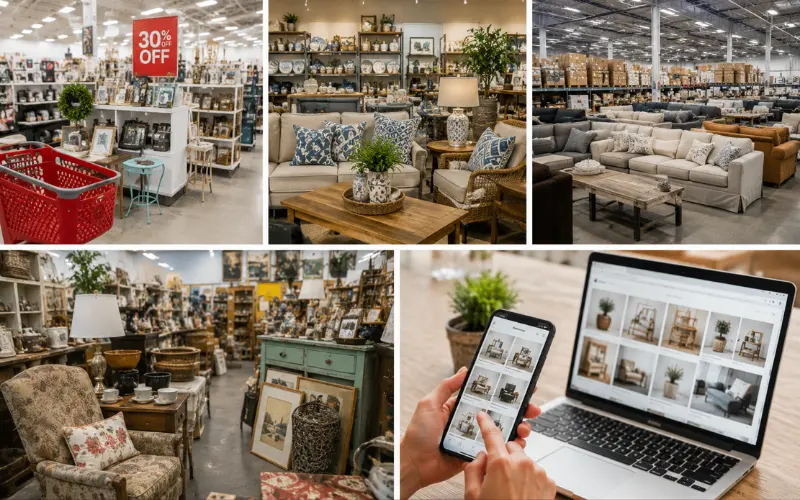
The Store Types Worth Actually Checking

Search results for this kind of query mostly point you to store locators. That’s useful for an address, but it skips the part that actually saves money: knowing which store type fits which purchase.
Big-box clearance sections (Hobby Lobby, Home Depot, Walmart) restock their markdown areas on a rolling basis, usually tied to seasonal resets. Wall decor, small furniture, and decorative accents cycle through fastest. These sections are best for smaller accent pieces where you want a guaranteed return policy if something breaks.
Off-price decor chains like HomeGoods and World Market run a different model entirely. Nothing is technically “clearance,” because the whole store buys closeout and canceled-order inventory at a discount and prices it below department-store rates from day one. You won’t find a red tag, but you’re already paying less than retail.
Warehouse and outlet formats carry deeper cuts on furniture, rugs, and larger case goods, since floor models and freight-damaged shipments move through these locations. If you’re after a home decor warehouse style deal on a sofa or dining set, this is where the biggest percentage savings usually live.
Local liquidation and Facebook Marketplace resale groups are the wildcard. Pricing swings store to store since inventory is bought in bulk lots, not curated by a corporate buyer. You’ll find genuine steals, but you also need to inspect items in person since return policies are often limited or nonexistent.
Online thrift and resale platforms round out the picture for anyone who can’t get to a physical store. Marketplaces built around secondhand decor let you filter by style and price, which works well if you’re hunting a specific look rather than whatever showed up on a truck this week. If that route appeals to you, an online thrift store home decor strategy pairs well with local clearance hunting, since you’re covering both new-but-marked-down and pre-owned inventory.
A Quick Comparison Before You Drive Anywhere
| Store Type | Typical Discount | Best For | Trade-Off |
|---|---|---|---|
| Big-box clearance racks | 30–50% off | Small accents, wall art, seasonal decor | Limited sizes and colors |
| Off-price decor chains | 20–60% below retail | Furniture, rugs, full-room pieces | Inventory changes weekly |
| Warehouse/outlet formats | 40–70% off | Large furniture, floor models | Cosmetic damage possible |
| Local liquidation stores | Varies widely | Bulk buys, unusual finds | No guaranteed return policy |
| Online thrift/resale | 30–80% below new | Vintage or discontinued styles | Shipping cost eats into savings |
What Actually Determines Whether You’re Getting a Real Deal

A markdown tag doesn’t automatically mean you’re saving money. Retail pricing has a habit of inflating the “original” price before applying a Discount Home Decor Stores Near Me, so the percentage off looks bigger than the real savings.
Before buying, I check three things every time:
- Compare the current price to what the same or similar item costs new elsewhere, not just to the store’s own “original” tag.
- Look at the item’s condition in person. A clearance sticker on a slightly dented box is a fair deal. The same sticker on a piece with a cracked frame or missing hardware usually isn’t, unless the price reflects that damage.
- Check the return window before you leave the store. Clearance and final-sale items often carry shorter or no return periods, and that changes the real cost if the piece doesn’t work in your space.
That last point trips people up constantly. A $40 mirror that can’t be returned is a worse deal than a $55 mirror with a 30-day window, if there’s any chance it won’t fit the wall you had in mind.
Timing Your Visit Actually Matters More Than Store Choice
Clearance inventory isn’t static. Most chains mark items down in stages, an initial cut of around 25 percent, then progressively deeper as the item sits unsold. Hobby Lobby, for example, runs continuous seasonal cycles where wall decor and home accents rotate onto clearance right before the next season’s stock arrives.
That means the deepest discounts show up in narrow windows, usually the two or three weeks before a seasonal changeover. Shopping the week before spring or fall resets tends to produce better prices than a random Tuesday in the middle of a season.
If you’re hunting a specific style, vintage western home decor or otherwise, it helps to check clearance sections during those transition windows rather than assuming stock stays constant year-round.
Regional Differences Are Bigger Than People Expect
Store density genuinely changes your odds. Cities with several competing off-price and outlet chains in close proximity tend to have deeper, more frequent markdowns, since stores are competing on the same inventory categories. Smaller markets often rely more heavily on a single big-box clearance section, which means less negotiating power and slower restocks.
If you’re building out a full shopping route rather than a single stop, city-specific guides help more than a general search. Readers researching options in Texas, Tennessee, or Southern California will find the local landscape looks noticeably different from a national chain’s average pricing pattern.
Frequently Asked Questions on Discount Home Decor Stores Near Me
Where is the cheapest place to buy Discount Home Decor Stores Near Me?
Warehouse and outlet-format stores usually post the deepest percentage Discount Home Decor Stores Near Me on furniture and large pieces, while off-price chains like HomeGoods tend to be the most consistently affordable for everyday accents without needing to catch a clearance cycle.
Where can I find wall decor with a Discount Home Decor Stores Near Me?
Big-box clearance sections restock wall art and mirrors frequently, especially right before seasonal resets, and often beat specialty decor stores on price for similar styles.
Where can I find clearance sales on home decor?
Check store clearance pages directly rather than relying on general search results, since inventory changes weekly and in-store stock frequently differs from what’s listed online.
Is Hobby Lobby having a sale on home decor?
Hobby Lobby runs rotating “always” percentage-off categories alongside a dedicated clearance section that updates continuously, so it’s worth checking both rather than assuming one covers everything on sale.
Are Discount Home Decor Stores Near Me actually cheaper than buying online?
Often yes for furniture and larger pieces, since shipping costs on bulky items can erase online savings. Smaller decor items sometimes price closer to even once you factor in shipping either way.
What’s the difference between clearance and liquidation home decor?
Clearance is a retailer marking down its own unsold inventory. Liquidation involves a separate business buying bulk overstock, returns, or freight-damaged goods and reselling them, usually at steeper discounts but with less predictable selection.
Do Discount Home Decor Stores Near Me restock regularly?
Most big-box and off-price chains restock on a rolling weekly basis, while local liquidation stores can vary from daily truck deliveries to sporadic bulk drops depending on their supplier relationships.
Is it worth buying home decor from a store’s clearance section if it can’t be returned?
Only if you’re confident about size, color, and placement before buying, since a non-returnable item that doesn’t fit your space isn’t actually a discount, it’s a sunk cost.

