
Vintage western home decor blends worn leather, hand-carved wood, cowhide, and frontier-era artifacts into a warm, lived-in interior. Done well, it reads as authentic and collected over time. Done poorly, it looks like a steakhouse. The difference comes down to restraint, material choice, and where you source your pieces, and that’s exactly what most guides on this topic skip over.
What Actually Separates Authentic Vintage Western Decor From Kitsch
Most articles list products. Almost none explain why some rooms full of cowboy decor feel curated and others feel like a costume party. After styling more than a few of these spaces, I can tell you it comes down to three things: patina, restraint, and mixing eras.
Patina matters more than the object itself. A brand-new cowhide rug with crisp edges looks like a prop. A rug with a slightly worn patch or an irregular hide shape looks like it’s been on a ranch floor for decades. Same goes for leather, wood, and metal. If everything in the room is uniformly clean and new, the eye clocks it as staged, even if every individual piece is “correct” for the style.
Restraint keeps it from tipping into theme decor. A general rule I use with clients: no single wall should carry more than three western motifs at once. One wagon wheel, one piece of framed cowboy art, and a wall hook is plenty. Stack a longhorn skull, a saddle, and a Native American-motif blanket on the same wall, and it stops reading as a home and starts reading as a set piece.
Mixing eras adds believability. Real ranch houses were never decorated all at once from a single catalog. They accumulated pieces across decades. A 1960s bentwood rocker next to a 1980s leather sofa and a hand-me-down turquoise-and-silver dish reads as genuine family history. A room where every item was clearly bought from the same online retailer in the same month does not.
Color Palette and Materials That Actually Work Together
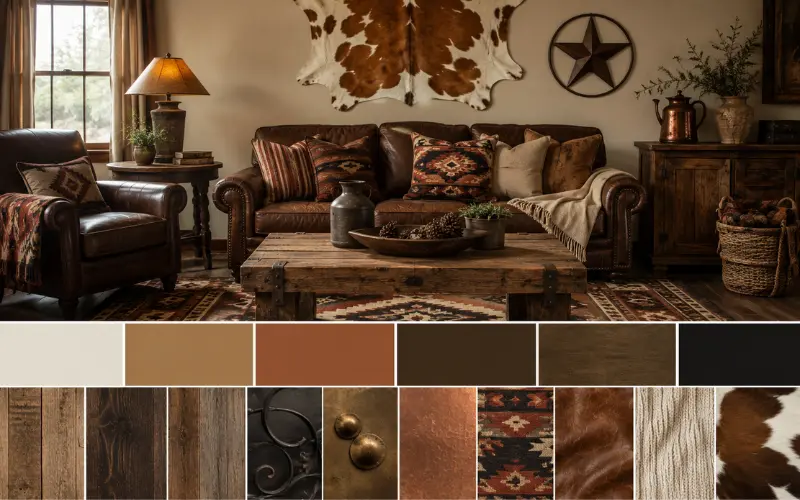
Competitors mention “earthy tones” and stop there. Here’s the actual breakdown that keeps a room cohesive instead of muddy.
| Element | What Works | What Clashes |
|---|---|---|
| Wall color | Warm white, adobe tan, muted terracotta | Cool grays, stark white, pastel blues |
| Wood tone | Weathered oak, dark walnut, reclaimed barnwood | High-gloss cherry, laminate |
| Metal accents | Wrought iron, aged brass, oxidized copper | Chrome, polished stainless steel |
| Textiles | Wool, leather, raw cotton, cowhide | Polyester blends, synthetic faux fur |
| Pattern | Navajo-inspired geometrics, stripes, diamond motifs | Florals, damask, anything Victorian |
Stick to two or three wood tones per room, max. Rooms with five different wood finishes read as cluttered no matter how “on theme” each piece is individually.
Vintage Western Home Decor Ideas for Living Room Spaces
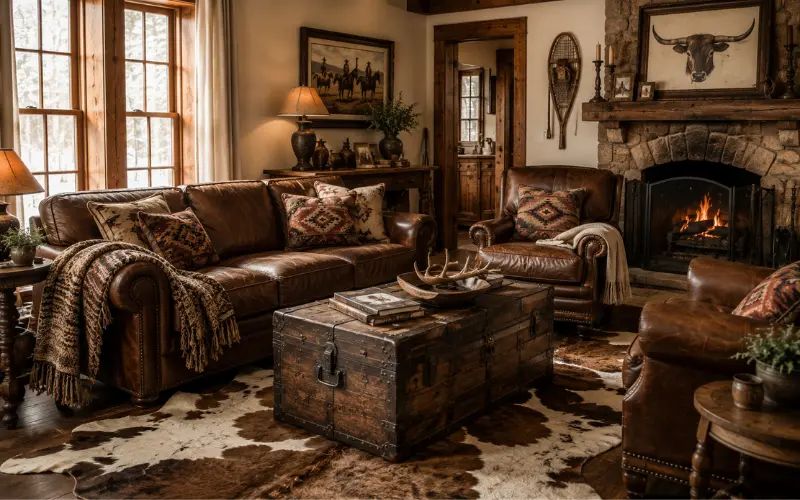
The living room carries the most weight in this style since it’s usually the largest, most visible space. A few practical starting points:
- Anchor with one large textile. A cowhide rug or a Navajo-pattern area rug under the coffee table does more to set the tone than a dozen small accessories combined.
- Layer leather seating with a woven throw. A worn leather sofa paired with a hand-woven wool blanket over the arm softens what could otherwise feel stiff.
- Use a vintage trunk as a coffee table. This is one of the most functional swaps you can make. It adds storage and an authentic weathered surface without needing to source a separate carved table.
- Keep wall art to landscapes, portraits, or line art of horses and cattle. Skip anything overtly cartoonish. The line between “western decor” and “theme park gift shop” is thinner than people think.
For rustic western living room ideas specifically, lean into texture over color. A room can be almost entirely neutral (cream, tan, brown) and still read as strongly western if the textures are right: rough-hewn wood, nubby wool, and worn leather side by side.
Sourcing: Genuine Vintage vs. New-Made Reproductions
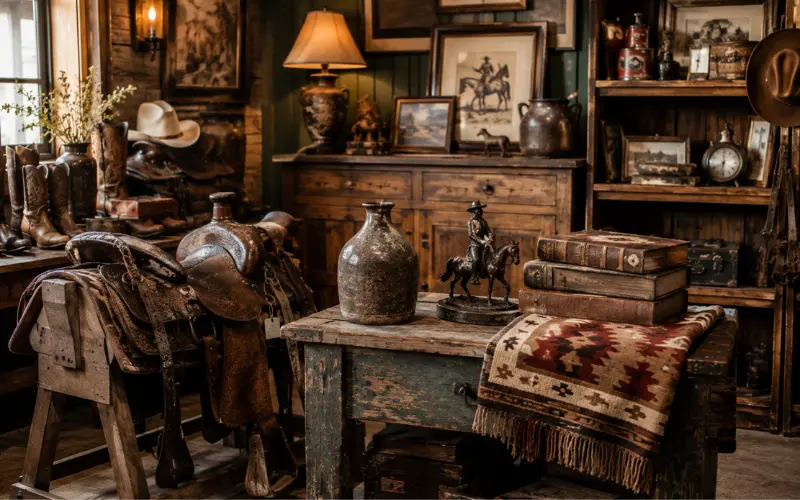
This is the part almost every competitor article glosses over, and it matters for both budget and authenticity.
Genuine vintage pieces (estate sales, antique malls, Etsy vintage sellers) cost more upfront but carry real patina you can’t fake. A 1950s cowboy figurine or an actual worn saddle has a weight and texture that new reproductions rarely nail. The tradeoff is time. You’re hunting, not ordering.
New-made reproductions (most big retailers) are faster and more consistent but often too clean. If you go this route, distress them slightly yourself: a light sanding on wood edges, a leather conditioner that darkens unevenly, or simply using the item outdoors for a season before bringing it inside.
A practical middle ground: buy the large, expensive anchor pieces (sofa, rug, coffee table) new for durability and comfort, then source the small accent pieces (figurines, frames, tins, books) secondhand. This gets you both authenticity and comfort without blowing the whole budget on antiques.
Vintage Western Home Decor Ideas DIY Projects That Don’t Look Homemade
DIY Vintage Western Home Decor has a reputation for looking exactly like what it is: a craft project. These hold up better because they rely on real materials instead of paint effects:
- Repurpose an old horse saddle as a bar stool seat. Mount it on a simple wood or metal stool base. This is a genuine period practice, not a Pinterest gimmick, and it uses an object that’s often cheap secondhand since saddle leather cracks with age and loses value as tack.
- Turn a wagon wheel into pendant lighting rather than a wall piece. Wall-mounted wagon wheels have become a visual cliché. Hung horizontally as a chandelier frame with small Edison bulbs, the same object reads as fresh.
- Distress new wood frames with a vinegar-steel wool solution instead of a store-bought “aging” glaze. It reacts with the wood tannins and produces uneven, believable graying that manufactured stains can’t replicate.
- Build a simple leather wall hanging from remnant hide. Leather offcuts from a local upholstery shop are usually cheap or free and can be cut into a fringed panel for a fraction of retail price.
Modern Vintage Western Home Decor Ideas: Making It Work in Contemporary Spaces
Not everyone wants a full ranch-house look. A growing number of homeowners want western elements inside an otherwise clean, contemporary interior, and this is where most guides offer nothing useful.
The trick is isolating western elements to one or two “moments” in an otherwise neutral room instead of spreading them everywhere. A minimalist living room with white walls, a low-profile sofa, and clean lines can take a single cowhide ottoman or one framed horse print and still feel intentional. Add a third or fourth western piece and the contemporary base starts to fight with the theme.
Mixed metal finishes also help bridge old and new. Pairing a matte black modern light fixture with a single aged-brass accent (like a vintage stirrup used as a bookend) keeps the room from tipping fully rustic while still nodding to the style.
Common Mistakes That Undercut the Look
- Buying matching sets. A matched saddle-brown leather sofa, loveseat, and ottoman from one collection reads as a showroom, not a home.
- Overusing cattle skulls. One is a statement. Three is a taxidermy shop.
- Ignoring lighting temperature. Cool white LED bulbs undercut every warm material in the room. Stick to warm white (2700K-3000K) bulbs regardless of fixture style.
- Skipping the floor. People spend heavily on walls and furniture, then leave bare tile or gray carpet underneath. The floor is half the visual weight of a western room.
FAQ
What defines Vintage Western Home Decor as opposed to modern western decor?
Vintage western decor pulls from mid-20th-century ranch and frontier aesthetics, with worn leather, hand-carved wood, and period artifacts. Modern western decor uses the same motifs (cowhide, horns, leather) but in cleaner, more minimalist forms with less ornamentation.
Is Vintage Western Home Decor still popular in 2026?
Yes. It’s had a resurgence alongside broader interest in Americana, ranch-core aesthetics, and the “quiet luxury meets rustic” trend showing up across home design platforms.
How much does it cost to decorate a room in vintage western style?
A single accent room (rug, a few wall pieces, one furniture swap) can be done for a few hundred dollars using secondhand sourcing. A full living room with genuine vintage furniture pieces typically runs into the low thousands, depending on how much is sourced new versus antique.
Can I do vintage western decor in a small apartment?
Yes. Focus on one anchor piece (a rug or a single wall gallery) rather than trying to fill every surface. Small spaces actually benefit from the restraint this style needs anyway.
What’s the difference between Vintage Western Home Decor and southwestern decor?
Western decor leans on cowboy and ranch culture (saddles, cattle, leather, wagon wheels). Southwestern decor draws more from desert and Pueblo influences (adobe textures, turquoise, terra cotta). They overlap but aren’t identical, and mixing them without intention is a common source of visual clutter.
Where can I find genuine Vintage Western Home Decor pieces?
Estate sales, antique malls, and vetted Etsy vintage sellers are the most reliable sources. Ranch auctions and farm liquidation sales, when you can find them locally, often have the most authentic and least marked-up pieces.
Does Vintage Western Home Decor work outside of the living room?
Yes, though it’s most common there. Bedrooms take well to a single leather headboard or a woven blanket as a bed topper. Bathrooms and kitchens should stay light on this style since humidity damages leather and unfinished wood over time.
How do I keep Vintage Western Home Decor from looking dated instead of vintage?
Anchor the room with contemporary furniture shapes (clean-lined sofas, simple case goods) and let the vintage pieces act as accents rather than the whole room. A room built entirely from period furniture reads as a museum diorama rather than a home someone lives in today.
Final Thought
Vintage western home decor rewards patience more than budget. The rooms that actually convince, the ones that don’t scream “theme,” are built by people willing to hunt for one genuinely worn saddle instead of buying five new “rustic” accessories in an afternoon. Start small: one anchor textile, one piece with real age on it, and let the room grow from there instead of trying to complete the look in a single order. That’s the difference between a space that feels collected over a lifetime and one that feels bought last weekend.

