
The right knobs and cabinet hardware come down to three things: size proportional to the drawer or door, a finish that matches your other fixtures (not necessarily your appliances), and hole spacing that fits your existing holes unless you’re drilling new ones. Get those three right and almost any style choice will look intentional rather than random.
Why “Knobs & More” Trips Up So Many Buyers
Most people start shopping for a Knobs & More Home Decor end up needing a spreadsheet. Knobs & More Home Decor sits at the intersection of plumbing fixtures, appliance finishes, door hinges, and light fixtures, so a choice that looks fine on its own can clash the moment it’s installed next to everything else in the room. That’s the actual problem “knobs and more” is trying to solve: it’s rarely just one knob, it’s dozens of small decisions that need to agree with each other.
I learned this the hard way on a kitchen refresh where I bought oil-rubbed bronze knobs before checking the faucet. The faucet was brushed nickel. It wasn’t a disaster, but it did look like an afterthought for two years until I finally swapped the faucet too.
Knobs or Pulls: What Actually Looks Better on Kitchen Cabinets
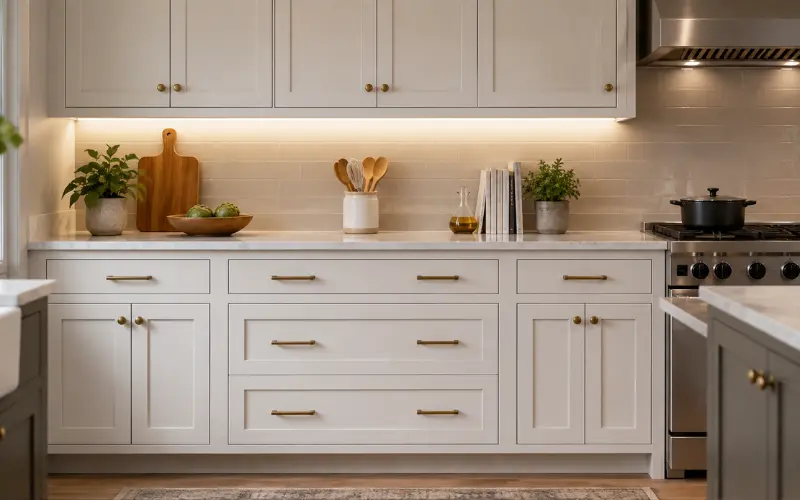
There’s no single right answer, but there is a practical one. Knobs work well on cabinet doors because a single grip point is all you need to swing a door open. Pulls, or handles, work better on drawers because you’re pulling straight out and a longer grip distributes the force evenly, so the drawer doesn’t stick or tilt when you yank one side.
A layout that consistently reads as “designed” rather than “decorated” usually follows this split:
- Knobs on doors — upper cabinets, lower cabinet doors, pantry doors
- Pulls on drawers — anything you slide open, especially wide ones like pot drawers
Mixing the two isn’t wrong. Plenty of high-end kitchens use pulls everywhere for a cleaner, more modern line, especially on slab-front cabinetry. But knobs-on-doors, pulls-on-drawers is the safest default if you’re not sure, and it’s the combination that shows up most in kitchen cabinet hardware planning done by professional kitchen designers.
The 1/3 Rule for Cabinet Handles, Explained Properly
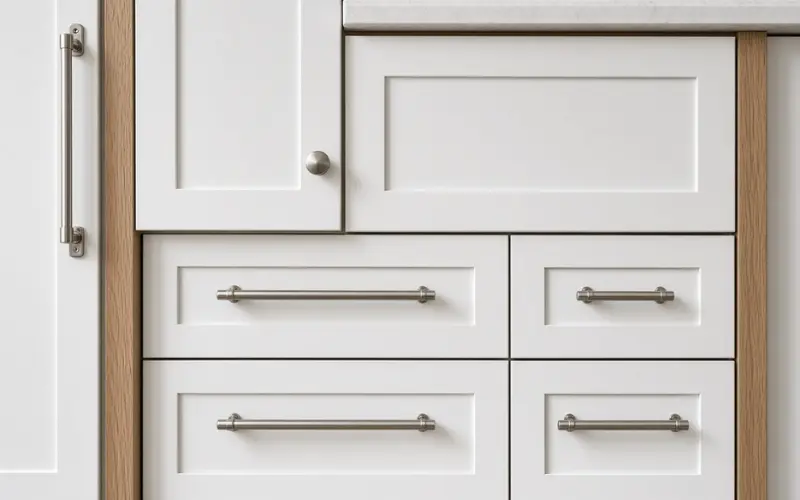
You’ll see “the 1/3 rule” mentioned constantly, but most articles skip the part that actually matters: it applies differently to pulls than it does to knobs.
For pulls: the hardware’s overall length should be roughly one-third the width of the drawer, or one-third the height of the door, measured center to center between the screw holes. A 36-inch drawer suits a pull around 10 to 12 inches. Manufacturers like Top Knobs actually treat one-third as a ceiling, not a target, meaning it’s the longest a pull should reasonably get before it starts looking oversized.
For knobs: the rule doesn’t translate directly because a knob is a single point, not a measurable length. Instead, designers use a smaller ratio, roughly 1/12 to 1/10 of the door or drawer width for the knob’s diameter. A standard cabinet knob is usually 1 to 1.5 inches across, which is why the same knob can look fine on a small drawer and lost on a wide pantry door.
For doors specifically, skip the 1/3 rule entirely. A pull between 5 and 7 inches is a safe range for upper cabinet doors, going longer only if you’re after a contemporary look or you have extra-tall pantry doors.
| Hardware Type | Sizing Guideline | Best Use |
|---|---|---|
| Knob | 1″–1.5″ diameter (roughly 1/10 of surface width) | Cabinet and pantry doors |
| Standard pull | 3″–5″ (small drawers) | Narrow drawers, upper cabinets |
| Long pull | 8″–12″, up to 1/3 of drawer width | Wide drawers, pot drawers, appliance panels |
| Appliance pull | Oversized, reinforced bolts | Dishwasher panels, fridge panels |
Finish and Material Trends Worth Knowing Before You Order
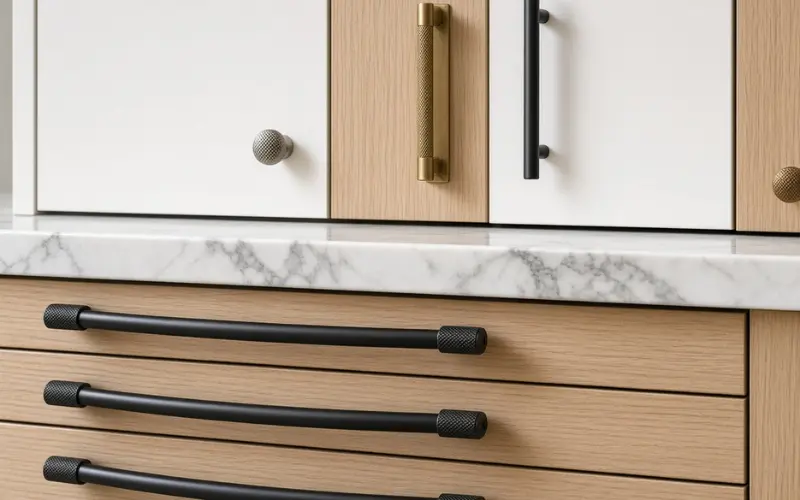
Cabinet hardware finishes shifted noticeably over the past couple of years, and buying based on a five-year-old blog post is a fast way to end up with something dated.
- Mixed metals are now standard, not a mistake. Matte black pulls with brass lighting, or brushed nickel with warm bronze accents, are common in current kitchens. You don’t need every metal in the room to match anymore.
- Living finishes are gaining ground. Unlacquered brass develops a patina with use instead of staying shiny, which some homeowners want and others find frustrating if they expected it to stay bright.
- Oversized, linear pulls on wide drawers and slab cabinets read as modern and make heavy drawers easier to open, since more length means more leverage.
- Textured and knurled details are showing up on knobs and pulls alike, adding grip and a tactile detail that a plain cylinder doesn’t have.
If you’re coordinating hardware with a full modern kitchen cabinets refresh, pick your finish family before you shop knob by knob. It saves a lot of returns.
Rubber Cabinet Knobs: A Niche Worth Knowing About
Rubber cabinet Knobs & More Home Decor rarely show up in glossy hardware catalogs, but they solve a specific, common problem: noise and grip in high-traffic cabinets. Kids’ bathrooms, RV or boat cabinetry, and garage workbenches all benefit from a rubber or soft-touch knob because they don’t clatter when a door swings shut and they’re easier to grip with wet or greasy hands. If you’ve got a child’s room where drawers get slammed fifty times a day, this is one upgrade that’s more functional than decorative, and worth it anyway.
Vintage Knobs: Buying for Character Without Overpaying
Vintage and reproduction Knobs & More Home Decor, think glass, milk glass, or aged brass with visible casting marks, add a texture that new hardware struggles to fake. A few things I’ve learned buying them:
- Salvage yards and estate sales often have genuinely old hardware for less than a “vintage-style” reproduction costs new.
- Check hole spacing before you fall in love with a set. Older hardware sometimes uses non-standard spacing that won’t line up with modern cabinet doors without new drilling.
- Glass knobs chip. Buy two or three extra if you’re outfitting a whole kitchen, because matching a chipped one later is close to impossible.
Where to Buy Decorative Knobs and Pulls
Big box stores like Home Depot and Target are fine for standard finishes in common sizes, and they’re useful if you need something today. Specialty hardware retailers and dedicated cabinet hardware sites carry a much wider range of finishes, materials, and less common sizes, which matters if you’re trying to match an existing set or find something like rubber or glass knobs that big-box stores rarely stock. Marketplaces such as Amazon are worth checking for price comparison, but read the return policy first since hardware finishes can look different in person than in photos.
A quick gut check before you buy: order one knob and one pull first if you’re unsure. Install them, live with them for a few days under your actual kitchen lighting, then order the rest. It costs a few extra dollars in shipping and saves you from redoing an entire kitchen’s worth of hardware.
Mistakes That Lead to Regret
- Buying finish first, size second. A beautiful finish on the wrong-sized pull still looks wrong.
- Ignoring existing hole spacing. Unless you’re comfortable drilling and filling old holes, measure your current spacing before ordering.
- Matching hardware to appliances instead of fixtures. Appliances get replaced more often than plumbing fixtures; match your lighting and faucets first.
- Assuming knobs and pulls from the same collection always match perfectly in finish. Even within one product line, batches can vary slightly. Order from the same batch if the collection matters to you.
FAQ on Knobs & More Home Decor
What Knobs & More Home Decor are in style now?
Warm brass and mixed-metal finishes, oversized linear pulls on drawers, and textured or knurled knobs are the dominant styles in current kitchens, alongside a continued preference for matte black in more contemporary spaces.
Where can I buy decorative knobs and pulls for home projects?
Specialty cabinet hardware retailers offer the widest selection of finishes and sizes, big box stores are convenient for standard options, and marketplaces are useful for price comparison as long as you check the return policy first.
What is the 1/3 rule for cabinet handles?
It’s a sizing guideline where a pull’s length should be roughly one-third the width of the drawer or height of the door, measured center to center. It applies to pulls, not to knobs, which use a smaller diameter-based ratio instead.
What looks better on kitchen cabinets, Knobs & More Home Decor?
Neither is universally better. Knobs suit doors since you only need one grip point to swing them open, while pulls suit drawers because a longer grip evenly distributes the pulling force.
Do Knobs & More Home Decor need to match exactly?
No. Many current kitchens deliberately mix finishes, like matte black pulls with brass lighting. What matters more is that the overall palette feels intentional rather than accidental.
Can I install cabinet knobs myself?
Yes, in most cases. If your new hardware matches your existing hole spacing, it’s a straightforward drill-and-screw job. If the spacing is different, you’ll need to fill the old holes and drill new ones, which is more work but still manageable as a weekend project.
Are rubber Knobs & More Home Decor only for kids’ rooms?
No. They’re also useful in RVs, boats, garages, and any cabinet that gets opened with wet, greasy, or gloved hands, since rubber grips better and doesn’t rattle.
How do I know what size knob to buy for my cabinets?
Aim for a diameter around one-tenth to one-twelfth of the door or drawer width. For most standard cabinets, that lands between 1 and 1.5 inches, which is why that range covers the majority of off-the-shelf knobs.

