
You do not need a spare bedroom to enjoy a dressing room that feels put together. A well-planned modern small dressing room design can turn a leftover corner, a slice of hallway, or a bedroom nook into a space that works as hard as it looks good. The trick is not squeezing more furniture into the room. It is choosing the right layout, storage, lighting, and finishes so the space feels open even when the square footage is not on your side.
This guide covers what actually matters when planning a modern small dressing room design, including a few details most articles skip, like how door swing and even sound can quietly shape how big or small a room feels.
Why a Modern Small Dressing Room Design Needs a Different Approach
Large walk-in closets can absorb design mistakes. Small spaces cannot. Every shelf, mirror, and light fixture in a modern small dressing room design has to earn its place. Before picking finishes or furniture, get clear on three things:
- How you actually get dressed (sitting or standing, folded clothes or hanging)
- How much natural light the room receives during the day
- Where the doorway and any windows sit, since these fix your usable wall space
Answering these questions first prevents the common mistake of buying beautiful furniture that simply does not fit the room’s flow.
Pick a Layout That Matches Your Room’s Shape
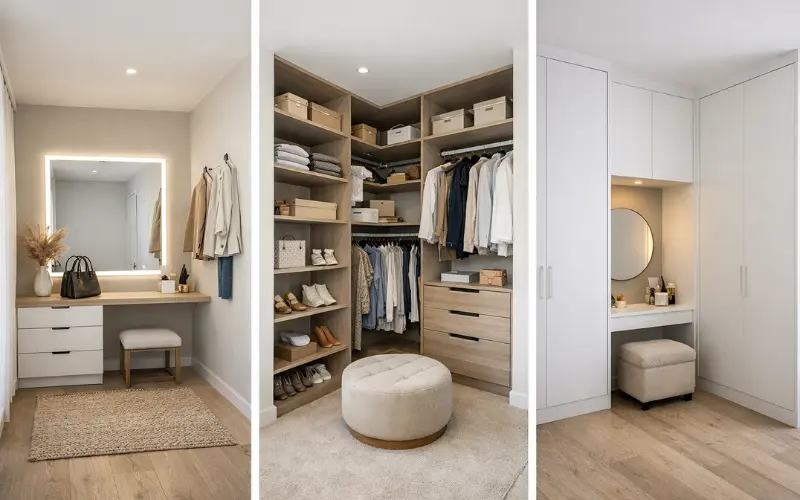
Most small dressing rooms fall into one of three shapes, and each calls for a different plan.
- The single-wall layout. A single run of slim wardrobes, drawers, and a mirror along one wall keeps the floor completely clear. This is the most forgiving layout for a modern small dressing room design because it never blocks a walking path.
- The corner layout. An unused bedroom corner can hold an L-shaped run of open shelving and a compact hanging rail, turning wasted space into one of the easiest wins in any modern small dressing room design.
- The alcove layout. A recess beside a chimney breast or between two walls is practically built for a mini dressing room. Fitted wardrobes with flush doors make the alcove disappear into the wall and keep sightlines clean.
Whichever shape you have, leave at least 90 centimeters of clear floor space in front of any wardrobe so the doors can open fully and you can move without bumping into furniture.
Storage Ideas That Free Up Floor Space
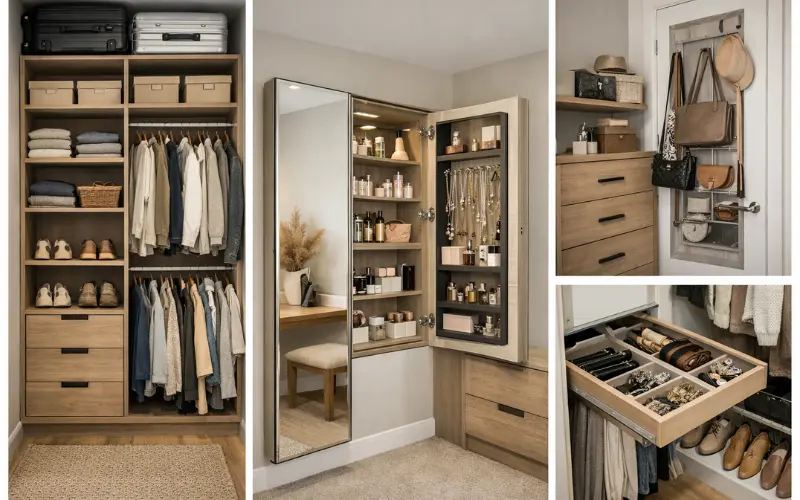
Storage is where most modern small dressing room design projects succeed or fail. The goal is to store more while the room visually holds less.
- Go floor-to-ceiling. Wall space above eye level is usually wasted. Stack shelving or cabinetry all the way up and reserve the top shelf for items you use rarely, like out-of-season coats or spare luggage.
- Hide storage behind the mirror. A mirrored cabinet door does double duty. It reflects light and hides jewelry, perfume, or makeup behind a clean surface, which is a detail that instantly makes a modern small dressing room design feel more considered.
- Choose drawers over doors near tight corners. Doors need swing space; drawers do not. In a tight footprint, drawer units let you use every last inch right up to a wall.
- Use the back of the door. A slim over-the-door rack or hook rail adds hanging space without touching your floor plan at all.
- Add pull-out accessory trays. Narrow pull-out units for belts, scarves, and ties tuck into gaps as small as 15 centimeters, which is often the leftover space beside a window or beam.
- Group by category, not by season. Sorting by type (tops, bottoms, formal wear) rather than by season keeps the space genuinely easy to use every single day, not just tidy for a week.
Lighting Details Most Guides Leave Out
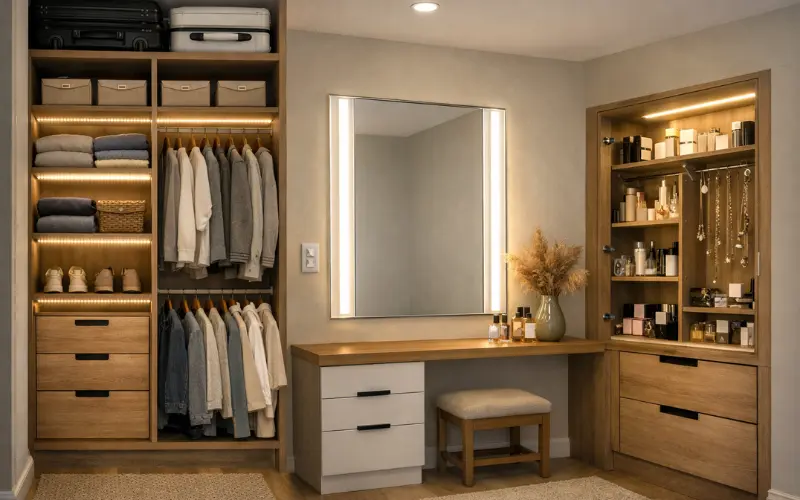
Lighting is where a modern small dressing room design either looks polished or looks like an afterthought, and it is worth more attention than most guides give it.
- Layer three types of light. Ambient light for the whole room, task light around the mirror, and accent light inside cabinets or shelving together remove flat shadows that make a small room feel closed in.
- Match your light temperature to your mirror use. A color temperature between 4000K and 5000K, close to natural daylight, shows true colors on skin and fabric. Warmer bulbs below 3000K can flatter skin but distort how colors actually look once you step outside.
- Light the mirror, not just the ceiling. Vertical strip lights on either side of a mirror eliminate the shadows that a single overhead bulb casts under the chin and eyes.
- Add a dimmer. Getting ready for a morning meeting and getting ready for an evening out need different brightness levels, and a dimmer switch costs little to install.
- Use LED strips under shelves. A thin LED strip under each shelf edge adds a soft glow that makes stacked clothes easier to see without adding a single visible fixture.
Mirrors: The Fastest Way to Make a Small Room Feel Larger
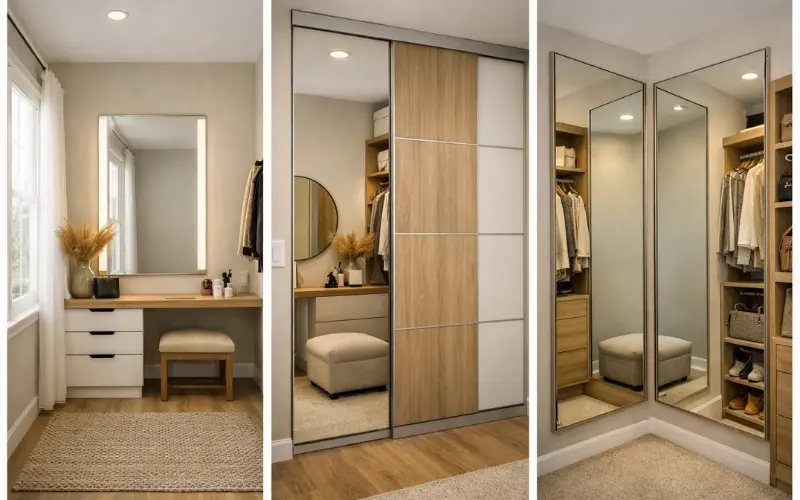
A full-length mirror is non-negotiable in any modern small dressing room design, but placement changes everything.
- Position the mirror opposite the main light source, usually a window, so it bounces daylight deeper into the room.
- A mirror mounted on a sliding wardrobe door saves the wall space a separate mirror would need.
- Two narrower mirrors placed at a slight angle in a corner can make a tight nook feel twice as wide as it is.
- Avoid placing a mirror directly opposite a cluttered shelf. It will double the mess, not the space.
Color and Material Choices That Open Up the Room
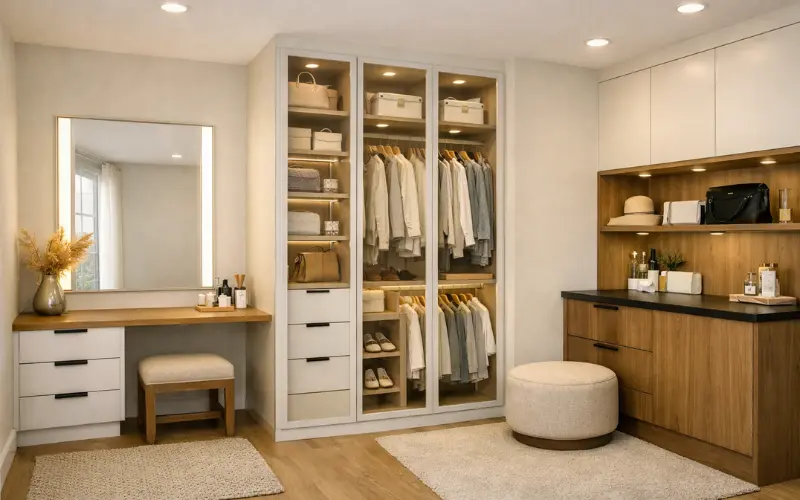
Color does real work in a modern small dressing room design, not just decoration.
- Light, warm neutrals like soft white, oatmeal, or pale grey reflect the most light and suit almost every space.
- Matte finishes on walls reduce glare from overhead lights, while a gloss or lacquer finish on cabinet fronts bounces light around without overwhelming the room.
- Glass-front cabinets add depth because you can see through them rather than at a flat, solid surface.
- If you love a darker palette, keep it to the lower half of the room or the cabinetry only, and keep the ceiling and upper walls light so the room still reads as tall and open.
Furniture and Seating That Do Not Crowd the Space
You do not need a full vanity table to get the benefit of one. A fold-down shelf, a slim floating counter, or a stool that tucks fully under a shelf when not in use all deliver the function of a dressing table without permanently claiming floor space. A pouf that slides under a bench is another simple way to add seating to a modern small dressing room design without it taking up a corner all day long.
Small Details That Make a Big Difference
A few details rarely make it into competitor guides, yet they change how a small dressing room actually feels to use:
- Sound and material softness. Hard surfaces in a small room can make it feel echoey. A soft rug or a fabric-lined drawer for delicates quiets the space and adds warmth.
- Ventilation. If the dressing area sits near a bathroom, a small extractor fan or vent prevents dampness from reaching stored clothes.
- Door swing direction. A door that opens outward instead of inward can free up several square feet of usable space inside a tight room.
- Vertical stripes or paneling. Thin vertical lines on a wardrobe design front or wall panel draw the eye upward, which visually raises a low ceiling.
Common Mistakes to Avoid
- Overfilling every shelf, which removes the breathing room that makes a small space feel calm
- Choosing a statement chandelier that eats up headroom in a low-ceilinged room
- Skipping task lighting and relying only on a ceiling bulb
- Picking heavy, dark furniture for a room under 20 square feet
Frequently Asked Questions
1. What is the minimum space needed for a modern small dressing room design?
A functional layout can work in as little as 15 to 20 square feet if you use a single-wall or corner layout with floor-to-ceiling storage.
2. What color works best for a small dressing room?
Light, warm neutrals such as soft white, cream, or pale grey reflect the most light and make the room feel larger than darker tones.
3. How do I add a dressing room without a spare room?
Convert a bedroom corner, an alcove, or even the end of a hallway with a slim wardrobe, a full-length mirror, and layered lighting.
4. What lighting is best for applying makeup in a small dressing room?
Vertical lights beside the mirror, in a daylight tone between 4000K and 5000K, give the most accurate, shadow-free reflection.
5. Should I use a mirrored wardrobe or a separate mirror in a small space?
A mirrored wardrobe door is usually the better choice because it saves wall space while still giving you a full reflection.
6. How can I add seating without losing floor space?
Choose a stool or pouf that slides fully under a shelf or bench when it is not in use.
7. Do glass-front cabinets work in small dressing rooms?
Yes. Glass fronts add visual depth and make the room feel more open than solid, closed cabinetry.
8. How do I stop a small dressing room from feeling cluttered?
Sort items by category, use closed storage for anything you do not use daily, and leave at least one shelf or surface completely empty.
Final Thoughts
A modern small dressing room design does not depend on square footage. It depends on smart choices: the right layout for your room’s shape, storage that goes vertical instead of wide, layered lighting that actually helps you get ready, and colors that keep the space feeling open. Start with one or two changes, like adding a mirrored cabinet door or layering your lighting, and build from there. A small room, planned well, can feel every bit as luxurious as a much larger one.

