
Yes, a good Best Wall Lamp for Bedroom earns its place in a bedroom, but only when it’s matched to how you actually use the bed. It frees up your nightstand, cuts glare compared to an open bedside lamp, and gives you a fixed light source that never gets knocked over. Where people go wrong isn’t the decision to buy one, it’s buying based on looks instead of function, and that’s the gap this guide fills.
My honest take: I wouldn’t pick a wall lamp off a product photo alone. I’d check the projection in millimetres, the switch location, the colour temperature, and whether the beam sits level with my eyes when I’m sitting up in bed. Those four things decide whether you use the lamp every night or unplug it within a month.
Why This Decision Is Trickier Than It Looks
Most bedroom lighting guides treat this as a styling choice. It isn’t, not really. It’s a placement and wiring problem dressed up as a styling choice.
Older homes often have a single power point near the skirting board and nothing near where your head sits in bed. Apartments and units add another layer: if you’re in a strata building, altering wiring inside a wall can need body corporate sign-off before an electrician even touches it. Renters face a simpler but stricter version of the same issue, since most leases don’t allow drilling into brick or rendered walls at all.
None of the competitor guides I looked at for this topic flagged that distinction clearly. They talk about hardwired versus plug-in as a style preference. In practice, it’s often decided for you before you even open a lighting catalogue.
What a Best Wall Lamp for Bedroom Actually Costs to Run
Here’s a number nobody else in this space seems to publish: a 5-watt LED wall lamp run for two hours a night, every night, costs roughly $3 to $5 a year in electricity at typical residential rates. That’s not a meaningful saving over a bedside lamp on its own. The real value isn’t the power bill, it’s the space and the quality of light. If cost saving is your only reason for switching, a wall lamp won’t move the needle much. If it’s comfort and clutter, it will.
Match the Lamp to What You Actually Do in Bed
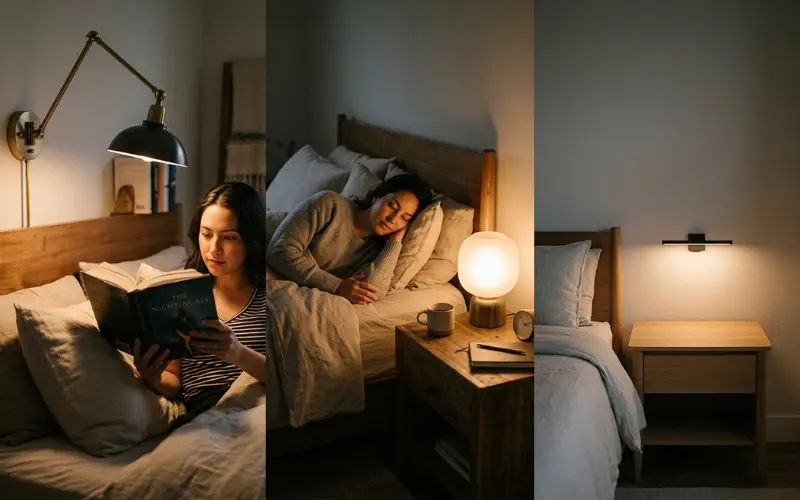
Three lighting personalities cover almost every bedroom:
The reader. You need directional light with an adjustable arm or rotating head, aimed at the page rather than your face. A shade or diffuser matters more than raw brightness here.
The wind-downer. You want a soft wash of light for the last twenty minutes before sleep, not a spotlight. A frosted or opal shade does this better than a clear one. If you’re weighing shade types, it’s worth understanding the difference between translucent glass and frosted glass before you buy, since the two scatter light very differently and one will suit a calmer bedroom far better than the other.
The minimalist. You just want the nightstand clear and a low, functional glow for getting in and out of bed at night. A slim fixed sconce with a low lumen output does the job without adding visual weight to the wall.
Most people are a mix of two of these, which is exactly why a dimmable fixture beats a fixed-output one almost every time.
Get the Height Right, and Check What’s Behind the Wall
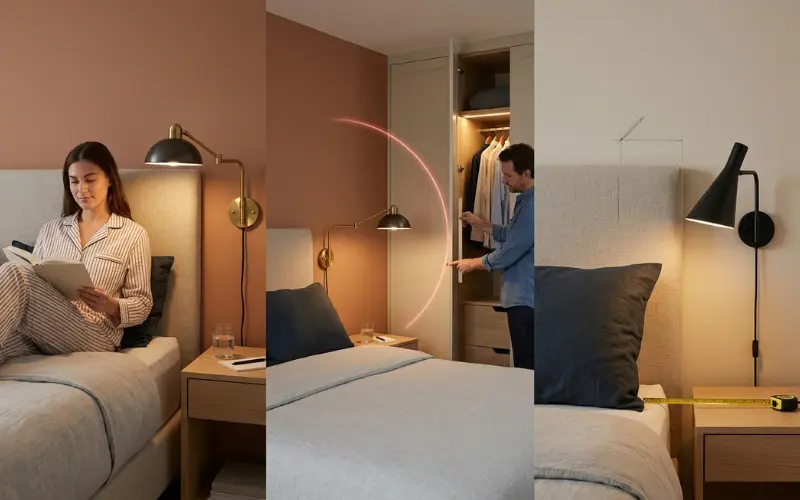
Sit up in bed in your usual position before you mark anything on the wall. As a starting point, the light source usually sits somewhere between 90 and 130 cm from the floor, depending on your mattress height and headboard, but that number means nothing until you’ve tested it against your own posture.
Here’s the part competitors consistently skip: check the swing radius of nearby doors before committing to a position. A built-in wardrobe door or a walk-in robe entrance can clip a projecting lamp arm if it’s mounted too close to the opening. If you’re planning wardrobe changes at the same time, it’s worth sense-checking your walk-in wardrobe dimensions against the lamp’s final position so the two don’t compete for the same few centimetres of wall.
Horizontally, keep the lamp 15 to 25 cm out from the mattress edge. Directly above the pillow almost always causes glare for whoever’s sleeping under it.
Colour Temperature and the Flicker Nobody Mentions
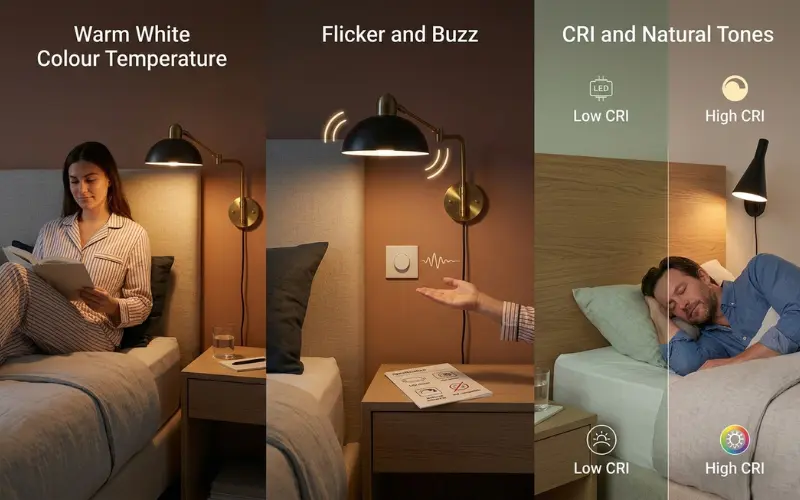
Warm white, somewhere between 2700K and 3000K, is the right range for a bedroom. Most guides stop there. What they don’t mention is that cheap dimmer switches paired with LED drivers can cause visible flicker or a faint buzzing sound, especially at low brightness. This isn’t a lamp fault, it’s a compatibility issue between the dimmer and the driver inside the fixture.
Before installing a dimmer, check the lamp’s packaging or spec sheet for compatible dimmer types (trailing-edge dimmers suit most LED fixtures better than older leading-edge ones). Skipping this check is one of the most common reasons people end up disappointed with an otherwise good lamp.
Colour rendering index, or CRI, is worth a mention too. Anything above 80 is acceptable; 90 and above makes timber, linen and skin tones look noticeably more natural under the light, which matters more than people expect once the sun’s gone down.
Plug-In, Rechargeable or Hardwired
| Option | Best suited to | Main trade-off |
|---|---|---|
| Plug-in | Renters, quick updates | Cord needs managing so it doesn’t trail across the wall |
| Rechargeable | No nearby power point, temporary layouts | Battery life usually covers a few nights before recharging |
| Hardwired | Owned homes, permanent renovations | Needs a licensed electrician, cleanest finish |
Rechargeable models have improved a lot and suit anyone who wants light without touching the wall at all. Hardwired still wins for a genuinely built-in look, but it’s the option with the least flexibility if you change your mind about placement later.
Wiring Rules Most Guides Gloss Over
If you’re hardwiring, the work needs to be done by a licensed electrician to meet AS/NZS 3000 wiring standards. That’s not optional, and it also matters for insurance if anything ever goes wrong. What’s less talked about is timing: if you’re already having any other electrical work done (a new power point, a ceiling fan, downlights), it’s far cheaper to add the wall lamp wiring in the same visit than to call an electrician back out separately for one small job.
For rentals, always check your lease before drilling, even for a light-duty wall anchor. Some landlords are fine with small anchor holes if they’re patched on move-out; others aren’t. It’s a five-minute conversation that saves a bond dispute later.
Mistakes That Waste Money
Buying the biggest, brightest fixture without checking lumens against room size is the most common one. A 600-plus lumen fixture at close range can be genuinely uncomfortable to read under.
Mounting too high so the beam lands on the top of your head instead of the page is the second. Ignoring the switch position is the third, and it’s the one people regret fastest: nothing undoes the appeal of a nice lamp faster than having to get out of bed to turn it off every night.
If you’re pulling the whole room together, keep the lamp’s finish loosely aligned with your other home décor furniture rather than treating it as an isolated purchase. It doesn’t need to match exactly, but a brushed brass lamp beside chrome door handles and a black bedframe tends to look accidental rather than intentional. And if timber is already a strong material in the room, whether that’s flooring or a bedhead, a lamp in a complementary tone will sit far more naturally against something like timber flooring than one picked purely because it was on sale.
A Quick Buying Checklist
- Decide the lamp’s main job: reading, ambient, or clearing the nightstand.
- Confirm colour temperature (2700K to 3000K) and dimmer compatibility if you want one.
- Sit in your usual reading position and mark the height on the wall before drilling anything.
- Check door and wardrobe clearance near the mounting spot.
- Choose plug-in, rechargeable or hardwired based on your lease and budget, not just looks.
- Confirm the switch is reachable from bed without sitting up fully.
A wall lamp that ticks these boxes tends to get used every single night. One chosen on looks alone tends to get switched off within a few weeks and quietly replaced.
FAQ on Best Wall Lamp for Bedroom
How high should a Best Wall Lamp for Bedroom be mounted?
Start by sitting up in bed in your normal position and marking the wall from there. As a rough guide, 90 to 130 cm from the floor works for most standard beds, but your mattress height and headboard will shift that.
Do I need an electrician for a Best Wall Lamp for Bedroom in Australia?
Only for hardwired fixtures. Plug-in and rechargeable wall lamps don’t need an electrician, but any fitting wired directly into the wall must be installed by a licensed electrician under AS/NZS 3000 standards.
Will a Best Wall Lamp for Bedroom actually save me money on electricity?
Not meaningfully. A typical LED wall lamp costs a few dollars a year to run. The real benefit is space and light quality, not the power bill.
Can I use a dimmer with any Best Wall Lamp for Bedroom?
No. Cheap dimmers paired with the wrong LED driver can cause flicker or a faint buzz. Check the lamp’s dimmer compatibility before installing one.
Is a plug-in Best Wall Lamp for Bedroom a good option for renters?
Yes, and rechargeable models are even easier since they don’t need a nearby power point at all. Always check your lease before drilling anchor holes, even small ones.
What colour temperature works Best Wall Lamp for Bedroom?
Somewhere between 2700K and 3000K. Anything cooler tends to feel clinical rather than restful in a bedroom setting.
How do I stop a Best Wall Lamp for Bedroom from disturbing my partner?
Choose a model with an adjustable arm or a shade that focuses the beam downward, and mount it slightly off-centre from the shared pillow zone rather than directly above it.
Can one wall lamp replace the main bedroom light?
For most rooms, no. A single wall lamp is best used as task or ambient lighting alongside a ceiling light, not as a full replacement for it.

