
An S Fold Curtains is a curtain that hangs from a track using evenly spaced carriers, so the fabric falls into a continuous, rolling S-shaped wave instead of bunching into individual pleats. There’s no separate curtain hook and pleat tape combo doing the work here: the wave itself is built into how the carriers sit on the track. It’s the style you’ll see in most new-build apartments and renovated living rooms because it reads as clean and architectural rather than fussy.
That’s the short version. Everything below is the part competitors gloss over: which hardware system you’re actually buying, why “fullness” numbers contradict each other across sites, what breaks first, and what it really costs.
The Two Hardware Systems Hiding Under One Name
Here’s something almost nobody explains clearly: “s fold curtain” isn’t one single piece of hardware. There are two distinct mechanisms sold under that name, and mixing them up is the most common reason people order the wrong parts.
Snap-tape carrier systems. The curtain header has a stiff tape sewn in with snap studs. Individual glider carriers with matching snaps click onto the tape at fixed points, and the S-wave is formed by the spacing of those carriers on the track. This is what most made-to-measure curtain companies (the kind that also fit blinds and shutters) sell as their standard s fold.
String-and-slide wave systems, sometimes labelled “wavefold” by hardware suppliers. Here, a continuous loop tape is sewn into the curtain, and separate hooks clip into the loops. The hooks connect to slides that run on a string threaded through the track, rather than snapping directly onto fixed points. This setup gives you finer control over spacing and is more forgiving if your window width doesn’t divide evenly.
Why this matters practically: if you ever need to replace a broken carrier or add extra hooks later, you need to know which system you have, because the parts are not interchangeable. If you’re buying tape, hooks, or carriers separately from a hardware supplier rather than a full custom curtain, check this before you order.
Fullness Ratios: Why The Numbers You’re Seeing Don’t Match
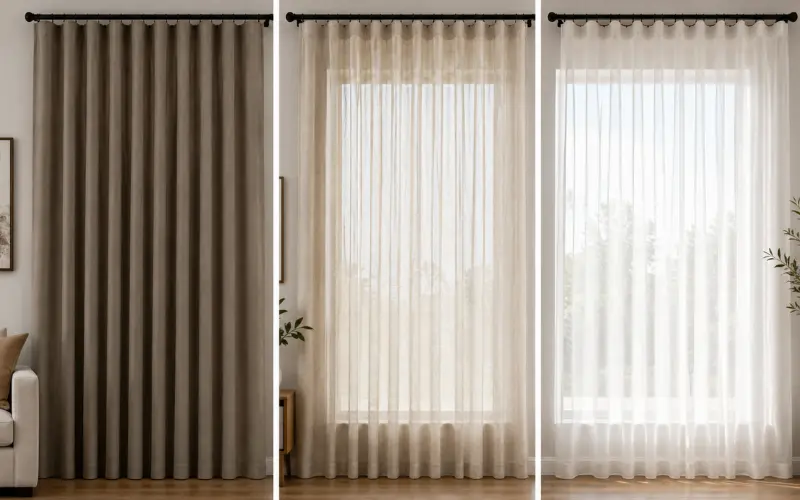
You’ll see s fold curtains described as needing “100% fullness,” “2x fabric,” or “2.2 to 2.4 times the track width.” These aren’t actually in conflict, they’re just different ways of saying overlapping things, and nobody bothers to reconcile them for you.
- “100% fullness” means you’re adding fabric equal to the track width on top of the flat width, which lands you at roughly double (2x) the track length in fabric.
- Suppliers quoting “2.2x” or “2.4x” are describing the same concept with a slightly more generous ratio, which produces deeper, denser waves.
- Anything below about 1.8x will look flat and thin when closed. Anything above 2.4x starts to waste fabric and add unnecessary weight on the track without a visible improvement in the wave.
My take: for a heavier blockout fabric, sit closer to 2x. For a lightweight sheer or linen, push toward 2.2–2.4x, because thinner fabric needs the extra bulk to hold a defined wave rather than collapsing into limp folds.
| Fullness Ratio | Best Fabric Type | Visual Result |
|---|---|---|
| 1.8x – 2.0x | Heavy blockout, velvet | Structured, slightly flatter wave |
| 2.0x – 2.2x | Standard cotton blends, linen blend | Balanced, most common choice |
| 2.2x – 2.4x | Sheer, voile, lightweight linen | Deep, soft, rolling wave |
S Fold Curtains vs Pinch Pleat: The Decision That Actually Matters
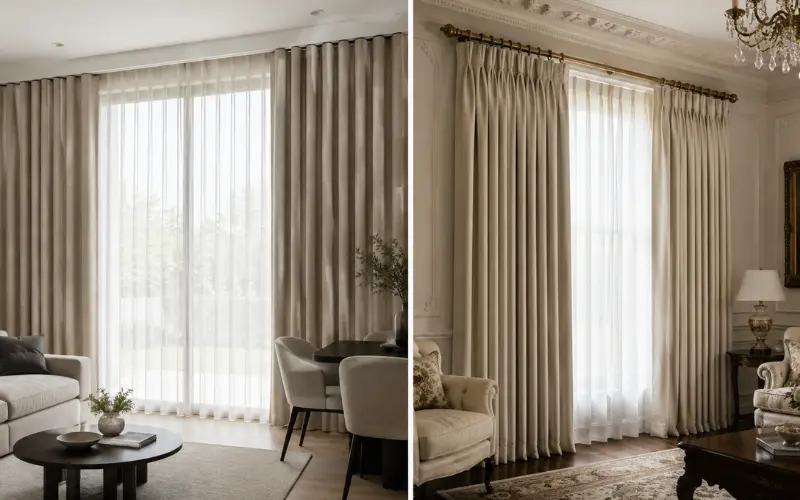
Most articles list this as a style comparison. The real decision points are functional.
- Fabric use: s fold curtains typically need less fabric per metre of track than pinch pleat, since pinch pleats often call for around 2.5x fullness to look right.
- Stacking: s fold curtains stack back tighter and flatter, which matters if you’ve got a narrow return wall next to the window and don’t want the curtain eating into your view when open.
- Ceiling vs formal rooms: s fold reads as contemporary and suits open-plan living and low-fuss interiors. Pinch pleat still wins in heritage homes or rooms with ornate cornices, where the more structured, tailored look matches the existing detailing.
- Motorisation: s fold curtains motorise more cleanly because the carrier spacing is already uniform, so there’s less risk of the wave distorting under a motor’s pull. Pinch pleat can be motorised too, but the pleats sometimes need adjusting after motor installation to sit evenly.
If you’re renovating a period home with detailed cornices, don’t default to s fold just because it’s trending. It can look oddly out of place against ornate trim.
Mounting: Ceiling vs Wall, and the Detail Everyone Skips
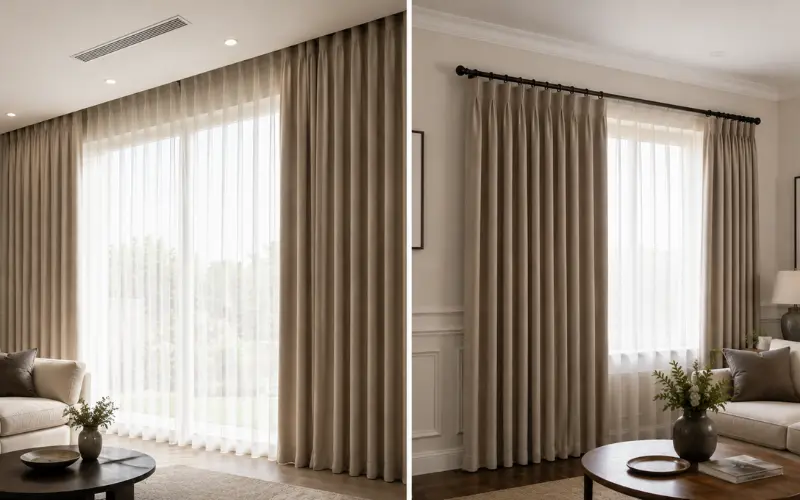
Ceiling-mounted s fold tracks give you the cleanest, most seamless look because the curtain runs floor to ceiling with no visible gap above the track. But here’s the detail that gets missed: if your ceiling has a cornice, downlights, or air vents running close to the window line, a ceiling mount can clash with them, and you may not have enough clearance for the track bracket screws to bite into solid material rather than just plasterboard.
Wall mounting solves that problem and works well behind bulkheads or period architraves, but it introduces a visible track and a small gap between the top of the curtain and the ceiling, which slightly reduces the height illusion s fold curtains are known for.
Field tip: if you’re unsure, check your ceiling for a joist or noggin near the window before committing to ceiling mount. Screwing a heavy blockout curtain’s track into plasterboard alone, without hitting a fixing point, is the single most common cause of a track sagging or pulling loose within the first year.
Fabric Choice: Beyond “Sheer or Blockout”
Everyone covers sheer versus blockout. Here’s what’s actually worth knowing when you’re choosing between them for an s fold specifically.
- Linen and linen-blend fabrics hold the S-wave beautifully because of their natural body, but 100% linen creases and can look uneven at the base of the wave over time. A linen-poly blend keeps the texture while resisting that sagging.
- Sheers need a slightly higher fullness ratio (closer to 2.2–2.4x) than blockouts to avoid looking thin and washed out when closed.
- Blockout s fold curtains with a three-layer construction block light fully and add real thermal value, keeping a room warmer in winter and cooler in summer, but they’re heavier, so make sure your track and brackets are rated for the extra weight, especially on a ceiling mount.
- Double-track setups, running a sheer s fold curtain on a front track and a blockout on a rear track, give you daytime light filtering and nighttime darkness from the same window without swapping curtains. It costs more but solves the sheer-vs-blockout dilemma entirely rather than forcing a compromise.
What S Fold Curtains Actually Cost
Prices vary a lot depending on fabric and whether installation is included, and a lot of articles avoid giving numbers at all. Rough ranges based on custom-made, professionally installed s fold curtains:
- Sheer s fold: budget-friendly end, entry-level pricing per metre installed
- Linen-blend s fold: mid-range, noticeably more than sheer due to fabric cost
- Blockout s fold: highest per-metre cost due to the three-layer construction and added weight-rated hardware
- Lined or premium s fold: sits at the top of the range, combining light filtering with a privacy backing
Get quotes from at least two suppliers before committing, and always ask whether the quote includes the track, not just the fabric and sewing. Some suppliers price these separately and it can catch people off guard.
Installing S Fold Curtains Yourself: What Actually Goes Wrong
If you’re doing a DIY install rather than paying for professional fitting, here’s where people run into trouble that isn’t covered in most step-by-step guides:
- Track sagging mid-span. On wide windows, a single-point bracket at each end isn’t enough. You need a support bracket roughly every 60–80cm along the track, especially with heavier blockout fabric, or the middle of the track will bow under the curtain’s weight.
- Uneven carrier spacing. When you’re clipping carriers on one at a time, it’s easy to lose count and end up with slightly uneven wave spacing near the end of the track. Lay the curtain flat and count the carrier positions against the header tape before you start clipping, rather than eyeballing it as you go.
- Wrong split point. If you want a centre opening, you need to plan which carrier is your centre point before you start, not after. Splitting off-centre because you didn’t check the midpoint first is one of the more common and most annoying DIY mistakes, because fixing it means unclipping half the curtain.
- Ignoring return arms. A return arm brings the curtain back to the wall at each end so light doesn’t leak around the sides. Skip it and you’ll get a visible gap of daylight down each edge, even with a well-fitted blockout fabric.
Quick Reference
| Task | What To Check First |
|---|---|
| Choosing hardware | Confirm snap-carrier system vs string-and-slide wave system |
| Setting fullness | Match ratio to fabric weight, not a flat rule |
| Mounting | Check for joists/noggins before ceiling mounting |
| Wide windows | Add mid-span support brackets every 60–80cm |
| Light gaps | Fit return arms at both ends |
If you’re planning the wider room around the curtains, matching the wave’s clean lines to your window shape is worth thinking through early, especially with arch windows or other non-standard openings where the track needs to follow a curve or step.
FAQ
Do s fold curtains need a special track, or will any curtain track work?
Yes, they need a specific s fold or wave track, either a snap-carrier system or a string-and-slide wave system. A standard curtain rod or basic gliding track won’t produce the S-shaped wave because the carrier spacing and mechanism are purpose-built for it.
Can I convert my existing pinch pleat curtains into s fold?
Not without resewing the header. S fold requires a different tape or carrier attachment sewn into the top of the curtain, so you’d need to remove the existing pleat tape and have a new header fitted, which is usually similar in cost to just having new curtains made.
How do s fold curtains handle in humid or coastal climates?
Linen-blend and blockout fabrics with mould and UV treatment hold up best in humid climates. Pure linen can absorb moisture and feel heavier or slightly limp in high humidity, so a treated blend is the safer choice near the coast or in tropical regions.
Are s fold curtains noisy when opening and closing?
Snap-carrier systems tend to run a little quieter than string-and-slide wave systems, since there are fewer moving parts sliding against the track. Either system will get quieter over time as the track wears in, and a light silicone-based track lubricant helps if yours is sticking or squeaking.
Can s fold curtains be used with a curtain wand instead of pulling the fabric directly?
Yes, and it’s worth adding if you’ve chosen a linen or linen-blend fabric, since repeated hand contact can leave marks or oils on natural fibres over time. A wand also reduces wear on the carriers themselves.
What’s the minimum window width for s fold curtains to look right?
There’s no strict minimum, but on very narrow windows (under about 60cm) the wave pattern doesn’t have enough width to develop properly and can look more like a single fold than a rolling wave. For narrow windows, a simpler heading style sometimes looks more proportional.
Do s fold curtains work well in rentals?
They can, but only if the track can be installed without permanent wall or ceiling damage, or if the property already has a compatible track. Speak to your landlord or body corporate before drilling into a ceiling for a rental fit-out.
How often should s fold curtain tracks be cleaned or serviced?
A light vacuum of the track channel every few months prevents dust buildup that causes carriers to stick. For heavily used curtains, a full inspection of carrier wear and bracket tightness once a year catches sagging before it becomes a real problem.

