
Modern pool designs rely on geometric shapes, minimal ornamentation, and a tight material palette, usually one or two finishes repeated consistently across the coping, decking, and waterline. The style works because it removes visual noise, not because it adds more features. Get the shape and materials right first, then layer in lighting, water features, or a spa.
Most articles on this topic stop at “pick a rectangle and add some LED lights.” That’s the surface. What actually separates a pool that photographs well from one that looks modern and holds up structurally, financially, and visually over ten years is a different conversation. That’s what we’re covering here.
Why Most “Modern” Pools Start Looking Dated Within 5 Years
Here’s something builders don’t advertise: a huge share of pools marketed as modern in 2019 and 2020 already look tired. Not because the geometric shape aged badly, but because of three specific mistakes.
- Trend-chasing finishes. Iridescent glass tile was everywhere five years ago. It still looks sharp in a well-executed pool, but a lot of builders slapped a glass waterline onto an otherwise generic pool and called it modern. The tile alone doesn’t do the work.
- Mismatched hardscape. A sleek pool shell surrounded by a mismatched paver pattern or leftover flagstone deck from a previous landscaping phase kills the effect instantly. Modern design is about material consistency, not any single feature.
- Ignoring the house. A pool that doesn’t relate to the architecture of the home reads as an add-on, not a design. If your home has warm wood siding and a low-slung roofline, a stark white geometric pool with glass tile can look out of place rather than intentional.
Shape Choices That Actually Perform in Real Yards
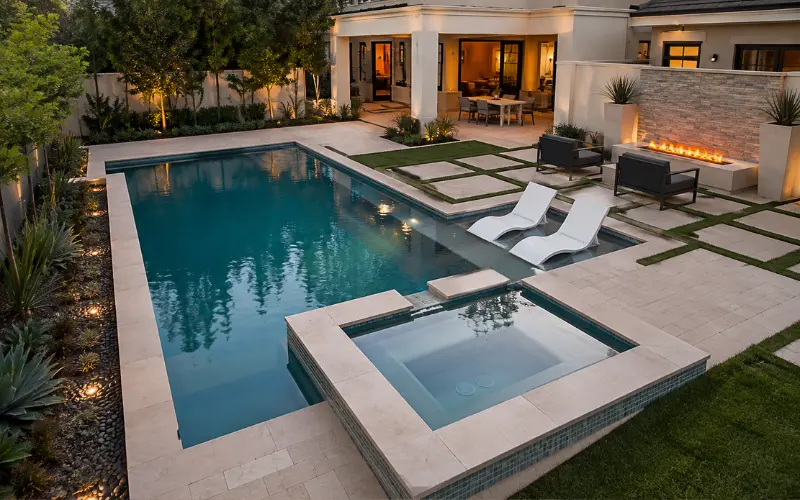
Rectangles and modified rectangles remain the backbone of Modern Pool Designs because they’re structurally efficient and easy to pair with straight-edge decking. But shape selection should account for how you actually use the yard, not just how it photographs from above.
- Long, narrow lots: A linear lap-style rectangle with a raised spa at one end uses the space efficiently and avoids awkward dead zones.
- Wide, shallow backyards: An L-shape or a rectangle with a single offset cutout lets you tuck a spa or sun shelf without stretching the pool the full width of the yard.
- Small urban or courtyard lots: A plunge pool or “cocktail pool,” typically under 200 square feet, delivers the geometric look without needing the footprint a full lap pool demands. These have quietly become one of the fastest-growing categories in residential construction because so many newer lots simply don’t have room for a traditional pool.
One thing worth knowing before you fall for a photo: circular and triangular shapes look striking in renderings but are harder and pricier to build well. The curved formwork and tile cuts around a circle cost more in labor than a straight-edge rectangle of the same square footage. Budget for that if you’re set on a round design.
Material Decisions That Separate Good From Great
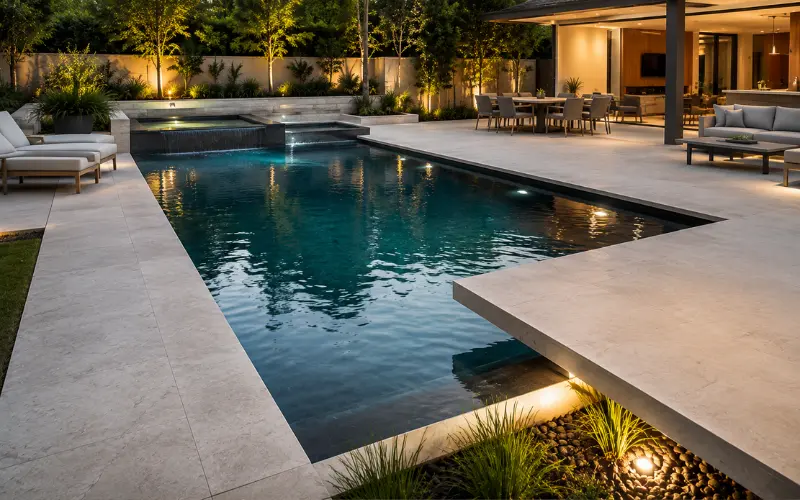
This is where most competitor guides get vague. Here’s what actually matters when you’re picking finishes Modern Pool Designs.
- Coping and decking. Matching or closely coordinating the coping material with the deck creates the cleanest look, but it’s not mandatory. A contrast approach, dark coping against a light deck or vice versa, works just as well if the two materials share a similar texture and finish. What kills the modern look is mixing a smooth, factory-cut coping with a rough, tumbled paver deck. The textures fight each other.
- Interior finish. This gets skipped in almost every competitor article, and it shouldn’t. Your interior finish affects both the water color and the long-term maintenance bill:
| Interior Finish | Typical Lifespan | Water Look | Relative Cost |
|---|---|---|---|
| Plaster (white/gray) | 7-12 years | Classic light blue | Lowest |
| Pebble/aggregate finish | 15-20 years | Deep blue-green, natural | Mid |
| Glass tile (full or partial) | 20+ years | Vivid, reflective | Highest |
| Quartz finish | 12-15 years | Sparkling, varied tone | Mid-high |
For a genuinely modern look, a dark pebble or quartz finish does more work than people expect. It makes the water read as near-black or deep teal, which reads far more contemporary than the pale blue of standard white plaster, and you don’t need to touch the tile budget to get that effect.
Cantilever decks. If your soil conditions allow it (check with a local structural engineer, since this depends heavily on regional soil stability), a cantilever edge eliminates coping altogether. The concrete deck extends slightly over the water’s edge, creating one continuous surface with zero seam. It’s one of the cleanest ways to achieve a minimalist look, and it’s cheaper than paver coping in the long run since there’s one less material to source and maintain.
What a Modern Pool Actually Costs
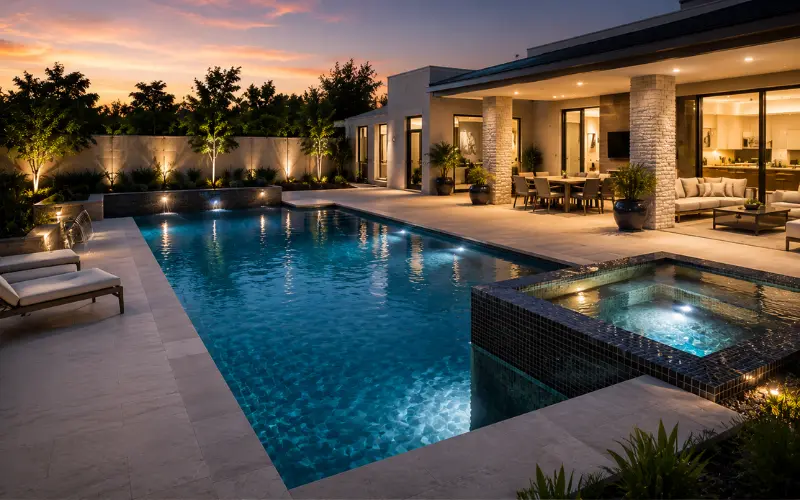
Every homeowner searching this topic eventually wants a number, and most articles dodge it. Here’s a realistic 2026 range for the U.S., broken down by what actually drives the cost up.
A basic geometric gunite pool with standard plaster, a paver deck, and no spa typically lands between $55,000 and $75,000 depending on region and excavation difficulty. Add a raised spa with a rimflow or spillway edge, and you’re adding $15,000 to $25,000. Glass tile, even used sparingly on a waterline or spa wall, adds another $8,000 to $20,000 depending on coverage. LED lighting packages run $2,000 to $6,000. A $100,000 pool typically includes a raised spa, partial glass tile, upgraded pebble or quartz interior, a metal scupper or two, and a paver deck with matching coping, not necessarily a bigger pool, but a more finished one.
If your budget is tighter, prioritize in this order: shape and shell quality first, interior finish second, spa third, decorative tile and water features last. You can always add a scupper or fire bowl in a future phase. You can’t easily change the shape once it’s poured.
Climate Considerations Competitors Skip
Nearly every article on this topic is written from a warm-climate builder’s perspective, which leaves out anyone building in a region that sees a real winter.
If you’re in a freeze-thaw climate, avoid natural stone coping with high porosity, like certain travertine grades, since water absorption followed by freezing can cause spalling and cracking over a few winters. Porcelain pavers, which are far denser and less porous, have become the smarter modern choice for northern climates and they mimic the look of concrete or stone almost perfectly. Also plan for a proper winterization line and skimmer plug setup at construction time. Retrofitting that later is more expensive and sometimes not fully possible depending on the plumbing layout.
Small-Yard Modern Pool Strategies
For anyone working with a smaller residential lot, a few field-tested moves make a big visual difference without added square footage:
- Run the decking material in a single direction that leads the eye toward the pool’s longest edge, which makes the space feel longer than it is.
- Skip a full-size spa and use a raised, narrow spillway wall instead. It gives the sound and visual interest of moving water without eating pool space.
- Keep planting minimal and structural (grasses, single specimen trees) instead of dense landscaping, which visually shrinks a small yard fast.
FAQ
What’s the difference between a Modern Pool Designs and a contemporary pool?
In practice, builders use these terms interchangeably. Both refer to geometric shapes, clean material palettes, and minimal ornamentation, as opposed to freeform, tropical, or classical Roman/Grecian styles.
Can a small backyard fit a Modern Pool Designs?
Yes. Plunge pools and cocktail pools, generally under 200 square feet, are built specifically for tight lots and still deliver the geometric, minimalist look.
Do Modern Pool Designs cost more than freeform pools?
Not inherently. Shape alone doesn’t drive cost much. What raises the price is glass tile, raised spas, water features, and upgraded interior finishes, which can appear on any pool shape.
What’s the most budget-friendly way to get a modern look?
A clean rectangular or modified-rectangle shape with a dark pebble or quartz interior finish and matching coping and deck material. This gets you 80% of the visual effect without spending on glass tile or elaborate water features.
Is glass tile worth the extra cost?
It depends on your climate and budget. It lasts longer than plaster and looks striking, but full coverage is expensive. Most builders recommend using it selectively, on a spa wall or waterline, rather than throughout.
How do I keep a Modern Pool Designs from looking cold or sterile?
Warm-toned wood decking (or a convincing composite), a fire bowl or two, and warm white LED lighting instead of stark blue-white keep a geometric pool from feeling clinical.
What pool shape is trending for 2026?
Modified rectangles with a single soft radius corner or curved cutout are gaining ground over strict right angles, blending the geometric base with one organic detail.
Does a Modern Pool Designs need a spa to look complete?
No. A well-proportioned rectangle with clean coping and a quality interior finish reads as fully modern on its own. A spa adds function and visual height, but it’s an addition, not a requirement.

