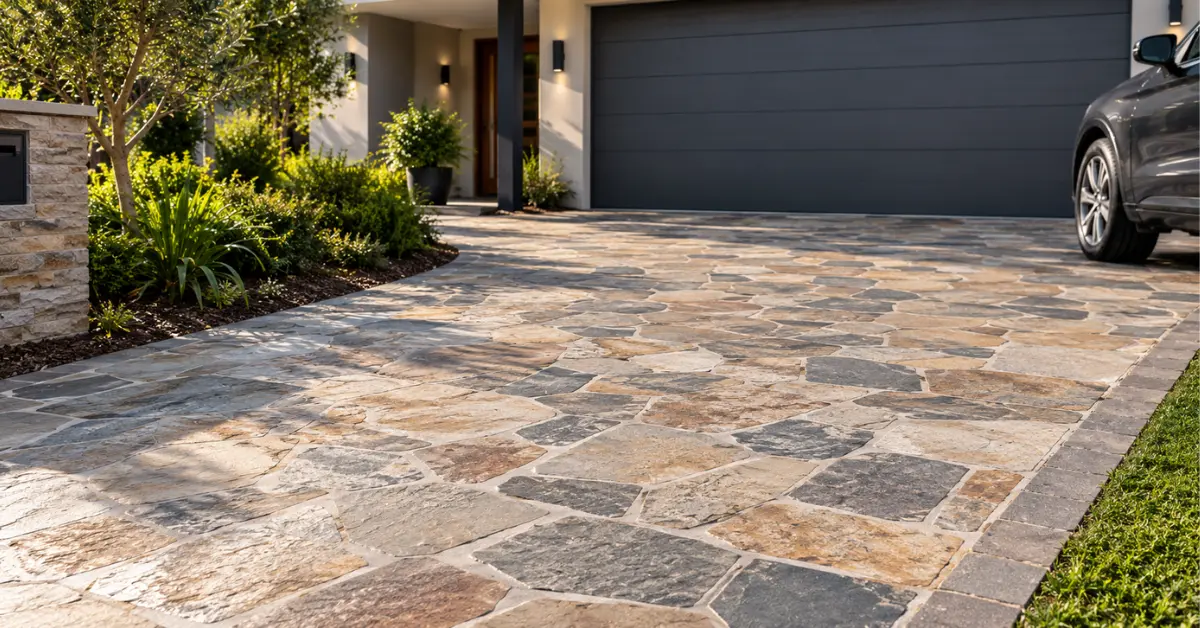
A crazy paving driveway installed correctly in Australia will typically cost $100 to $250+ per square metre and last 30 to 50 years or more, but the number that matters most isn’t the price per square metre, it’s the stone thickness and base depth underneath it. Most failures inside the first decade trace back to stone laid too thin or bedded on sand instead of a compacted base or concrete slab. Get those two things right and the irregular pattern itself becomes almost a non-issue.
Why a Driveway Punishes Crazy Paving Differently Than a Path
A footpath spreads weight evenly across a wide sole. A car doesn’t. Its full weight sits on four small contact patches, and every time someone turns the wheel while parked, that patch drags sideways across the stone instead of just pressing down on it.
That twisting load is the part most homeowners never think about. It’s why the areas just outside a garage door, where people turn in and stop, fail years before the rest of the driveway even shows a hairline crack. If you’re mapping out where the driveway meets the garage, it’s worth thinking about that transition zone as part of your broader garage design rather than an afterthought tacked on at the end.
Joints matter more here too. Crazy paving has more joint length per square metre than a rectangular paver layout because the pieces are irregular. Every one of those joints is a potential weak point if the bedding beneath it wasn’t compacted properly before the stone went down.
What It Actually Costs in Australia Right Now
Prices vary more by region and site condition than by stone choice alone, but here’s a realistic breakdown based on current installer quotes across the major cities.
| Cost component | Typical range (AUD/m²) | What moves the price |
|---|---|---|
| Stone supply | $40–$100 | Type, thickness, finish |
| Excavation and site prep | $30–$80 | Existing surface, access, soil |
| Base and compaction | $20–$60 | Depth required, reactive clay |
| Laying and jointing | $40–$100 | Cutting complexity, joint width |
| Fully installed total | $100–$250+ | All of the above combined |
A 50 square metre single driveway at the mid-range works out to roughly $7,500 to $9,000. Sydney quotes tend to sit at the top of that band, Adelaide and regional areas closer to the bottom.
The trap most people fall into is comparing two quotes on the per-square-metre figure alone. One tradie might be quoting to lay stone over your existing sound slab. Another is pricing full excavation, 150mm of road base, and new edge restraints. Those aren’t the same job, and the cheaper number on paper is often the more expensive one once problems show up in year three.
Stone Thickness Is the Number Competitors Gloss Over
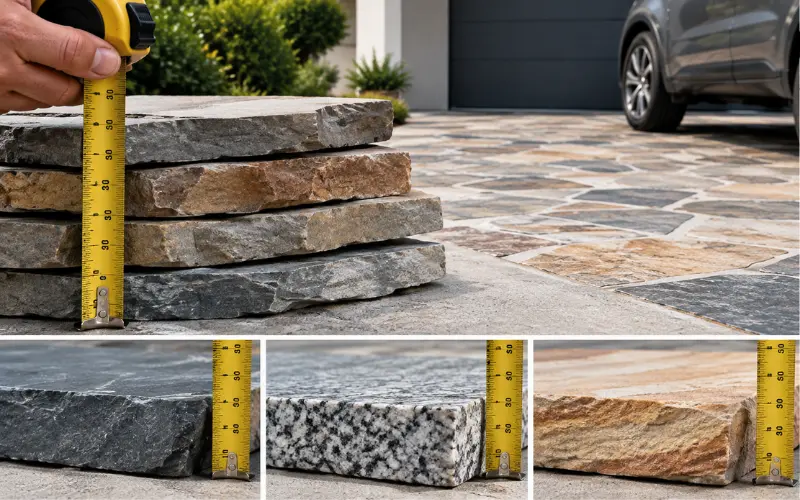
Most guides mention that thicker stone is better and leave it there. Here’s the actual specification: anything under 25mm is a pathway stone, not a driveway stone. For a residential driveway carrying daily car traffic, you want a minimum of 30mm, and I’d push for 40mm if the household runs an SUV, a ute, or gets regular deliveries.
Bluestone and granite handle thinner sections better than sandstone because they’re denser and less prone to snapping under a point load. Sandstone driveways that have genuinely lasted are almost always laid thicker, often 40 to 50mm, specifically to compensate for the softer material.
Ask your supplier directly whether the stone is rated for vehicle areas. A lot of crazy paving sold online is patio stock re-labelled for driveways, and the supplier usually knows the difference even when the listing doesn’t say so.
The Base Decides the Outcome, Not the Stone
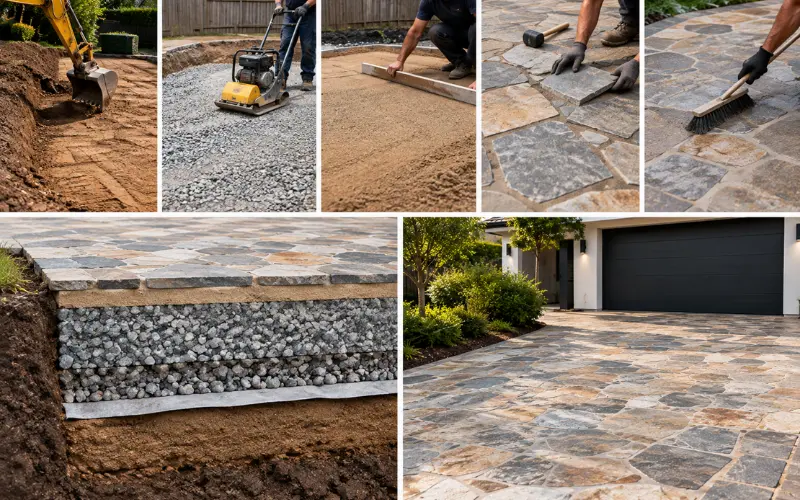
If there’s one thing every competitor article underplays, it’s this: a driveway with premium granite on a weak base will fail before a modest sandstone driveway on a properly engineered one.
A build-up that actually holds up under vehicles looks like this:
- Compacted natural subgrade
- 100 to 150mm of crushed road base, compacted in layers, not dumped and rolled once
- A bedding layer suited to the stone thickness
- Crazy paving laid with consistent, fully supported joints
- Jointing material packed tight, not just brushed over the top
On reactive clay soils, which cover large parts of western Sydney and pockets of Melbourne, add an extra 50mm of base and consider a geotextile separation layer. Clay that swells and shrinks with moisture will move whatever sits above it, and a shallow base gives the movement nowhere to go except through your paving.
A Real 10-Year Inspection Method, Not a Marketing Claim
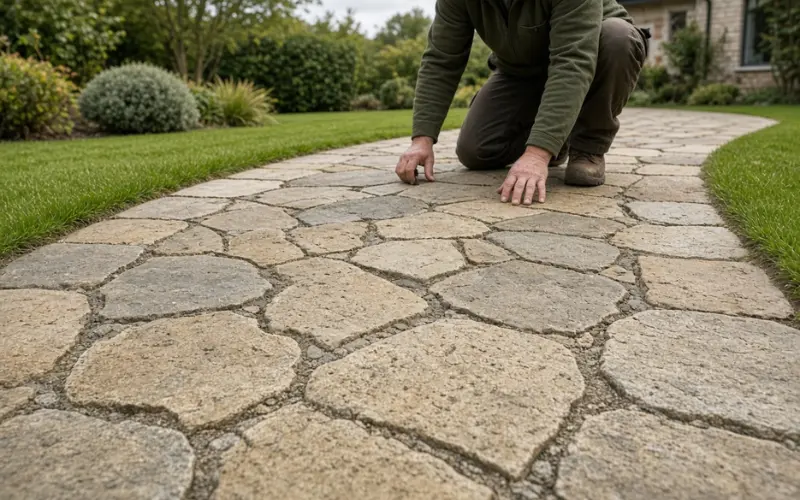
There’s no standardised laboratory test that certifies a crazy paving driveway for “10 years of load.” Anyone who tells you their driveway passed a formal 10-year load test is stretching the truth. What actually exists is a practical way to track performance over time, and it’s more useful than any single number.
At installation: photograph the finished surface from a few fixed spots. Note any existing settlement, joint widths, and low points. This becomes your baseline.
Years one and two: check after heavy rain and again after a dry spell. Look for rocking stones, joint erosion, and standing water. Small issues caught here are cheap to fix.
Years three to five: compare the wheel tracks against the untouched sections. If the tracks have visibly settled while the rest hasn’t moved, the problem sits in the base, not the stone.
Years six to ten: walk the whole surface. Stones should feel stable underfoot, water should still drain where it’s meant to, and joints shouldn’t have repeatedly washed out in the same spots.
That process tells you far more about a driveway’s real performance than any headline durability figure.
Drainage Failures Show Up Before Stone Failures
Water does more damage to a driveway than car weight ever will. Australian councils generally require a minimum fall of 1 to 2% to move surface water away from the house, and driveways that skip this detail develop pooling within a year or two.
Watch these spots specifically:
- Garage thresholds, where water should never pool or run inward
- Downpipe discharge points near the paving edge
- Side boundaries, where runoff can slowly undermine the pavement from underneath
- Any low point that collects water after rain and hasn’t drained by the next day
If a puddle keeps forming in the same place, adding more jointing sand won’t fix it. Something underneath has shifted, and that needs investigating before it spreads.
Council Rules You Can’t Ignore
Most residential crazy paving driveways in NSW fall under exempt development, provided the hardstand area doesn’t exceed 15% of the lot or 150 square metres, whichever is smaller. The work also needs to meet AS/NZS 2890.1 for off-street parking, and stormwater has to connect to the proper system rather than running onto a neighbour’s block. Victorian councils apply similar drainage and setback conditions, though the exact thresholds vary by municipality, so a quick call before finalising a design saves a headache later.
Which Stones Actually Perform Under Wheels
Bluestone handles vehicle traffic better than almost anything else in this category. It’s dense, low-maintenance, and suits a modern aesthetic.
Granite matches bluestone for durability and tends to be the choice for high-use driveways where budget isn’t the limiting factor.
Sandstone remains popular for its warmth and colour range, but it’s softer and more porous. It works fine on a driveway when laid thick and sealed, but it’s not the stone to skimp on thickness with.
Travertine and limestone are better suited to patios and pool surrounds. Some suppliers market them as driveway-safe, but confirm the exact thickness and rating before committing, because plenty of failures trace back to this exact substitution.
If your surrounding landscape already leans on natural stone, tying the driveway into a wider paved garden area or a matching cheap DIY garden path for lower-traffic zones can keep the material palette consistent without paying driveway rates across the whole property.
Maintenance That Actually Extends Service Life
Crazy paving driveways don’t need much upkeep, but the upkeep they do need is specific to the joints, not the stone surface itself.
- Sweep debris out of joints regularly, especially through autumn
- Avoid acidic cleaners entirely, particularly on sandstone and limestone
- Reseal every three to five years with a breathable, penetrating sealer
- Check joints annually and repoint small cracks before they widen
- Keep pressure washing on low settings, aimed away from the joints directly
Unlike a poured concrete slab, individual stones can usually be lifted and re-bedded without redoing the whole driveway. That repair flexibility is one of the genuine long-term advantages over concrete or asphalt.
Tying the Driveway Into the Rest of the Frontage
A driveway doesn’t exist on its own. Pairing the paving colour and pattern with complementary front fence ideas or a timber fence design creates a stronger, more deliberate street presence than treating the driveway as an isolated project. If you’re planning the whole frontage from scratch, it’s worth reading through broader driveway design approaches before locking in the stone, since the layout and slope often dictate which paving pattern will actually work.
When Crazy Paving Isn’t the Right Call
It’s not the answer for every site. Steer away from it if:
- You need the lowest possible upfront cost
- The site has severe, unresolved drainage problems
- Heavy trucks will use the driveway regularly
- You want a surface that needs close to zero maintenance
In those cases, plain concrete or a uniform paver system will usually serve better, and save the crazy paving budget for a lower-traffic path or entrance feature instead.
Final Take
A crazy paving driveway earns its reputation when the base, drainage, and stone thickness are treated as non-negotiable rather than optional upgrades. Get those three right and the surface will comfortably outlast a 10-year window with nothing more than routine sealing and the odd joint repair. Skip any of them, and the stone gets blamed for what was really a foundation problem.
FAQ
How thick should stone be for a crazy paving driveway?
Minimum 30mm for standard cars, 40 to 50mm if the household runs an SUV, ute, or receives regular delivery vehicles.
Can a crazy paving driveway handle a 4WD?
Yes, provided the base is properly compacted, the stone is thick enough, and joints are fully packed. The base construction matters more than the vehicle type.
Do I need council approval for a crazy paving driveway in NSW?
Most residential driveways under 150 square metres and within 15% of the lot size are exempt development, provided they meet drainage and off-street parking standards. Larger or non-compliant driveways need approval.
Is crazy paving slippery when wet?
It depends on the finish. Natural split or sandblasted surfaces grip well. Polished or honed finishes get noticeably slippery, so avoid them on a driveway.
How often does a crazy paving driveway need sealing?
Every three to five years for most stones, sooner in high-traffic wheel paths or near a garage where oil drips accumulate.
Can individual stones be repaired without redoing the whole driveway?
Yes, and it’s one of the material’s biggest advantages. Localised settlement can usually be fixed by lifting and re-bedding the affected section.
Does reactive clay soil ruin a crazy paving driveway?
Not if the base accounts for it. An extra 50mm of compacted road base and a geotextile separation layer largely neutralise seasonal ground movement.
Is crazy paving more expensive than plain concrete?
Yes, generally by a wide margin, mostly due to labour. Cutting and fitting irregular pieces by hand takes several times longer than pouring and finishing a slab