
If you’ve searched “oriental home decor” and landed on ten different articles showing the same bamboo blind and the same Buddha statue, you’re not alone. Most guides describe the look. Very few explain how to actually build it in a real house, on a real budget, without it looking like a hotel lobby.
Direct answer: Oriental home decor refers to interior styling inspired by East and Southeast Asian design traditions, primarily Chinese, Japanese, Korean, Thai, and Vietnamese, built around natural materials, restrained color, meaningful objects, and a deliberate sense of balance. The strongest results come from picking one cultural tradition and going deep, rather than mixing lanterns, Buddhas, and chinoiserie prints into one room and calling it “Asian style.”
I’ve pulled apart what actually separates a room that reads as intentional from one that reads as a theme park gift shop. Here’s what most articles on this topic leave out.
Why “Oriental” Gets Used Loosely, and Why That Causes Problems
The word “oriental” is a holdover term. In interior design retail it still shows up on curtain poles, rugs, and lamp listings, so you’ll see it in this article because that’s the language people actually search. But in everyday usage, most designers and stylists now say “Asian-inspired” or name the specific tradition (Japanese, Chinoiserie, Korean, Thai) instead.
That distinction isn’t just political correctness. It’s practical. A room styled around Japanese wabi-sabi principles looks nothing like a room built around Chinese chinoiserie or Thai tropical warmth. Treating them as one interchangeable “oriental” bucket is exactly why so many attempts at this style end up feeling generic instead of intentional.
The Elements That Actually Do the Work
Skip the object list you’ve already seen everywhere (bamboo, lanterns, Buddha statues, red accents). Here’s what separates a convincing room from a themed one:
- Negative space is a design choice, not empty shelving. In Japanese and Korean interiors especially, what you leave off a surface matters as much as what you put on it. A shelf with three objects and open space around them reads calmer than a shelf packed with six.
- Sheen and texture contrast do more than color does. A matte lacquered cabinet next to a raw linen throw creates visual depth without adding a single new color to the room.
- Height variation mimics landscape. Traditional Chinese and Japanese decor often stacks low, mid, and tall elements (a floor cushion, a side table, a tall vase) to echo mountains and horizon lines. Flat, same-height furniture arrangements flatten the whole effect.
- Asymmetry is intentional, not sloppy. Western styling instinct wants matching lamps on either side of a sofa. Asian design traditions, especially Japanese, often deliberately avoid mirror symmetry because it feels static.
Simple Oriental Home Decor Ideas You Can Start With Today
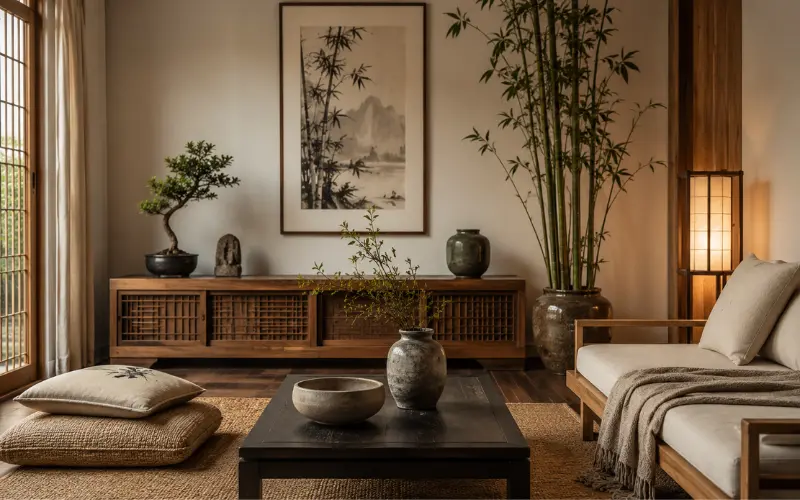
You don’t need a renovation budget to shift a room. These are the changes that give the biggest visual return for the least effort:
- Swap one lamp for a paper or rice-paper shade. The diffused light alone changes the mood of a room more than most people expect.
- Add one grounding object with weight, like a stone bowl or a ceramic vase, on an otherwise empty surface. One heavy object reads more intentional than five small trinkets.
- Bring in a single plant with sculptural form, like a bonsai, snake plant, or a bamboo stalk in a simple pot. Avoid bushy, sprawling plants, they read as tropical rather than Asian-inspired.
- Layer a textured throw or floor cushion in a natural fiber, linen, cotton, or raw silk, over a plain sofa or reading chair.
- Frame one piece of ink-wash or botanical artwork instead of a gallery wall. Restraint is the actual style choice here, not a budget compromise.
Oriental Home Decor Ideas on a Budget
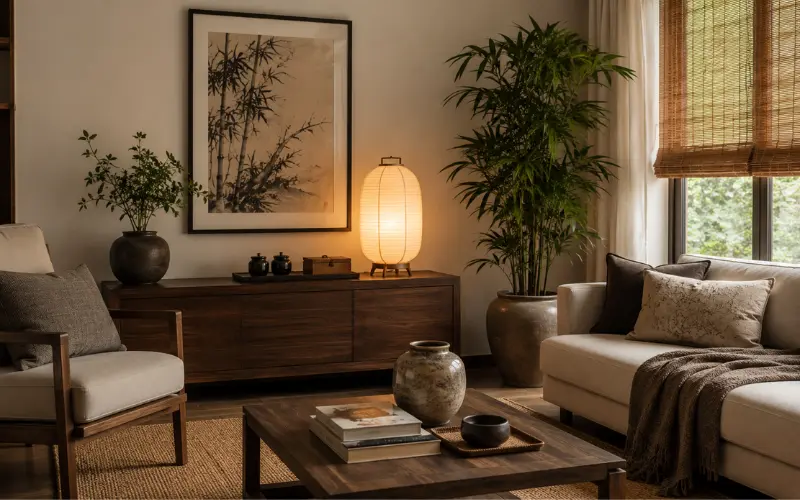
Here’s where most articles get vague. Real numbers help more than vague encouragement, so here’s how I’d actually spend a limited budget, in order of impact:
- Lighting first (roughly $20 to $60). A paper lantern pendant or a single rice-paper table lamp changes a room faster than almost anything else you can buy.
- One textile layer next ($15 to $50). A linen throw, a woven floor mat, or bamboo blinds on one window.
- A single ceramic or stone accent piece ($10 to $40). Thrift stores and estate sales are genuinely good sources here, older ceramics often have better glaze and weight than new mass-produced pieces at the same price.
- Wall art last ($20 to $80 framed). Ink-wash prints, botanical line art, or a single scroll painting.
Skip buying a “matching set.” Rooms that look collected over time, rather than purchased in one trip, read as more authentic and, frankly, more expensive than they are.
Modern Oriental Home Decor Ideas
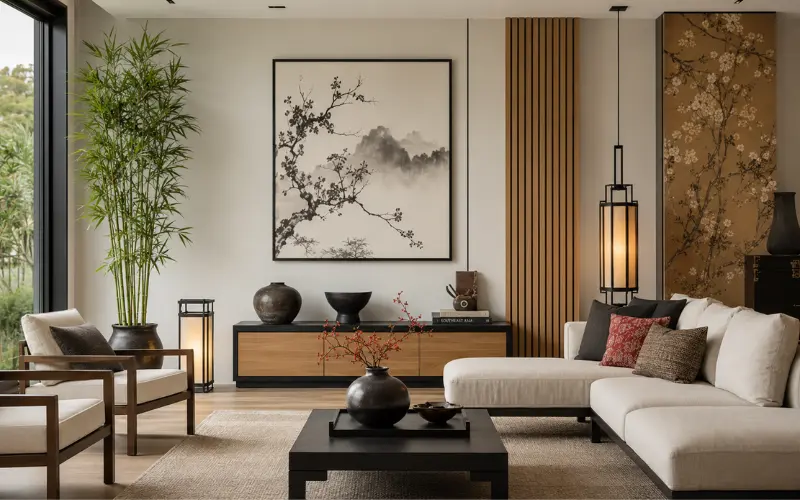
If the traditional version feels too heavy for your space, the modern approach strips it down without losing the character:
- Dark wood is replaced with light oak or ash, keeping the low-profile silhouettes but losing the ornate carving.
- Chinoiserie prints appear on one accent wall or a single cabinet, rather than wallpapering an entire room.
- Feng shui principles get applied to furniture placement, not decor volume, meaning fewer statues and lanterns, more attention to how furniture faces doors and windows.
- Black steel or brass fixtures replace carved wood details, giving a contemporary edge while keeping the restrained color palette intact.
This modern, pared-back version overlaps heavily with what’s marketed as Japandi, but it isn’t identical. Japandi specifically fuses Japanese minimalism with Scandinavian warmth and pale wood tones. A modern oriental take can still lean into richer reds, black lacquer, or gold accents that Japandi deliberately avoids.
The 3-5-7 Rule, and Why It Matters More in This Style Than Others
This is a general interior styling rule, not one invented for Asian decor specifically, but it fits this aesthetic unusually well because of the asymmetry principle mentioned earlier.
The rule: when styling a shelf, console, or vignette, group objects in odd numbers, typically 3, 5, or 7 items, at varying heights. Odd numbers avoid the rigid, mirrored look that even numbers create, and varying height keeps the eye moving instead of landing flat.
For an oriental-style vignette, that might look like:
- One tall item (a slim vase or a single stem in a ceramic bottle)
- One mid-height item (a small stone Buddha or a lacquered box)
- One low, wide item (a shallow bowl or a stack of two books)
Three objects, three heights, uneven spacing between them. That’s it. It’s a small rule, but it’s the difference between a shelf that looks staged by a professional and one that looks like items were placed without thought.
How Do I Make My House Look Japanese Specifically
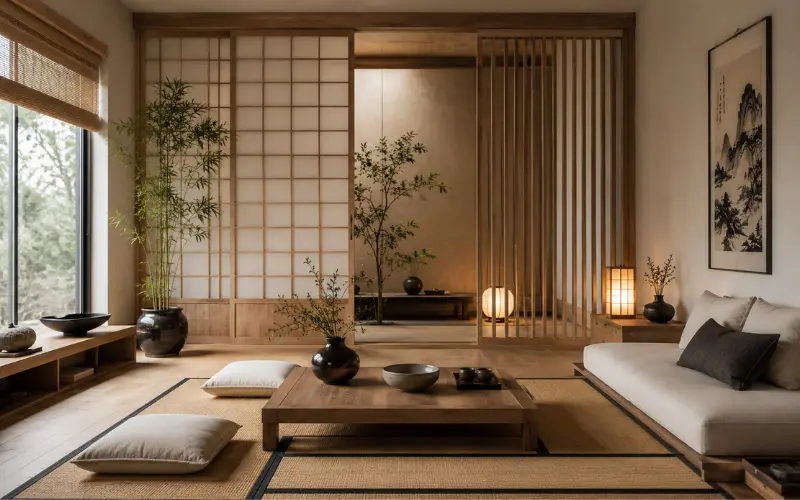
If your search intent is actually Japanese rather than generic “oriental,” the execution is narrower and more forgiving of a small budget:
- Lower your furniture’s visual height. A platform bed frame, a low coffee table, floor cushions instead of extra armchairs. This single change does more than any accessory.
- Use shoji-style screens as room dividers, even a simple frosted or slatted panel does the job in an apartment without structural changes.
- Choose imperfection over polish. Wabi-sabi values a slightly uneven ceramic bowl or visibly grained wood over anything glossy or mass-produced.
- Keep the palette to two or three tones. Natural wood, off-white or cream, and one accent (often deep green, black, or muted red) is enough. Adding a fourth color usually pulls the room toward a different aesthetic entirely.
- Let tatami-style flooring or a woven rug define one zone, rather than covering the whole room.
Asian Decor for the Living Room
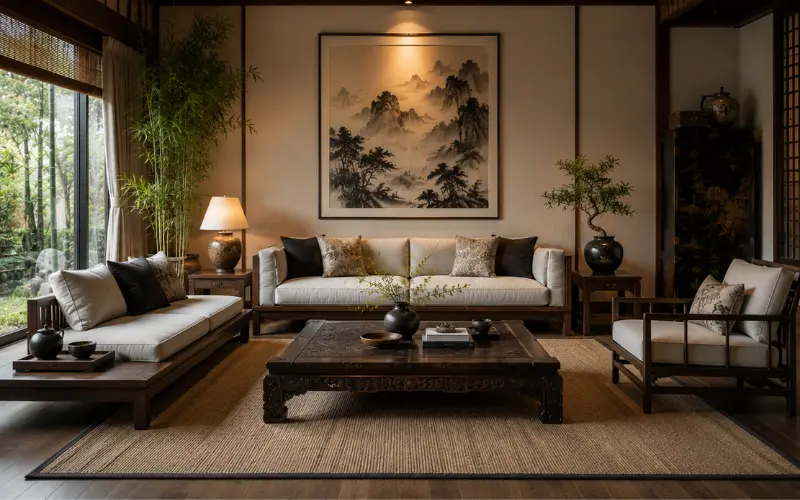
The living room carries the most weight in this style because it’s usually the first room people style and the one guests actually see. A few things I’d prioritize specifically here that get skipped elsewhere:
- Seating height matters more than seating shape. A low-slung sofa or a daybed reads more Asian-inspired than a tall, overstuffed sectional, regardless of fabric or color.
- The coffee table can carry more visual weight than the sofa. A carved, lacquered, or live-edge wood table becomes the room’s anchor piece, letting the sofa stay plain and neutral.
- One rug, not a layered rug situation. Layering rugs is a Western maximalist habit that clashes with the restraint this style depends on.
- Position seating to face a window or a focal wall art piece, echoing the indoor-outdoor connection that shows up across nearly every Asian design tradition.
Asian Decorations for a Party
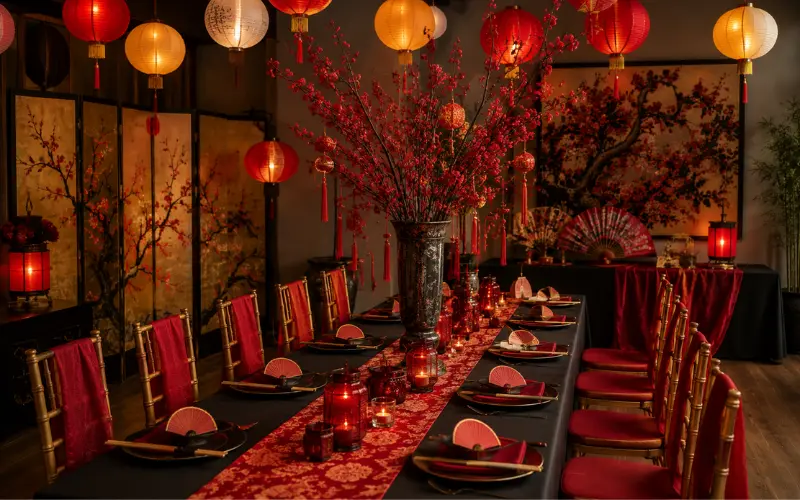
This is one angle almost nobody covers, and it’s a genuinely common search: styling for a one-off event rather than a permanent room. Whether it’s a themed dinner, a Lunar New Year gathering, or a bridal shower, temporary styling has different rules than permanent decor.
- Rent or borrow large pieces instead of buying them. Folding screens, large lanterns, and low tables are expensive to own and easy to source secondhand or through party rental companies for one night.
- Paper lanterns in varying sizes strung overhead create instant atmosphere and pack away easily afterward.
- Use runners instead of full tablecloths. A single silk or embroidered table runner down the center of a plain tablecloth reads more intentional than covering the whole table in patterned fabric.
- Fresh or silk cherry blossom branches in tall vases work as both centerpiece and photo backdrop, and they scale up cheaply for a large table.
- Chopstick place settings with a folded napkin and a small paper fan double as favors guests can take home.
If it’s a Lunar New Year event specifically, red and gold aren’t optional accent colors, they carry meaning tied to luck and prosperity, so lean into them rather than swapping in a “safer” neutral palette.
Where to Actually Shop for This
Pinterest is where most people gather inspiration for this style, and it’s genuinely useful for that, but it’s a mood board tool, not a sourcing tool. For actually buying pieces:
- Specialty importers and Asian home goods stores carry pieces made in the country of origin, which tend to have better proportion and craftsmanship than mass-market “Asian-inspired” lines.
- Etsy is strong for handmade ceramics, textiles, and smaller decorative objects, but check seller location and materials before buying, plenty of “oriental style” listings are printed reproductions rather than handmade goods.
- Estate sales and antique shops are consistently underrated for this look. Vintage lacquered boxes, brass items, and ceramics often have a patina that new pieces simply can’t fake.
- Big-box retailers are fine for structural pieces, blinds, low platform beds, plain linen bedding, where the craftsmanship story matters less than the silhouette.
A quick note on sourcing responsibly: if a piece references a specific cultural or religious symbol (a Buddha statue is the most common example), it’s worth knowing that in some traditions these are meant for reverence, not floor decor. Placing one at ground level or in a bathroom is considered disrespectful in several Buddhist cultures. If you want the aesthetic without the misstep, choose a decorative motif instead, like a lotus print or a bamboo motif, rather than a religious figure.
Quick Comparison: Which Tradition Fits Your Space
| Tradition | Best for | Signature material | Color approach |
|---|---|---|---|
| Japanese (Zen/Wabi-sabi) | Small spaces, minimalists | Raw wood, paper, stone | Two-tone, muted |
| Chinese Contemporary | Living rooms, entryways | Lacquer, silk, porcelain | Bold red or gold accent on neutral base |
| Korean Hanji-inspired | Bedrooms, reading nooks | Handmade paper, natural dye textiles | Soft, muted, tactile |
| Southeast Asian Tropical | Sunrooms, conservatories | Rattan, teak, woven fiber | Warm neutrals, open layout |
Mistakes That Push a Room from “Styled” to “Themed”
- Buying every element from one collection. A matching lantern, Buddha, and cushion set from the same retailer almost always looks like a display, not a home.
- Using pattern on every surface. One patterned element per room, a rug, a cushion, or a wallpaper wall, not several competing at once.
- Skipping the empty space. Filling every shelf and surface fights the whole point of the aesthetic.
- Treating red as the only “Asian” color. Plenty of authentic interiors, especially Japanese and Korean ones, use almost no red at all.
FAQ
What are some current Oriental Home Decor trends?
Right now the shift is toward pared-back, single-material rooms rather than mixed cultural motifs, think one strong wood or lacquer piece and quiet surroundings rather than multiple decorative objects competing for attention. Warm neutral palettes with a single sage or terracotta accent are replacing the deeper reds and golds that dominated a decade ago.
What is Oriental Home Decor interior design, exactly?
It’s a design approach drawing on East and Southeast Asian traditions, using natural materials, restrained color, and intentional object placement to create calm, balanced spaces. It’s best understood as a family of related styles (Japanese, Chinese, Korean, Southeast Asian) rather than one single look.
Is it better to say “Oriental Home Decor” or “Asian-inspired” decor?
Most current design writing uses “Asian-inspired” or names the specific tradition. “Oriental” still appears on some retail product listings, but it’s considered outdated when referring to people or broad style categories.
How much does it cost to redecorate one room in this style?
A budget refresh (lighting, one textile, one accent piece, one framed print) typically runs $65 to $230 depending on quality. A full furniture-level redo with a platform bed or new sofa easily runs into the thousands, so most people are better off phasing it in room by room.
Can I mix Japanese and Chinese decor elements in the same room?
You can, but it takes a steadier hand. The safest approach is to let one tradition set the furniture and palette, then borrow one or two accent pieces from another, rather than splitting the room evenly between two styles.
What plants work best for this look?
Bonsai, bamboo, snake plants, and orchids all read as intentional. Large leafy tropicals like monstera or palms tend to pull the room toward a jungle or boho look instead.
Do I need a Buddha statue to get the style right?
No, and if you’re not part of a Buddhist tradition, it’s worth choosing a different focal object out of respect, plenty of ceramic, botanical, or ink-wash pieces carry the same calm visual weight without the cultural weight attached.
What’s the fastest single change that makes a room look more Asian-inspired?
Lower the furniture’s visual height and add one paper or fabric lantern-style light source. Those two changes alone shift a room’s mood faster than any amount of accessorizing.
Final Thoughts
Creating a beautiful home with Oriental home decor isn’t about filling every corner with themed accessories or following outdated decorating rules. The most inviting spaces focus on balance, natural materials, thoughtful furniture placement, and a handful of meaningful pieces that reflect a specific design tradition rather than mixing everything together.
Whether you’re updating a single room or refreshing your entire home, start with small, intentional changes. A paper lantern, a handcrafted ceramic vase, or a simple ink-wash artwork can have a bigger impact than a cart full of matching decor. Build your space gradually, stay true to one aesthetic, and let quality and simplicity shape the final result. With the right approach, Oriental home decor can create a timeless, peaceful home that feels authentic, elegant, and uniquely yours.

