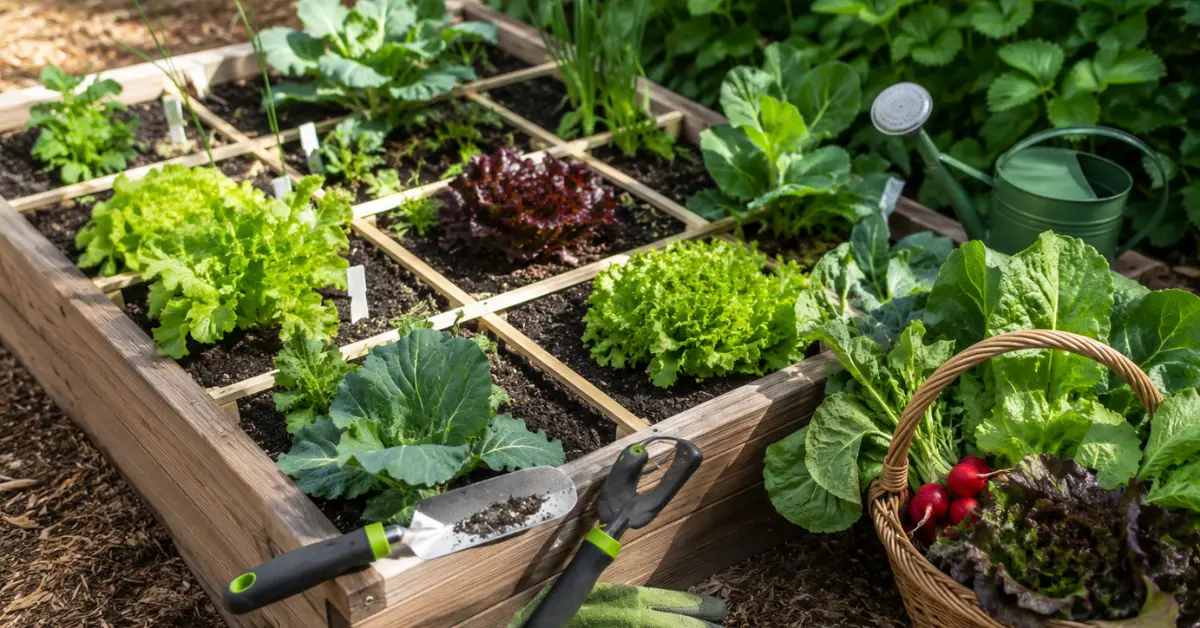
If you have ever stared at a raised bed wondering exactly how far apart to plant your lettuce versus your carrots, you are not alone. Spacing mistakes are one of the most common reasons home gardeners end up with patchy harvests, crowded plants, and a garden that looks more like a weed patch than a productive food plot. That is exactly where the right square foot gardening tool makes all the difference — and once you start using one, you will wonder how you ever planted without it.
Whether you are brand new to raised bed gardening or you have been doing it for years, understanding what a square foot gardening tool does, how to use one, and what to look for when buying one will help you get dramatically better results from every square inch of your garden.
What Is a Square Foot Gardening Tool?
A square foot gardening tool is a planting aid designed to help gardeners implement the square foot gardening method with precision. The concept behind this method, originally popularized by Mel Bartholomew in his bestselling book, divides a raised bed into a grid of one-foot squares. Each square is planted with a specific number of plants based on their mature size — 1 tomato per square, 4 lettuce plants per square, 16 carrots per square, and so on.
The problem is that eyeballing those spacings is surprisingly hard, especially for beginners. A quality square foot gardening tool takes the guesswork entirely out of the equation. The most popular version on the market today is a color-coded seed spacer template — a plastic grid tool that you press into your soil to create perfectly spaced planting holes in seconds. The holes are organized by color: each color corresponds to a spacing category (1, 2, 4, 9, or 16 plants per square foot), making it easy to look up your vegetable on a planting chart, choose the right color hole, and drop your seed or seedling in with confidence.
Why Proper Spacing Is Non-Negotiable
Many first-time gardeners underestimate how much spacing affects plant health and yield. Plants grown too close together compete for water, nutrients, and sunlight. The result is weaker plants, lower yields, and much more disease pressure because airflow is restricted between leaves. On the other hand, plants spaced too far apart waste precious bed space that could be growing food.
Using a square foot gardening tool consistently solves both problems. When plants are correctly spaced, they form a natural living mulch — their leaves eventually touch and cover the soil surface, which suppresses weeds naturally. Gardeners who use precision spacing tools consistently report dramatically fewer weeds and noticeably larger harvests from the same amount of space compared to traditional row gardening.
What Comes in a Good Square Foot Gardening Tool Kit
Not all square foot gardening tools are created equal. Here is what a well-designed kit should include:
Color-Coded Seed Spacer Template
This is the core of the tool. A 12-by-12-inch template that fits perfectly inside one square of your grid, with holes punched at each correct spacing interval. The color coding is essential — it means you do not have to measure anything. You simply check your seed packet or planting guide for the spacing, match it to the color on the tool, and plant.
Magnetic Seed Dibber and Funnel
A dibber is a pointed tool used to push seeds into the soil to the correct depth. The magnetic attachment to the main template keeps everything together in one piece so nothing gets lost in the garden. Some kits also include a seed spoon for handling tiny seeds like carrots and radishes without crushing them.
Vegetable Planting Guide
A good square foot gardening tool should come with a reference chart listing common vegetables and which spacing color to use for each one. This is especially useful for gardeners who are new to the method.
Soil Impression Feature
Some versions of the square foot gardening tool leave visible impressions in the soil when pressed down, so you can lift the template away and still see exactly where each planting hole should go. This is a small detail that makes a big practical difference.
How to Use a Square Foot Gardening Tool Step by Step
Using the tool is straightforward, but a few tips will help you get the most out of it.
Step 1 — Set up your raised bed properly.
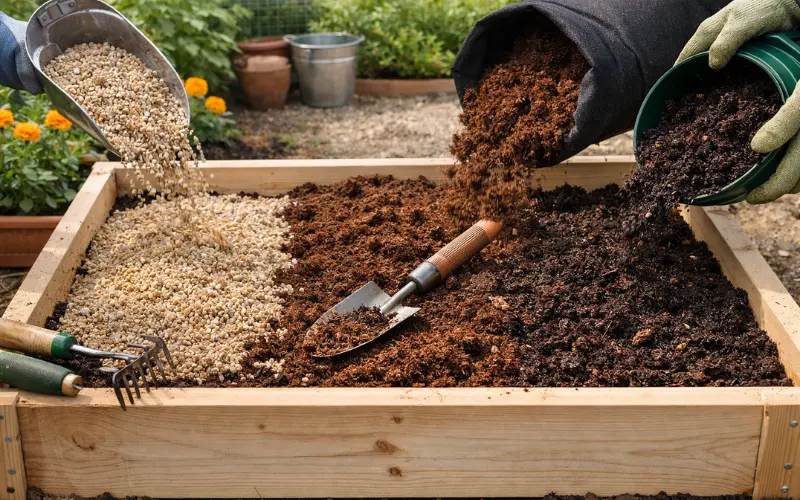
The square foot gardening method works best in a well-amended growing medium. The classic formula is one-third coarse vermiculite, one-third peat moss or coco coir, and one-third blended compost. This loose, nutrient-rich mix allows roots to grow freely and makes it easy to press the tool in evenly.
Step 2 — Lay out your grid.
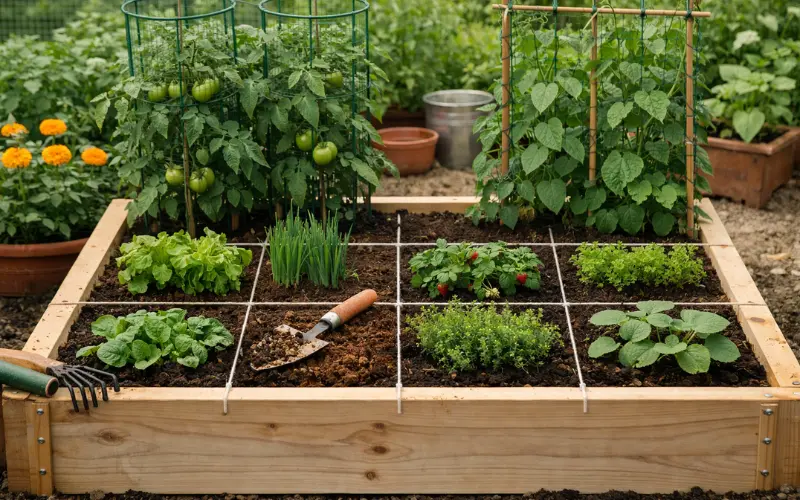
Before planting, map out what goes where. Taller plants like tomatoes and beans should go on the north side of the bed so they do not shade shorter crops. Group plants with similar watering needs together.
Step 3 — Place the square foot gardening tool in the first square.
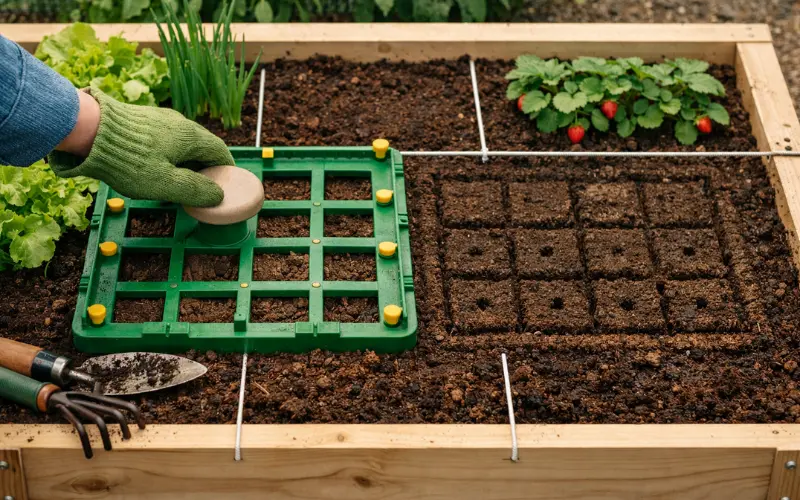
Press gently and evenly so the template leaves clear soil impressions. The outer perimeter of the tool also leaves an impression that serves as the boundary between your squares.
Step 4 — Match your vegetable to the correct color spacing.
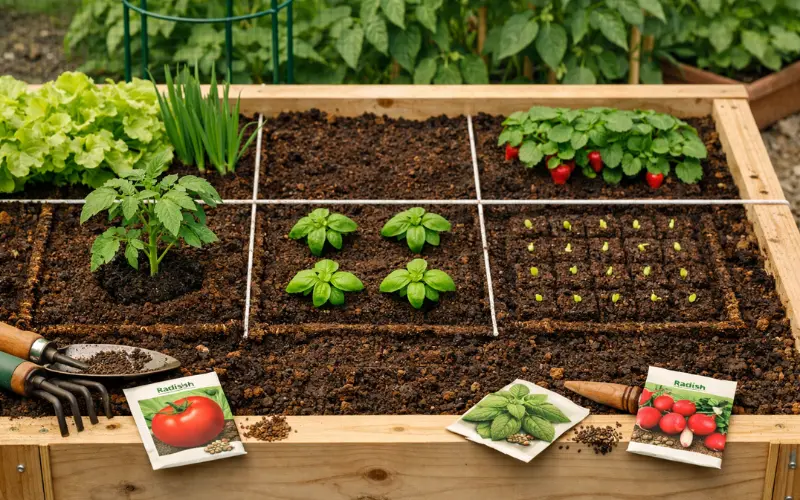
Check the included planting guide or the seed packet. A tomato needs 1 plant per square foot (1 hole). Basil is typically 4 per square foot. Radishes go in at 16 per square foot.
Step 5 — Use the dibber to create each planting hole at the correct depth.
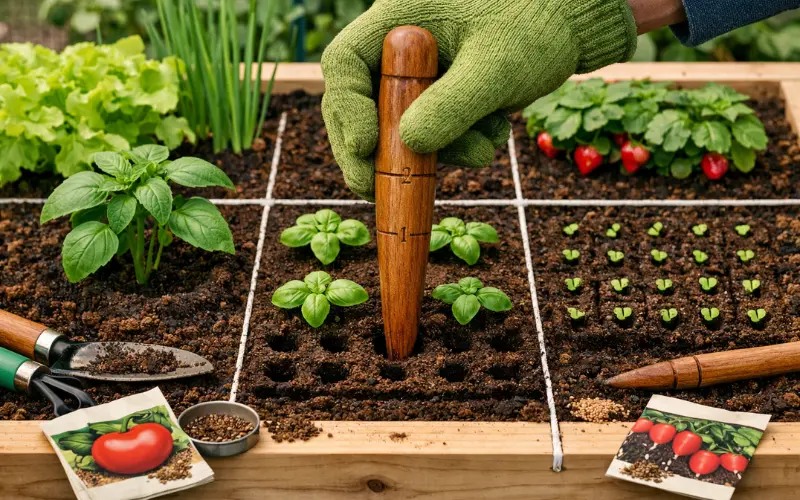
Most vegetable seeds should be planted at a depth of two to three times their width. The dibber takes care of this automatically if it is marked with depth guides.
Step 6 — Drop in seeds or seedlings, cover, water gently, and move to the next square.
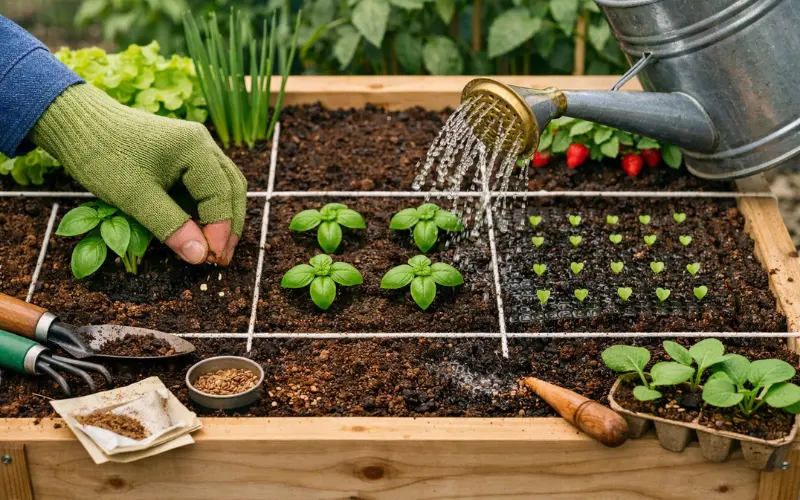
The whole process per square takes under a minute once you get into a rhythm.
Comparing Square Foot Gardening Tools: What to Look For
The market has a few versions of this tool, and they are not all equivalent. Here is what separates a great square foot gardening tool from a disappointing one.
- Durability. Look for food-safe, UV-resistant plastic. Garden tools get left out in the sun, rained on, and stepped on. Cheap plastic cracks within a season.
- Clear color coding. The colors need to be bold and easy to distinguish, even for people with color vision differences. Some manufacturers have improved their designs to use both color and shape cues.
- Compatibility with the spacing guide. The planting guide that comes with the tool should cover at least 30 to 40 common vegetables, herbs, and flowers. If it only covers a handful of crops, you will constantly be guessing.
- Size accuracy. The template should measure exactly 12 by 12 inches to fit flush inside a standard square foot grid. Even a few millimeters off creates cumulative errors across a large bed.
- Magnetic components. A dibber that attaches magnetically to the template is a genuine quality-of-life feature — it keeps the kit together and means you have one tool to pick up and move, not three or four separate pieces.
Square Foot Gardening Tool vs. DIY Spacing Methods
Some gardeners try to replicate the square foot gardening tool’s function using rulers, string grids, or homemade wooden templates. These approaches can work, but they are slower, less precise, and harder to use consistently — especially if you are gardening with kids or teaching the method to a beginner.
A purpose-built square foot gardening tool turns a five-minute fiddly process into a 30-second step. Over the course of an entire growing season, that time savings adds up significantly. More importantly, the precision it delivers translates directly into better plant performance and higher yields.
Common Mistakes to Avoid When Using the Tool
Even with the best square foot gardening tool in hand, a few mistakes can undermine your results.
Skipping the planting guide is the most common error. Guessing at spacing instead of checking the chart — even when you feel confident — often leads to overcrowding. Soil that is not loose enough is another common issue: if your growing medium is compacted, the tool will not press in evenly, and your holes will be inconsistent. And forgetting to water immediately after planting means seeds dry out before they can germinate, wasting all the precise work you just did.
Who Benefits Most from a Square Foot Gardening Tool
This tool is genuinely useful for virtually every type of home gardener. Beginners benefit the most because it eliminates one of the main learning curves — understanding spacing. Experienced gardeners benefit from the speed and consistency it delivers, especially when managing large beds with many different crops. Families with children find it makes gardening feel like an activity rather than a chore, because the color coding is intuitive and satisfying to use. And anyone with limited mobility appreciates that the tool allows precise planting with minimal bending and reaching.
Frequently Asked Questions
1. What is a square foot gardening tool used for?
It is a seed spacing template used to plant vegetables, herbs, and flowers at precisely the right distance apart inside a raised bed. It eliminates guesswork and helps you maximize the yield from every square foot of growing space.
2. Does a square foot gardening tool work with any raised bed size?
Yes. The tool works one square at a time, so it is compatible with any raised bed that uses a grid system — whether your bed is 4×4, 4×8, or any other size.
3. Can I use a square foot gardening tool for seedlings or just seeds?
Both. The template helps you position seedlings at correct spacings just as well as it guides seed placement. The dibber can also be used to make a hole large enough for a small transplant.
4. How many plants can I fit in a square foot?
It depends on the plant. Large crops like tomatoes, peppers, and broccoli get 1 plant per square foot. Medium crops like lettuce and spinach get 4. Small crops like beets and parsley get 9. Tiny crops like carrots, radishes, and onions get 16.
5. Is the square foot gardening method suitable for beginners?
Absolutely. It is arguably the most beginner-friendly gardening system available. The structured grid approach eliminates most of the guesswork around spacing, soil depth, and bed layout.
6. Do I need a special soil mix to use a square foot gardening tool?
Not strictly required, but a loose, fluffy growing medium like the classic one-third vermiculite, one-third peat moss, and one-third compost blend will give you the cleanest soil impressions and the best growing conditions.
7. How do I clean and store a square foot gardening tool?
Rinse with water after each use to remove soil. Dry before storing to prevent any mold or staining. Most quality tools are durable enough to be stored outdoors in mild conditions, but bringing them inside over winter extends their life significantly.
8. Can I use a square foot gardening tool for container gardening?
Yes, as long as your container is at least 12 inches wide. The tool works in any square-foot section of soil, including large containers and grow bags.
9. What vegetables work best with the square foot gardening method?
Virtually all vegetables work well, but the biggest gains are seen with crops that benefit from dense planting: lettuces, spinach, radishes, carrots, beets, onions, and herbs. Large vining crops like squash and cucumbers need special accommodation — typically one plant per square with vertical support.
10. Is a square foot gardening tool worth buying if I already have a grid?
Yes. A grid tells you where your squares are, but it does not help you space individual plants within each square. The square foot gardening tool handles the within-square precision that a grid alone cannot provide.
Final Thoughts
A square foot gardening tool is one of those rare gardening purchases that genuinely pays for itself in a single season. The precision it delivers means less wasted seed, fewer weeds, healthier plants, and significantly more food from the same amount of space. Whether you are planting your very first raised bed or you are a seasoned grower looking to tighten up your technique, adding this tool to your gardening kit is one of the smartest decisions you can make. The method is proven, the tool is simple to use, and the results speak for themselves — denser, more productive, more organized beds that are a pleasure to tend all season long.