
Picking a vanity sounds simple until you stand at the sink and realize your back is aching after thirty seconds of brushing your teeth. The standard height for bathroom vanity has actually shifted a lot over the past few decades, and knowing where things stand today can save you from a costly remodeling mistake.
This guide walks through every number you need: inches, centimeters, millimeters, and feet, plus the real-world factors that decide whether your vanity should sit low, tall, or somewhere in between.
What Is the Standard Height for Bathroom Vanity Today?
For most of the twentieth century, the standard height for bathroom vanity sat between 30 and 32 inches. That number came from an era when vanities doubled as seated dressing tables, not standing workstations. Bathrooms were built to serve both adults and children with one compromise height, and 30 to 32 inches was that compromise.
Fast forward to today, and the picture looks different. Most vanities sold now range from 34 to 36 inches, a change driven by taller average adult height and a growing preference for counters that match kitchen cabinetry. Builders and custom shops report that the majority of new installs land at 36 inches, especially in primary bathrooms.
So which number is “standard”? Honestly, both are correct depending on context. The traditional standard height for bathroom vanity is 30 to 32 inches, while the modern standard, often called comfort height, is 34 to 36 inches. If you’re shopping today without a specific reason to go lower, 34 to 36 inches is the safer, more future-proof choice.
Standard Height for Bathroom Vanity in Inches, CM, MM, and Feet
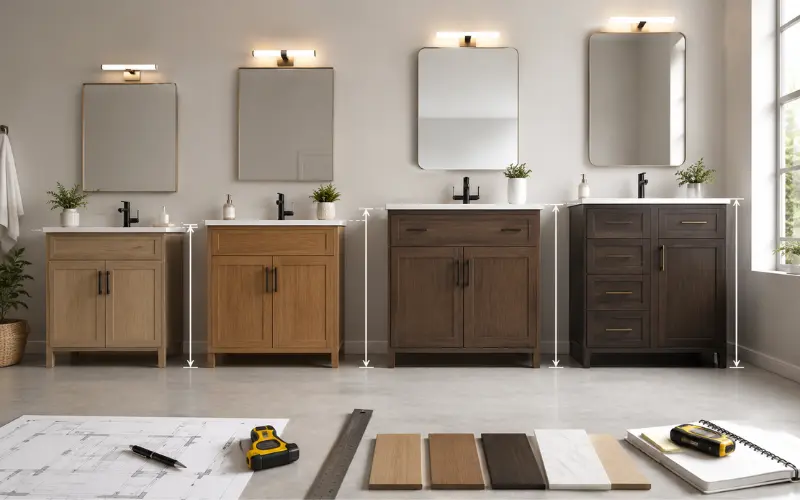
Different projects call for different units, especially if you’re working with imported fixtures or international contractors. Here’s the full breakdown.
| Measurement Type | Inches | Feet | Centimeters | Millimeters |
|---|---|---|---|---|
| Traditional height | 30 to 32 in | 2.5 to 2.67 ft | 76 to 81 cm | 762 to 813 mm |
| Comfort height | 34 to 36 in | 2.83 to 3 ft | 86 to 91 cm | 864 to 914 mm |
| ADA maximum | 34 in | 2.83 ft | 86 cm | 864 mm |
| Custom tall (for 6’+ users) | 38 to 40 in | 3.17 to 3.33 ft | 97 to 102 cm | 965 to 1,016 mm |
Knowing the standard height for bathroom vanity in cm matters if you’re pairing a US-made cabinet with European fixtures, since faucets, mirrors, and lighting are often specified in metric measurements. A quick tip: multiply inches by 2.54 to get centimeters, or by 25.4 to get millimeters.
Standard Height for Bathroom Vanity IKEA and Other Ready-to-Assemble Brands
Flat-pack and ready-to-assemble vanities, including IKEA’s bathroom lines, typically ship at or near comfort height, generally in the 33 to 35 inch range before the countertop is added. Because these systems separate the cabinet base from the countertop, the finished height depends on which top you pair with the base. Always check the combined measurement (cabinet plus countertop plus any leveling feet) rather than relying on the cabinet spec alone. This detail trips up a lot of first-time renovators who assume the box height is the final height.
Standard Vanity Height and Depth: Why Both Numbers Matter
Height gets most of the attention, but depth quietly shapes how a vanity feels day to day. Standard vanity height and depth work together: a 36-inch-tall vanity with a shallow 17-inch depth can feel tippy or cramped for storage, while a deeper 21 to 24 inch vanity gives you more counter space for daily essentials.
- Shallow depth (17 to 19 inches): Best for powder rooms and tight layouts.
- Standard depth (20 to 21 inches): The most common choice for single-sink vanities.
- Deep depth (22 to 24 inches): Common in primary bathrooms and double-sink setups.
If your bathroom is narrow, prioritize depth adjustments before height ones. A vanity that’s too deep will bump your knees on the toilet or tub long before a slightly tall countertop becomes a real problem.
Bathroom Vanity Height From Floor: How It’s Actually Measured
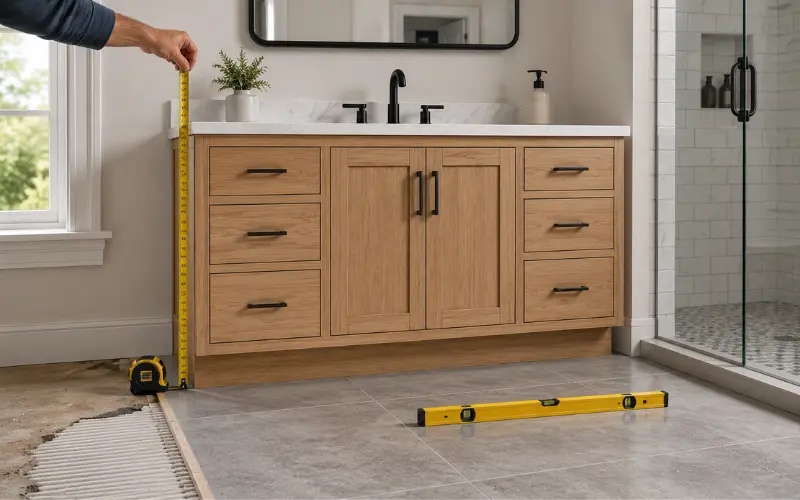
Every measurement in this guide, including the standard height for bathroom vanity, is taken from the finished floor to the top of the countertop, not the top of the cabinet box. This distinction trips people up constantly. Here’s the correct order of operations:
- Install and level your finished flooring first.
- Measure from that finished floor surface, not the subfloor.
- Set your cabinet height so that cabinet plus countertop thickness equals your target finished height.
- Add sink height on top only if you’re using a vessel-style sink, since undermount and drop-in sinks don’t change the finished measurement.
Skipping step one is the most common error we see. If you install a vanity before laying tile, your final bathroom vanity height from floor will be off once the flooring goes in, sometimes by half an inch or more.
Height of Bathroom Vanity Outlet Placement
Building codes and practical experience both point to the same answer here. The height of bathroom vanity outlet placement typically falls 4 inches above the backsplash or countertop, which usually lands around 40 to 44 inches from the floor when using a comfort-height vanity. If your vanity has an integrated outlet inside a drawer (a increasingly popular feature for hair tools), that outlet sits inside the cabinet itself rather than on the wall, so this rule applies only to wall-mounted outlets. Always confirm outlet height against your local electrical code before cutting into drywall, since requirements can vary by municipality.
Why Are Bathroom Vanities So Tall Now?

This is one of the most searched questions on this topic, and the answer comes down to three converging trends:
- Average height has increased. Adults today are, on average, taller than the generation that set the original 30 to 32 inch standard decades ago.
- Kitchen and bathroom design now match. Homeowners want a consistent feel between rooms, and kitchen counters have long sat around 36 inches.
- Ergonomic research caught up with design. Bending at a low counter for years contributes to back and neck strain, and comfort-height vanities reduce that repeated motion.
The shift toward taller vanities isn’t a passing trend. It reflects a genuine correction toward counters that fit how people actually use them.
What Are Common Mistakes With Vanity Height?
Even experienced renovators get tripped up here. Watch for these:
- Forgetting countertop thickness. A 34-inch cabinet with a 1.25-inch stone top finishes at 35.25 inches, not 34.
- Measuring before the flooring is installed. This throws off the final bathroom vanity height from floor.
- Ignoring the sink type. Vessel sinks add height, so the cabinet needs to sit lower to compensate.
- Choosing height based on trends instead of the household. A stunning 36-inch floating vanity is a poor fit for a household with young kids and no step stool.
- Skipping the mirror and lighting relationship. A taller vanity shifts where your mirror and sconces should sit, and forgetting this leaves awkward gaps or a mirror that’s too low for taller users.
Is 37 Too Tall for a Bathroom Vanity?
Not necessarily, but it’s pushing past what most people find comfortable. A 37-inch vanity works well for households where the primary users are 6 feet tall or taller, since the extra height keeps them from bending at the sink. For an average-height household, 37 inches often starts to feel like reaching or standing on tiptoe for shorter users. If you’re custom-building and unsure, test the elbow method below before committing to anything above 36 inches.
What Is a Comfort Height Vanity?
A comfort height vanity is any unit built to 34 to 36 inches, matching the feel of a standard kitchen counter. The term borrows from comfort height toilets, which use the same logic: less bending means less strain on the knees and back. Comfort height has become the default recommendation for primary bathrooms and any household made up mostly of adults.
Finding Your Personal Ideal Height: The Elbow Test
Manufacturer charts are useful, but your own body is the most accurate measuring tool you have. Try this before finalizing your vanity order:
- Stand up straight next to your kitchen counter or current vanity.
- Let your arms hang naturally, then bend your elbows to 90 degrees.
- Notice where your relaxed hands land. That height, give or take an inch, is your ideal counter height.
- Repeat with the tallest and shortest regular users of the bathroom, then find a height that works reasonably well for everyone.
This five-minute test catches problems that spec sheets can’t, especially in shared bathrooms with a wide age range.
Frequently Asked Questions
What is the standard height for bathroom vanity in the US?
Most vanities today are built between 34 and 36 inches, though the older 30 to 32 inch standard is still common in powder rooms and kids’ bathrooms.
What is the standard height for bathroom vanity in feet?
The modern comfort-height range works out to roughly 2.83 to 3 feet, while the traditional range is about 2.5 to 2.67 feet.
Is 36 inches too tall for a bathroom vanity?
For most adults, 36 inches feels comfortable and matches typical kitchen counter height. It can feel tall for children or shorter users without a step stool.
Does countertop thickness change the final vanity height?
Yes. Always add your countertop thickness, usually 1 to 1.5 inches, to the cabinet height to get your true finished measurement.
What height works best for a vessel sink?
Since vessel sinks sit above the counter and add several inches, most vessel sink installations use a shorter cabinet, often around 30 to 32 inches, so the finished sink rim lands in a comfortable range.
How high should a bathroom vanity outlet be placed?
Outlets are typically installed about 4 inches above the backsplash or counter, which generally puts them around 40 to 44 inches from the floor.
What is a comfort height vanity?
A comfort height vanity is built to 34 to 36 inches, matching standard kitchen counter height for easier, more ergonomic daily use.
Is 37 inches too tall for a bathroom vanity?
It can be, unless the primary users are notably tall. For most households, staying at or below 36 inches keeps the vanity comfortable for a wider range of people.
Do ADA-compliant vanities follow a different height standard?
Yes. ADA guidelines cap the finished countertop height at 34 inches and require specific knee and toe clearance underneath.
Making the Final Decision
The standard height for bathroom vanity isn’t a single fixed number anymore. It’s a range shaped by who uses the space, what kind of sink sits on top, and whether accessibility matters for your household now or in the future. For most primary bathrooms, 34 to 36 inches is the smart default. For kids’ bathrooms, powder rooms, or ADA-compliant spaces, 30 to 34 inches still earns its place.
Measure twice, account for your countertop and flooring, and run the elbow test before you buy. Getting the standard height for bathroom vanity right the first time saves you from a redo down the road.

