
Yes, bathroom niche ideas are still worth building around for most standard and custom showers, but only when the niche is planned during rough-in, not bolted on as an afterthought. A well-placed niche beats a wire caddy on durability and resale appeal, though it adds real cost for waterproofing and can become a maintenance headache if the size or slope is wrong. The decision comes down to your shower’s plumbing wall, your budget for tile labor, and whether you actually want one more surface to clean.
What a Niche Actually Costs You (Not Just in Dollars)
Most articles on this topic show you pretty photos and skip the number that actually decides whether you build one. A basic single niche, framed and tiled to match your shower walls, typically adds $300 to $700 to a standard remodel when it’s planned before drywall goes up. Add a second niche, mitered corners, a mosaic accent, or integrated lighting, and that number climbs past $1,200 pretty fast.
Here’s the part competitors gloss over: retrofitting a niche into an existing shower wall, after the fact, almost always costs more than building one in from scratch. You’re not just cutting tile. You’re cutting into a wall that may already have a vapor barrier, insulation, or in older homes, plumbing you didn’t know was there. If you’re weighing a full remodel against a smaller update, it’s worth comparing niche costs against other bathroom renovations on a budget before you commit tile crews to demo.
The Waterproofing Detail Most Guides Skip
A niche is a hole in your shower’s waterproof envelope. That’s not a design fact, it’s a structural one, and it’s the reason a badly built niche fails years before the rest of the shower does.
The sloped bottom shelf of your niche needs to pitch forward, roughly a quarter inch per foot, so standing water drains out instead of sitting against the grout line. I’ve seen more than one bathroom where a flat-bottomed niche turned into a slow leak two years post-install because nobody thought about drainage, only aesthetics.
- Preformed niche boxes (foam or PVC units) come pre-sloped and pre-waterproofed, which is why most tile contractors prefer them over framed-and-membraned builds
- Corner seams need waterproofing tape or liquid membrane, not just grout, since grout alone will crack under thermal movement
- Mitered edges look cleaner but cost more labor hours, because matching a 45-degree stone cut on four sides takes real skill
If your contractor can’t explain how they’re solving drainage before they explain tile color, that’s worth pausing on.
Bathroom Niche Ideas by Shower Type
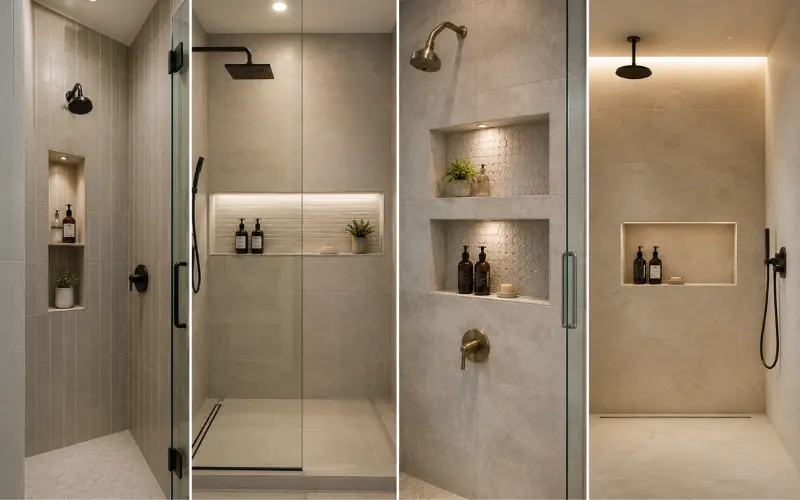
| Shower Type | Best Niche Approach | Why It Works |
|---|---|---|
| Small stall shower | Single vertical niche | Uses height instead of width, doesn’t eat wall space needed for turning room |
| Walk-in / curbless shower | Horizontal or wall-to-wall niche | Reinforces the open, linear look and stays out of the splash zone |
| Shared or family shower | Stacked or double niche | Gives each person their own shelf without crowding one space |
| Wet room layout | Recessed niche flush with tile plane | Keeps the seamless look a wet room depends on, since a projecting shelf breaks the flow |
If you’re planning around a modern wet room bathroom, a flush recessed niche matters more here than in a standard shower, because a projecting shelf undercuts the whole point of the layout.
Height, Reach, and the Numbers Nobody Publishes
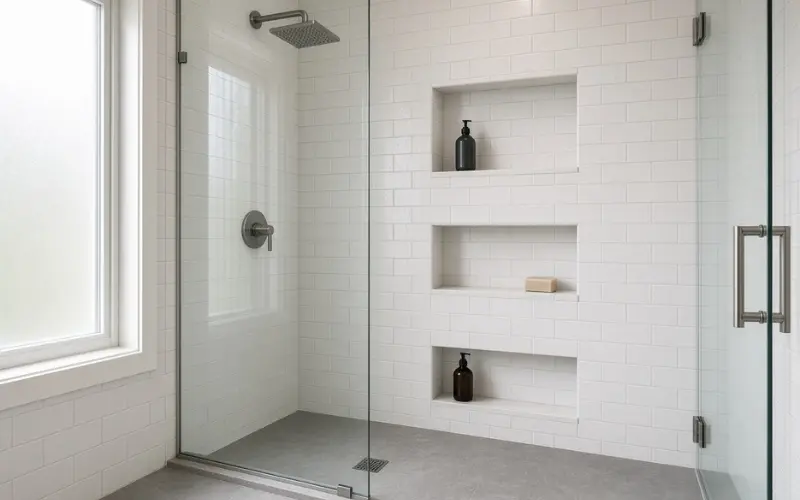
Most niche guides tell you to put the shelf “at a comfortable height” without giving you an actual number. Here’s what tile setters actually use as a starting point:
- Primary niche: 42 to 48 inches from the shower floor, roughly shoulder height for an average adult
- Secondary or lower niche: 24 to 30 inches, within easy reach for kids or anyone showering seated
- Shaving niche: 12 to 16 inches, positioned for a foot to rest comfortably on the ledge
These numbers should shift based on who’s using the shower, not just the tile layout. If you’re also working through vanity height while you’re at it, the same reach-and-comfort logic applies to your standard height for a bathroom vanity, since both fixtures get sized around actual body height, not a design trend.
When a Niche Isn’t the Right Call
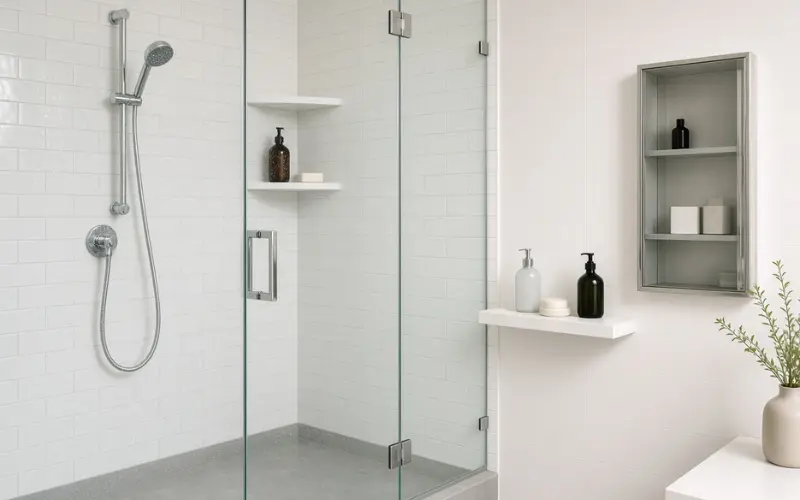
Not every shower should have one, and no competitor article says this outright. Skip the niche, or replace it with a different solution, if:
- Your shower wall backs directly onto a load-bearing or plumbing-dense wall, where cutting a 4-inch-deep cavity risks hitting a stack vent or stud you can’t move
- You’re renovating on a tight budget and the niche would eat the money better spent on waterproofing the whole enclosure
- You want a completely flush, minimalist wall with zero visual breaks, in which case a corner shelf or teak caddy does the job without touching the membrane
A tiled corner shelf, a recessed medicine-cabinet-style unit mounted outside the wet zone, or a slim floating shelf on a non-shower wall all solve the storage problem without the waterproofing risk. They’re not as photogenic on Pinterest, but they don’t fail in year three either.
Small Bathroom Niche Ideas That Don’t Fight the Space
In a compact shower, a niche has to earn its square footage. Vertical orientation almost always wins here because it borrows height instead of width, and width is the thing you’re short on. Two other moves that work well in tight layouts:
- Corner niches angled into the least-used part of the stall, which keeps the main tiled wall clean and uninterrupted
- Bench-integrated niches, where the storage cavity is cut into the side of a shower bench rather than the wall, freeing up vertical tile space entirely
If your whole bathroom is running small, it helps to plan the niche alongside the rest of the layout rather than as an isolated decision. These ideas pair well with a broader look at small modern bathroom design, since niche placement usually depends on where your fixtures and door swing land.
Resale Value: What Buyers Actually Notice
Real estate agents I’ve talked to about this are split, and that split is worth knowing before you spend money chasing “resale value.” A clean, properly tiled niche reads as an upgrade to most buyers, the same way a frameless glass enclosure does. But an oddly placed or poorly finished one, cracked grout, mismatched tile, uneven shelves, reads as a DIY flag and can actually hurt a showing.
If resale is part of your calculation, pair the niche with other shower upgrades buyers notice immediately, like a frameless shower screen, which tends to move the needle on perceived quality more than the niche alone does.
Maintenance: The Part Nobody Wants to Talk About
A niche is a shelf with three extra corners for soap scum and mildew to collect in. Grout lines inside a niche see more standing water than your shower walls do, which means they need resealing more often, roughly every 12 to 18 months instead of the standard 2 to 3 years for vertical wall grout.
A few habits keep this manageable:
- Wipe the niche shelf dry after each shower, since it holds moisture longer than a vertical surface
- Use a squeegee on the back wall of the niche, not just the shower glass
- Reseal grout in the niche on its own schedule, separate from the rest of the shower
Frequently Asked Questions
Are Bathroom Niche Ideas a good idea?
For most showers, yes, as long as the niche is planned before construction and built with proper slope and waterproofing. The main risk isn’t the concept, it’s rushed installation.
Are Bathroom Niche Ideas dated?
No, but flat, single-band niches at eye level without any design integration can look dated. Niches that echo the shower’s tile pattern or use a contrasting material still read as current.
What to do instead of a shower Bathroom Niche Ideas?
A recessed corner shelf, a teak or metal caddy, or a built-in bench with integrated storage all work as alternatives when a wall-cut niche isn’t practical.
What are common shower Bathroom Niche Ideas mistakes?
Flat-bottomed shelves that trap water, niches placed too close to the shower head where they get constant direct spray, and mismatched grout lines between the niche and the surrounding wall.
How deep should a shower Bathroom Niche Ideas be?
Most niches run 3 to 4 inches deep, enough to hold standard bottles without protruding into the shower’s usable space.
Can you add a Bathroom Niche Ideas to an existing shower without a full remodel?
Sometimes, if the wall isn’t load-bearing and doesn’t have plumbing running through it, but it usually requires opening the wall and can cost more than building one during an original remodel.
Do Bathroom Niche Ideas need a light?
No, but a small integrated LED strip makes a deep or dark-tiled niche easier to use and adds a soft secondary light source in the shower.
What size Bathroom Niche Ideas fits two people’s products?
A double niche, roughly 12 by 24 inches or two stacked single niches, generally holds enough for two people without crowding.

