
A Small Backyard Natural Swimming Pools is a chemical-free pool that uses a planted regeneration zone instead of chlorine to filter the water. In a compact yard, that regeneration zone typically needs to equal 50 to 100 percent of your swimming area, which is the single biggest constraint on how small you can actually go. Most homeowners land somewhere between 300 and 800 square feet total, not the tiny plunge-pool footprint the Pinterest photos suggest.
That number surprises a lot of people who start this project after seeing a gorgeous 10-foot pond on social media. So before you fall in love with a design, let’s get into the parts nobody tells you upfront: the real math, the real cost, and the design tricks that actually let you shrink the footprint without wrecking the water quality.
Why “Small” Is the Hardest Version of This Project
Here’s the part that trips people up. A conventional pool gets smaller by just… being smaller. A natural pool doesn’t scale down that cleanly, because the biology inside it doesn’t shrink proportionally.
The regeneration zone is a living filter. It needs a minimum volume of plants, gravel, and beneficial bacteria to process bather load and organic debris. Go too small and the system loses what pool builders call “biological momentum”: there simply isn’t enough filtering capacity to keep up, and you get algae blooms within weeks instead of a stable pool.
That’s why most European manufacturers, including long-running builders like Biotop, generally won’t guarantee a stable system below about 300 to 430 square feet of total water surface. Below that, you can still build one, but you’re trading margin for size, and you’ll need to lean harder on mechanical assistance (skimmers, UV, circulation pumps) to make up the difference.
How Much Yard You Actually Need
Forget the vague “it depends” answers. Here’s the real range, based on how pool designers actually size these systems:
| Total Footprint | Swim Zone | Regeneration Zone | Realistic For |
|---|---|---|---|
| 300–400 sq ft | 150–200 sq ft | 150–200 sq ft (1:1) | Small urban yard, 1–3 swimmers |
| 500–800 sq ft | 250–400 sq ft | 250–400 sq ft | Family yard, occasional gatherings |
| 800–2,000 sq ft | 400–1,000 sq ft | 400–1,000 sq ft | Standard residential pond |
Two design decisions change this math more than anything else:
- Ratio, not just square footage. A 1:1 ratio (swim zone and regeneration zone equal size) gives you the smallest possible footprint for a given amount of swimming space. A 1:2 ratio is more forgiving on maintenance but eats more yard.
- Depth compensates for width. A swim zone dug to 6 to 8 feet holds more water volume per square foot of surface than a shallow 4-foot pool, which gives the biology more buffer to work with in a tight space. This is the single most underused trick for shrinking a footprint: go deep before you go wide.
If your yard genuinely can’t fit 300 square feet of combined water, you’re not out of options, you just need to look at the hybrid designs below instead of a pure natural pond.
What a Small Natural Pool Actually Costs
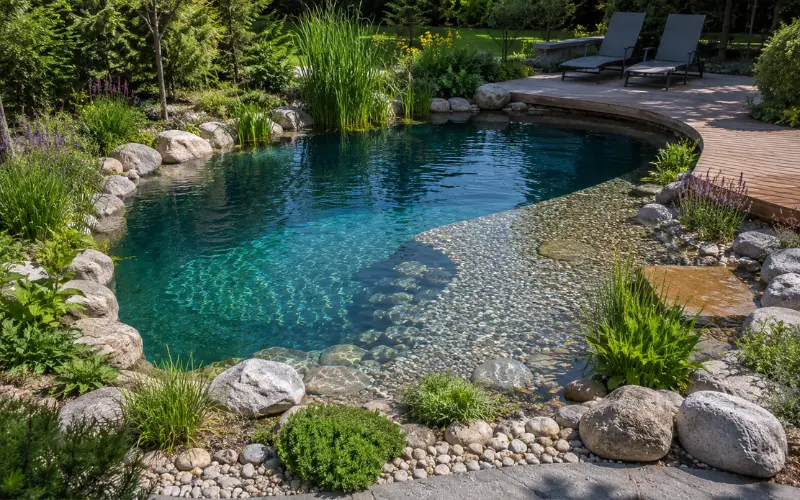
Every competitor article quotes “10 percent more than a conventional pool” and stops there. That figure comes from industry estimates on standard-sized installations, and it under-represents what happens at small scale, where fixed costs (excavation mobilization, liner cutting, plumbing runs) don’t shrink proportionally with the pool.
Realistic ranges for a small backyard build:
- Professional installation: $25,000–$60,000+ for a fully engineered small natural pool with proper regeneration zone, liner, and biological filtration hardware.
- DIY or owner-assisted build: $8,000–$20,000, depending heavily on whether you’re renting excavation equipment, doing your own liner work, and sourcing plants locally instead of through a specialty nursery.
- Low-budget backyard swimming pond: $3,000–$8,000 is achievable if you’re building a smaller pond-style system by hand, using a rubber pond liner instead of engineered concrete, and planting from divisions rather than potted specimens.
Where the money actually goes, in order of impact:
- Excavation (especially if you need to go 6+ feet deep for the swim zone)
- Liner or concrete shell (EPDM rubber liner is the budget option; gunite/concrete costs more but lasts longer)
- Circulation system (pump, skimmer, and any UV or mechanical assist you add for a small footprint)
- Plants and substrate (gravel, expanded clay, and the aquatic plant palette for the regeneration zone)
Annual upkeep runs lower than a chlorine pool over time. You’re not buying chemicals, but you are budgeting for occasional plant division, sediment removal in spring, and periodic pump maintenance.
DIY vs. Hiring a Pro: Where the Line Actually Is
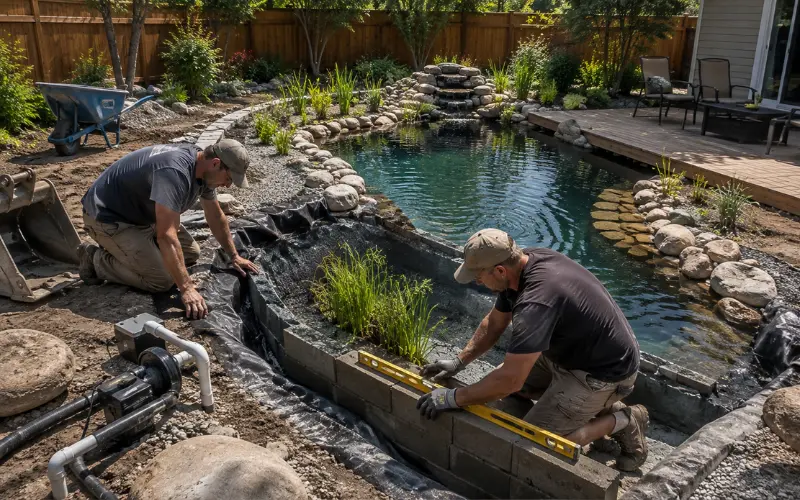
Reddit threads on this topic are full of people who built their own small natural pools successfully, and just as many who regret skipping professional input on one specific piece: the wall between the swim zone and regeneration zone.
That wall (sometimes a submerged concrete block wall, sometimes a fabricated barrier) controls water flow between zones. Get it wrong and water short-circuits around the filtration area instead of through it, which is the most common reason small DIY natural pools turn green.
Reasonable DIY territory:
- Digging and liner installation for a pond-style build
- Planting and stocking the regeneration zone
- Building a deck or surround
- Ongoing plant maintenance
Where it pays to bring in an expert, even briefly:
- Sizing the pump and calculating turnover rate for your specific volume
- Designing the zone-separation wall or barrier
- Grading for proper drainage away from the structure
- Anything involving structural retaining walls on a slope
A hybrid approach works well for budget-conscious builders: pay a consultant for a one-time design and sizing session, then do the physical labor yourself. This is where a lot of the “low budget Small Backyard Natural Swimming Pools DIY” search traffic actually lands, because it’s the realistic middle ground.
Design Approaches That Actually Work in Tight Yards
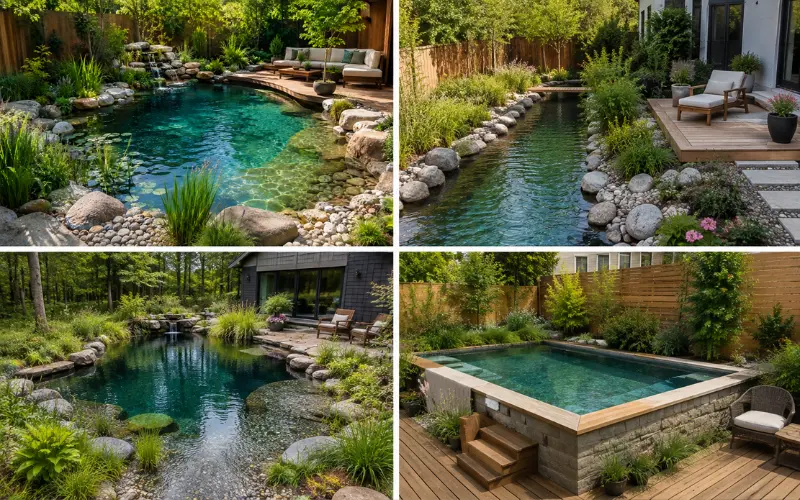
Most articles show you inspiration photos without explaining which design category each one belongs to. Here’s the practical breakdownon Small Backyard Natural Swimming Pools:
Two-pot systems separate the swim zone and regeneration zone into visually distinct areas, sometimes connected by a narrow channel. This is the most space-efficient layout because you can push the regeneration zone into an oddly shaped corner of the yard that wouldn’t work for swimming anyway.
One-pot (combined) systems blend both zones into a single pond-like body of water, often with a hidden underwater wall. These read as more naturalistic and pond-like, but they’re harder to shrink because the visual transition between zones needs room to look intentional rather than cramped.
Above-ground and semi-raised natural pools are the newest answer to the small-yard problem. Using a raised frame or partial excavation, builders can reduce the dig depth needed while still hitting the water volume the biology requires. These cost more per square foot than a fully in-ground pond but solve real problems on yards with poor drainage, high water tables, or slope.
Plunge-style natural pools (the small, deep, cold-plunge-adjacent designs trending on Pinterest) are the hardest version to make biologically stable at true “plunge pool” size. If you want that aesthetic, budget for mechanical filtration assistance rather than expecting the plants to do all the work in under 150 square feet.
Plants That Carry the Filtration Load in a Small Zone
When your regeneration zone is small, plant selection matters more than it does in a large pond, because you have less room for redundancy if one species struggles.
- Submerged oxygenators (hornwort, anacharis) do the bulk of nutrient uptake and should occupy the deepest part of your regeneration zone.
- Marginal plants (sedges, rushes, dwarf cattail) sit at the edges in 6 to 18 inches of water and handle nitrate and phosphate absorption, the nutrients that feed algae if left unchecked.
- Floating-leaf plants (water lilies, but choose compact varieties for small pools) provide shade that suppresses algae growth by limiting the sunlight hitting open water.
In a small system, resist the urge to over-plant for looks. A crowded regeneration zone actually reduces water flow through the substrate, which defeats the purpose. Leave visible gravel and open channels between plant groupings.
Maintenance in a Small System Is Different, Not Just Smaller
A small natural pool doesn’t get proportionally less maintenance than a large one. In some ways it needs more attention, because there’s less buffer capacity to absorb a bad week of heat or heavy swimmer use.
- Check water clarity weekly during peak summer, not monthly. Small volumes shift faster than large ones.
- Trim regeneration zone plants before they get root-bound; in a tight footprint, overgrown roots can clog substrate faster than in a spacious pond.
- Remove sediment from the swim zone floor each spring, before plant growth resumes and makes access harder.
- Watch evaporation closely in hot climates. A small pool loses a higher percentage of its total volume to evaporation than a large one, which concentrates minerals and nutrients faster if you don’t top it off.
- No draining needed for winter in most climates. Cut back plants as you would any perennial garden bed and let the system go dormant.
Building One in a Warm Climate (California and Similar Zones)
Small Backyard Natural Swimming Pools in Southern California, Arizona, or similar climates face a different challenge than the Hudson Valley examples most articles use: heat accelerates both plant growth and algae growth, and evaporation is aggressive.
A few things worth knowing before you plan a build in a hot, dry region:
- Local health department rules vary by county, and some jurisdictions in California classify natural pools as “man-made bodies of water” requiring the same permitting as a conventional pool, while others have no specific category yet. Call your local building department before finalizing a design, not after.
- Shade siting matters more here than in cooler climates. Full sun all day accelerates algae faster than the plants can outcompete it in a small regeneration zone. Partial afternoon shade from a pergola or strategically placed tree can meaningfully reduce maintenance load.
- Plant selection should skew toward heat-tolerant natives rather than the cool-climate palette shown in most European design photos. A local aquatic nursery familiar with natural pools will know what actually survives a Central Valley or desert summer.
Mistakes That Show Up Again and Again
- Sizing the pool to the yard instead of the yard to the biology. People fall in love with a footprint that looks good on paper, then discover the regeneration zone can’t keep up.
- Skipping the zone-separation wall design. This is the single most common cause of green water in small DIY builds.
- Choosing a liner without checking UV resistance. Small pools have a higher surface-area-to-volume ratio exposed to sun, which degrades cheap liners faster than expected.
- Underestimating evaporation top-off in hot climates. A small pool can lose a noticeable percentage of its volume weekly in peak summer heat.
- Planting for looks instead of function. A regeneration zone that’s all showy bloomers and no submerged oxygenators will look great in July and murky by August.
FAQ on Small Backyard Natural Swimming Pools
What is the Small Backyard Natural Swimming Pools can be and still work?
Most builders won’t guarantee stable water quality below roughly 300 square feet of combined swim and regeneration zone, though mechanically assisted small systems have gone smaller with added filtration.
Can I convert my existing chlorine pool into a natural pool?
Yes. This is a common retrofit: you build a regeneration zone adjacent to the existing pool and modify the pump system to circulate water through it, which avoids a full re-dig.
Do Small Backyard Natural Swimming Pools need a permit in the US?
In most areas, yes, the same as any in-ground water feature, though the specific category (“pool” vs. “pond”) depends on your local jurisdiction and can affect fencing and safety requirements.
How long does it take for a new natural pool to stabilize?
Expect several weeks to a full season before the plant and microbial ecosystem reaches equilibrium. Early cloudiness or a mild algae bloom in the first season is normal, not a sign of failure.
Will a Small Backyard Natural Swimming Pools attract mosquitoes?
A properly circulating system with moving water and healthy plant cover deters mosquito breeding better than stagnant water. Standing, non-circulating water is the actual risk factor, not the natural design itself.
Can I build a Small Backyard Natural Swimming Pools pond myself without hiring a contractor?
Yes, particularly for pond-style builds using a rubber liner, but most successful DIY builders still consult a specialist for pump sizing and the zone-separation design before digging.
Is a Small Backyard Natural Swimming Pools safe to swim in without chlorine?
Yes, when properly designed and maintained. The regeneration zone’s plants and beneficial bacteria process organic material and pathogens biologically, similar to how a healthy pond or lake self-regulates.
How much yard space beyond the pool itself should I plan for?
Add roughly 3 to 5 feet of buffer around the water’s edge for planting, access for maintenance, and any deck or seating area, on top of the water surface footprint itself.

